Although fluid monitoring technology has come of age in recent years, its level of sophistication varies widely across industries. Some users of bulk chemicals, fuels, and other fluids use state-of-the-art systems with bells and whistles like automated data gathering and transmission. At the other extreme, some tank farms still “stick the tanks.” Although 95% of large industrial facilities have gauges and monitors on their tanks, most rely on a human being to read them.
For users of bulk lubricants, advances in online fluid monitoring have produced innovative systems that save time and money. For example, the EyeTank service from Chevron Global Lubricants (San Ramon, Calif.) enables reliable maintenance of bulk lubricants at optimum levels. By combining proven technologies from companies such as Level Devil, FuelQuest, and SMARTLogix, this new approach to fluid monitoring safeguards lubricants and equipment, prevents costly mishaps, and benefits users’ bottom lines.
A new tiger for your tank
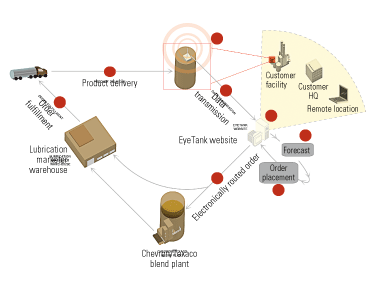
Here’s how the EyeTank service works (Figure 5):
1. Sensors measure the fluid level within the tank at regular intervals daily.
2. Readings are sent via wire, cellular, or satellite transmission to the 
EyeTank service.
3. The data are analyzed and placed in a confidential folder on the EyeTank portal, which the user can access via a standard web browser.
4. If the user chooses the Forecast option, EyeTank notes when the level is getting low and notifies the user that he needs to order fluid, manually.
5. If the user chooses the Auto-Replenishment option, EyeTank places the order automatically.
6. The order is routed to the Chevron/Texaco Blend Plant or to the customer’s lubricant supplier.
7. The order is filled and double-checked against specifications for blend, quantity, and packaging.
8. Product is shipped to the user’s facility and used to refill the tank.
|
5. Use remote monitoring. Planning, data transparency, and forecasting are already familiar business tools for large industrial plants. But until now, they have not been applied to their full potential to managing inventory of bulk lubricants. Courtesy: Chevron Global Lubricants
|
By checking their confidential folder periodically, users can monitor their supply of lubricating fluid and optimize its inventory level. The Auto-Replenishment option is especially useful for eliminating the costs and stress of placing emergency orders and waiting for deliveries. And it should go without saying that automating the process for taking level readings reduces labor costs. Even if its tanks are equipped with sensors and gauges, it can take several hours to gather data at a large plant.
Among the other benefits of the EyeTank service is its support for simultaneous viewing of the levels in multiple tanks. Finally, because the system digitizes level readings, they become available for input into supply-chain management applications. Often, mundane data such as tank levels escape the reach of sophisticated, centralized enterprise resource planning systems increasingly used by power companies to tightly integrate their business processes for the sake of gaining a competitive edge.
Oiling the inventory process
In the past, industrial facilities such as power plants could glean some information about their lubricant inventories from their accounting systems. But rolling this data across multiple plants took time and required that every transaction be coded the same way. Beyond the basic problems with assembling and analyzing this business information, there was another issue that limited its potential value: It wasn’t up to date.
With the advent of online fluid monitoring systems such as EyeTank, one person or a team of decision-makers can rapidly access accumulated knowledge—and precise, current data—about dozens or even hundreds of far-flung plant sites. Such data now can be viewed for separate tanks or aggregated for overall inventory management from one central location. Beyond their ability to generate ordering alerts or automatically place orders, new online fluid monitoring systems improve resource planning by basing it on near-real-time data.
This exemplifies a proactive, as opposed to a reactive, approach to lubricant management. Users can see trends, compare performance, and take action before inventory problems occur or broader business processes are affected.
The benefits of centralization
A major efficiency benefit of online fluid monitoring is data centralization. Central oversight of hundreds of storage sites and plant locations is much more efficient than one-by-one local monitoring and individual reporting by phone or e-mail.
Data centralization also improves security—not just of level data but also of physical security. Close, near-real-time monitoring of tank levels lowers the potential for theft of valuable product. At some companies that store large quantities of expensive lubricants in remote and widely distributed tanks, field supervision may be minimal, and an online fluid monitoring system can be a vital tool for tracking usage. Unexpected usage—for example, while a production facility is shut down, such as over a holiday weekend—can be detected and communicated immediately to a business manager.
Centralizing lubricant level data also can save a company money by minimizing spills that are costly to clean up and may warrant a fine. Knowing the precise level of each tank at all times can help avoid both problems. An online fluid monitoring system usually pays for itself in a few months to a year, depending on fluid usage and the user’s business model. However, it could pay for itself immediately if it prevents a spill of hazardous material.
—Contributed by John Malone, global sector specialist for Chevron Global Lubricants. For more information, call 925-842-1000 or visit www.chevrontexacolubricants.com.