POWER PLANT TRAINING
New techniques required
Historians often point to specific wars that illustrate how winning armies applied new armaments and defensive and offensive maneuvers to defeat their enemies. For example, in the American Revolutionary War, the fledgling colonial army defeated the more powerful, better-equipped British forces because the latter insisted on standing in columns and formations—because that’s the way war was fought. Meanwhile, the colonists fought with what amounted to guerrilla tactics: dispersed units and hiding behind trees. Important to note, however, is that better tactics—not necessarily the most advanced weaponry—ruled the day.
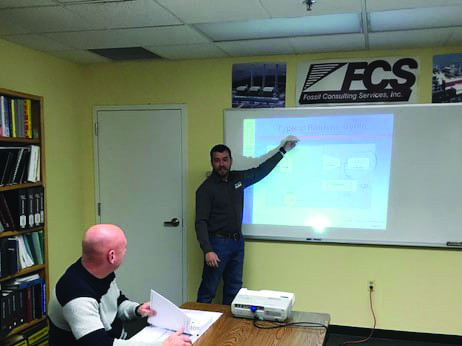
An analogous situation is apparent in the power plant training arena. If your team is diligently sitting in classrooms listening to an instructor drone on, then you are not applying modern techniques and methods. And some will argue that in today’s competitive markets for electricity, that could spell early defeat. However, it is the ability to apply the latest technology to your situation that results in a competitive posture, not simply possessing the latest technology.
Also, it matters little whether you are using the latest simulation technology or traditional classroom methods; off-the-shelf training solutions simply don’t cut it. A generic product must be customized for specific plants, machines, and personnel if it’s going to make a contribution to your plant. Similarly, vendor-supplied training is rarely sufficient. This seems obvious because of the many organizations that provide training above and beyond what vendors supply.
Thus, power plants must somehow strike a balance between the supplier, who knows the most about the equipment but often provides inadequate (albeit free or low-cost) training, and the training services supplier, who typically sells a generic package that must then be customized to some degree.
New media
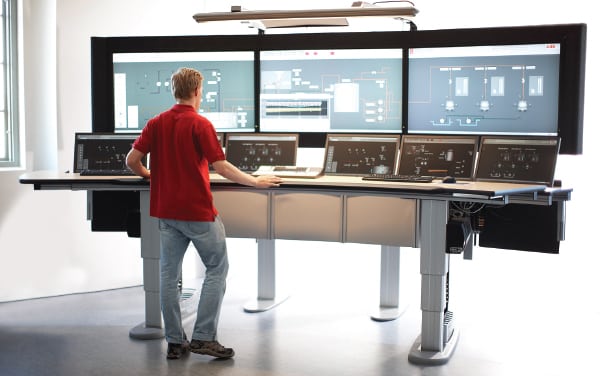
Perhaps the most significant wholesale change in the training arena is with the tools of the trade. Printed text has been augmented, even replaced, by video, audio, Internet, and computer-based tools. With the power of the latest hardware and software, in fact, computer, audio, and video are being combined into sophisticated educational packages. The rate of change in computer capability is probably a blessing and a curse: No sooner does a plant or firm buy the latest package with elaborate graphics and simulation than a more advanced version becomes available (Figure 1).

1. Not just a video game. Modernization of the first unit of Hong Kong’s eight-unit, 4,100-MW Castle Peak Power Station called for the installation of an Invensys Foxboro I/A Series distributed control system to reduce unit start-up times, improve thermal efficiency, and minimize maintenance efforts and material costs. A rigorous training program designed to qualify operators on the intricacies of modern digital control systems is no longer an option; it’s a necessity. Courtesy: Castle Peak Power Station
One of the latest and fastest growing techniques for teaching the topic of business management, for example, is a sophisticated computer simulation game. Computer simulation games emerged over the past decade to improve upon textbook-based training, which may successfully teach the theoretical but can fail to convey the practical. Specialists say this can be a particular problem for the management disciplines of finance, marketing, information science, organizational behavior, and so on. Computer simulations force students to actually sift through, make decisions from, and observe market response to reams of financial data on balance sheets, income statements, cash-flow reports, interest-rate projections, import/export fee schedules, and the like. Most important, the data are constantly changing as the training advances and the computer model processes the participants’ business decisions.
Many simulation training programs model only a single industry and have a preprogrammed business cycle. Such programs are often referred to as “partial economies.” Although teams appear to be playing against each other, they really are playing “beat the program.” In contrast, more complex simulations model multiple industries in multiple countries, and the outcomes depend on the interactions of participating management teams. This more complex model is referred to as a “general equilibrium system.”
Though such training tools are impressive, seasoned power plant managers caution that high-technology solutions often are applied beyond the specific need of the plant. Although computers are pervasive, it will be some time before they replace print and traditional instructors. It is difficult, if not impossible, to replace a terrific instructor who knows the specific equipment or technology in depth.
And are the new media, supposedly new weapons in the training battle, actually just empty shells? Has the same old material simply been given a new look? An in-depth examination of some computer-based training programs, for instance, reveals that much of the material is simply the same stuff that appears in course books and texts: graphics, flow diagrams, text, questions and answers. Granted, some color is thrown in; the computer screen may even allow the direction of flow to be depicted with bright, moving colored dots.
Whether this is an improvement over the text presentation is open to debate. After all, the trainee has some ability to visualize what’s going on if the printed diagrams and explanatory text are top-quality. And three-dimensional graphics could be viewed just as well on a slide projector as on a computer screen. Published literature about power plant training programs is replete with descriptions of the latest technology, methods, graphics, motivators, and so on but surprisingly lean on quantifying the benefits of the new media.
Tailored training
It should go without saying that a successful training program must be customized to a specific facility and its workforce. But customizing has many dimensions. One that may be apparent is training personnel to operate the unit within its original design specifications. For example, in a competitive environment, it may pay to overload a unit during peak periods because purchased-power rates are so much higher than usual. Additional revenue may more than compensate for any damage to equipment that must later be corrected. But operators must be trained to understand when the economics may be appropriate for such action. They also must be trained to keep a closer watch on all critical parameters as the unit operates in an overload condition and recognize that planned maintenance intervals will shorten and consumption of consumables, such as lubricating oils, will increase (Figure 2).

2. Improved lubrication processes. Proper lubrication practices can’t be taught in the classroom; they require that trainees reach out and touch the equipment. A good example is the “Grease Caddy” that senses high-frequency emissions produced by bearings and tells users when to lubricate, when not to lubricate, and when to stop lubricating to optimize bearing life. Courtesy: UE Systems Inc.
The following specific tips for customizing training should help you achieve the results you’re hoping for.
Make it flexible. Corporate-directed programs are great for the corporate training department and make class planning, development, and record-keeping easy. But standardized programs are not great for the individual power plant. Each plant’s needs should be assessed and then the training customized to meet those needs.
Hold students accountable. At many plants attendance is the only measured parameter for a training program and suffices for a passing grade. But merely attending training is of no benefit, other than fulfilling environmental- or safety-legislated requirements. The effectiveness of training somehow must be measured, with written tests, student presentations, mandatory question-and-answer sessions, and the like.
Make it challenging. Most power producers have established standards for recurring, or recertification, training. Nobody doubts the need for such programs, given the limitations of our human storage banks and the complexities of power plants, but recurring training must be carefully designed and administered so that veteran workers aren’t bored or, worse, intellectually insulted. Recurring training should enhance professionalism, emphasizing the latest technical developments and new maintenance tools. It’s a good idea to have experienced, credible instructors for every training class, but it’s essential to have them for recurring training. Power plant veterans are an incredibly critical bunch—often rightly so—and therefore there’s no way an inexperienced instructor or a cheap CD-ROM training program can hold their attention or answer all their questions. Even grizzled old instructors should encourage heavy student participation during recurring training.
Maintain management responsibility. Many line managers have abdicated responsibility for training to a staff member—often one who’s a young, liberal-arts-educated professional instructor. There may be nothing wrong with the staffer’s abilities, but without strong, continuous backing from the managers and supervisors, the training program will be ineffective. If training is truly important to you as a manager, you should show it, not just say it. For example, you can make it a habit to let the training department lead off every staff meeting. Also, you can regularly sit in on training classes, not just as a bored observer, but as an active participant with an open, eager-to-learn mind.
Build it into the schedule. All too often people return from training sessions to find themselves badly behind in their regular work. That’s a sure sign that training is not being treated as an important part of the job. Just as time is allocated for measuring vibration levels and sampling water chemistry, time must be allocated for the learning process.
Serve it up in digestible amounts. Operators and technicians often think of training as either punishment or an endurance contest. To avoid this, break up the sessions and the topics into bite-sized chunks. If your trainers aren’t interactive, dynamic, interesting people, get new ones.
Broader personnel objectives
Excellent training that makes the most of modern tools may be more important now than ever, because power plant personnel are no longer expected to learn a trade and perform it competently for decades and then retire. Rather, each person is expected to strive to be a self-contained, multiskilled unit that has depth of understanding, can fill in where needed, and can continuously update his or her skills portfolio. Self-sufficient cells of competence and cross-training are the order of the day, not vertical hierarchical organizations.
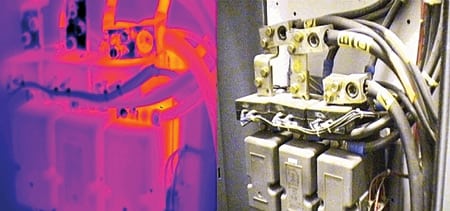
3. Diagnose pending failures. You can’t fix a problem you can’t see. The step-down transformer powering the cooling tower of Lawrence Energy Center’s Unit 5 was on the verge of a catastrophic failure that would have shut down the entire plant. A thermographic inspection diagnosed the problem as a broken or loose rotor bar. Repairs were completed before the transformer failed. Courtesy: Westar Energy
At the same time as workplace staffing expectations are changing, so too are plant tools. As a consequence, training programs are being designed to present the advanced technology tools now commonplace in the typical power plant: predictive maintenance software, lube oil analysis, and thermography, to name a few (Figure 3).
Achieving this vision of a flexible, multiskilled workforce should not be considered a corporate objective, either. With the permanent, structural changes in the workforce, global competition, accelerated technological change, and deregulation in the power industry it has become every individual’s responsibility to view learning and skill development as constant throughout one’s career. Today, if you find yourself performing a repetitive job—pushing the same buttons at a power plant, drafting flow sheets, or calculating the same parameters—your skill will likely become obsolete and eventually be consolidated or even replaced by a computer or robot, or outsourced.
Avoiding human error
In many ways, a competition is ensuing between plant operators and computers. In some cases, better training can give operators the advantage. Consider this: Executives at a Midwest nuclear station plotted the causes of plant error, assigning those causes to hardware, documentation, or personnel categories. After determining that personnel errors were far too high, management implemented a focused training program designed to reduce the error rate, and results were quantified. The program included aspects of airline-type training videos, awareness training, peer videos in which workers shared lessons learned with other employees, and improved communications.
At other facilities, workers are trained to minimize errors by avoiding intervention in the facility’s control system unless absolutely required. Thus, the operator is essentially trained to maintain vigilance over the computer control system, not necessarily the plant itself.
One plant veteran gives this prediction, tongue only lightly in cheek: The power plant of the future will be operated by two creatures: one operator and one dog. The operator will be there to feed the dog, and the dog will be there to keep the operator’s hands off the equipment.
—From the editors of POWER