In the previous two installments of "Competitive Maintenance Strategies," we examined several best practices that should be part of the workday routine for high-performing plants. In Part I, we discussed the characteristics of a good reliability-centered maintenance program, the use of root-cause analysis as a maintenance tool, and ways to improve your predictive maintenance program (March 2010). In Part II, we focused on combined-cycle plants, especially heat-recovery steam generators, to identify several operating practices that are directly linked to the cost of plant maintenance. One specific area discussed was the need for a good valve maintenance program (April 2010). This third and final installment addresses three more areas where an investment in good maintenance practices pays operating availability dividends.
Give Batteries More than Specific-Gravity Tests
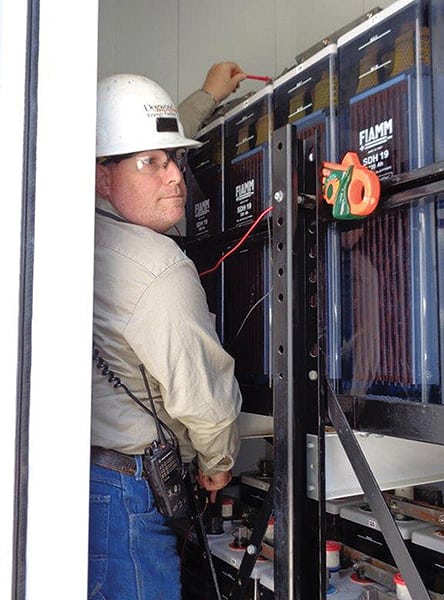
The time-honored method of assessing the overall condition of lead acid, wet-cell battery banks is to manually measure cell voltage, current, and electrolyte specific gravity, and to visually check fluid level and terminal post connections. While this is satisfying to some, most experts say that you should conduct more tests to get a true measure of the health of their batteries.
One way to do this is to deep-discharge new batteries once every five years, increasing the frequency of deep-discharge later, as the batteries reach the end of their 20-year life. A typical flooded-cell battery is rated for 50 deep discharges in its 20-year life, so 10 to 15 deep discharges for testing are not detrimental to the battery. In addition, a discharge serves to agitate the electrolyte, which is good for the battery.
But many substation engineers are opposed to deep discharges, partly because they feel this takes away from the life of the battery, and also because the battery string must be taken off-line to discharge it. Discharge tests are costly as well, because a utility must invest in its own battery-loading bank to absorb the energy. Consequently, utilities have always wanted a simpler indicator of battery strength and remaining life that is easy to apply, less labor-intensive, and less risky to both personnel and batteries.
Hence, battery monitors, as contrasted with single-function testing devices, should be included in any battery room. Single-function testers, such as hydrometers or voltmeters, check just one parameter, such as specific gravity or voltage. By contrast, battery monitors continuously check a variety of parameters, such as voltage, temperature, fluid level, float current, and cell impedance or resistance. Two developments have promoted the use of monitors: automation through electronic sensors coupled with computers, and the downsizing of large, labor-intensive maintenance organizations to reduce costs.
Hunt Down Sources of Condenser Air In-leakage
Air leaking into a steam turbine condenser robs a plant of capacity and efficiency and contributes to corrosion because of the higher levels of dissolved O 2 and CO 2 in the condensate. It also can lead to serious tube-freezing incidents if the condenser is air-cooled and located in a cold-weather climate. To stay on top of the problem, some power plant engineers have installed online instruments that determine air in-leakage rates based on gas concentrations in the condensate. However, the instruments can be problematic, and they only indicate the presence of a leak, rather than pinpointing the actual leak sites.
Most plants find it more effective to routinely test the steam components that are under vacuum, using mass spectrometry and helium as a tracer gas. One technician sprays helium around potential leak sites — such as expansion joints, flanges, and valves — while another uses the mass spectrometer to detect the inert gas at the discharge of the air-removal system: air ejector, vacuum pump, or hogger. Mass spectrometry is considered more effective than other inspection methods — such as ultrasound, infrared, decay tests, and condenser flooding — because it can:
-
Pinpoint the location of leaks as small as 3 x 10 -4 cubic feet per minute, thanks to helium’s tiny molecular size.
-
Be performed online (in fact, 15% or higher turbine load is optimum).
-
Function without removing pipe insulation, equipment barricades, or other obstacles.
-
Be repeated quickly and inexpensively to verify that leaks have been fixed.
You should perform a leak-detection survey prior to a major outage to plan work items and immediately after the outage to check tightness on components that were disassembled. A survey also can be conducted when a sudden increase in air in-leakage is detected, based on condenser backpressure, decay tests, dissolved oxygen concentration in the condensate, or air-removal rates.
Many leaks found through mass spectrometry can be stopped almost immediately. A typical example is a drain valve that was inadvertently left open. Other leaks, such as the gaskets around rupture discs or manway covers, can be temporarily repaired until the next scheduled shutdown. Leaks in pump-shaft or turbine-gland seals, however, usually cannot be repaired online. Because it can determine the rate of air in-leakage at any one leak site, mass spectrometry can help a plant decide how long the repairs can be deferred.
Consider Online Cleaning of Generator Coolers
Managing risk — as opposed to completely avoiding it — means taking calculated gambles to cut expenses and sustain availability. Some maintenance groups are doing just that when they attack heat-exchanger fouling in their hydrogen-cooled electric generators. The hydrogen is cooled by service water in a tube-and-shell heat exchanger, which, over time, becomes fouled with deposits.
Traditionally, plants have cleaned the deposits by shutting down the plant and manually brushing the heat exchanger tubes. This procedure is somewhat effective at restoring cooler performance, but hard deposits that are not removed by brush eventually began to build up. Besides, taking the units out of service means the plant availability will take a hit.
To improve on the traditional practice, innovative plants have considered two methods: liquid-fill-and-circulate and foam cleaning. The former raises concerns about spills, aggressive liquids leaking through to the generator, and the handling and disposal of waste liquid. Foam cleaning, by contrast, is faster and neater, with more control of cleaning parameters such as flow, temperature, and velocity. Plus, if hydrogen leaks occur during a foam cleaning, the hydrogen will be carried safely outdoors by the foam and detected immediately by a flammable gas analyzer.
The first step is to determine an appropriate concentration for the foam cleaner by laboratory testing of deposit samples. Often, straight hydrochloric acid is effective in dissolving the deposits, but a formic/oxalic acid mixture may be selected because of its lower aggressiveness to the Cu-Ni and steel materials. The cleaning procedure begins by reducing the station’s electrical load to where one water-to-hydrogen cooler can be taken out of service; typically, plants have four, and three can carry about 75% of the load. Then the one heat exchanger is isolated, drained of service water, and injected with the formic/oxalic acid foam. The entire procedure takes about four hours for each cooler, with the foam-injection stage taking only about one hour.
According to plant managers who have tried it, the procedure is remarkably effective, reducing hydrogen temperatures in electric generators by as much as 45F with no indications of hydrogen leakage or excessive thermal stress on any of the cooler bundles. In at least one case, generators that had been derated because of temperature limitations were restored to full capacity.
— Dr. Robert Peltier, PE, is POWER’s editor-in-chief.