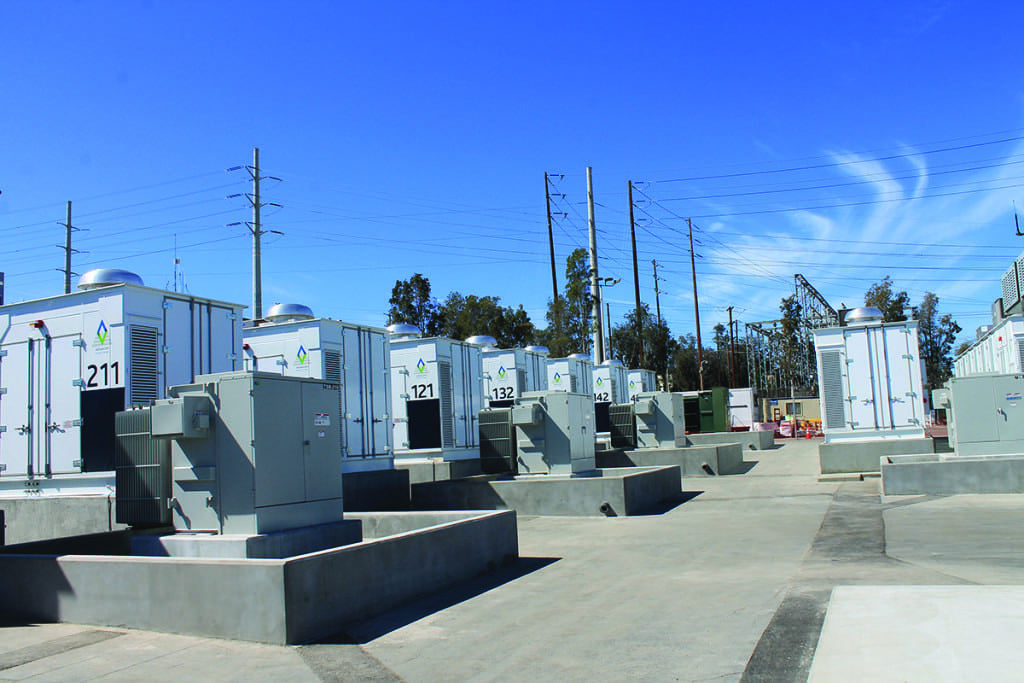
For the power engineer, delivering an instantaneous and consistent power supply can be an elusive goal. Yet without it, grid frequency regulation is impossible. Today, frequency regulation is an ancillary service bought by the hour, the day prior to utilization, and dispensed on an as-needed basis by dispatch communiqués and provided by the ancillary service provider on a 15-minute basis.
Sounds complicated, and it is. Wear and tear on generating equipment, conflicting dispatch signals with varying loads, and wasted fuel are all part of the current implementation of this ancillary service.
Mobile batteries
Reno, Nevada-based Altair Nanotechnologies (Altairnano), a provider of energy storage systems, has developed a lithium-titanate battery system to mitigate some of these ancillary services difficulties. The power storage system provides frequency regulation on a 1-second dispatch basis, as needed.
AES, one of the world’s largest power companies, understood the game-changing possibilities of Altairnano’s technology for mitigating major frequency regulation problems. With AES, Altairnana developed a 2-MW, 500-kWh system with the capability of producing 1,000 amps at 1,000 volts that was designed and built to fit inside two 53-foot trailers. The Altairnano battery system was recently pilot-tested at AES’s Indianapolis Power & Light location. KEMA served as the test contractor, providing independent third-party analysis.
New battery technology
The lithium-titanate battery system exhibits three times the power capabilities of existing batteries and can be described as the combination of a battery and a supercapacitor. This means power can be extracted from as well as inserted into the battery. Altairnano’s lithium-titanate technology is unique because it lacks a solid electrolyte interface (SEI), as shown in Figure 6.

6. Battery technology comparison. A comparison configuration of a typical lithium-ion battery with a new lithium-titanate battery. Source: Altair Nanotechnologies
The SEI is a "film" on the anode that is an internal resistor that limits power output and generates heat in a standard lithium-ion battery. Therefore, the lack of an SEI allows the lithium-titanate battery to work efficiently in extreme temperatures and eliminates thermal runaway risk. This battery’s operating temperature range also is wider than that of other technologies: from –40C to 55C (–40F to 131F). This capability eliminates the need for supplemental heating when the battery is used in low-temperature environments.
Inside the AES 53-foot trailer (Figure 7) reside numerous Altairnano Super Modules installed in racks (Figure 8). The batteries are air-cooled (the black circles in Figure 8 are the fans) in order to mitigate I 2 R heating in the modules. An air-conditioning system for the trailer keeps the temperature below 55C (131F).
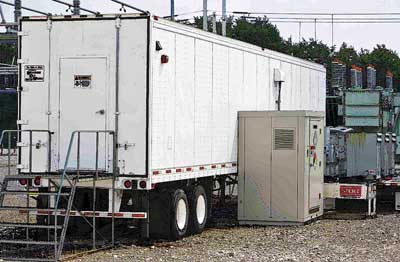
7. Batteries on wheels. The Altairnano/AES 1-MW system can produce 250 kWh and is contained within a single 53-foot trailer. Courtesy: Altair Nanotechnologies

8. Modular arrangement. The batteries are arranged in racks within the trailer along with air-cooled fans, air conditioning, and various computer monitoring systems and controls. Courtesy: Altair Nanotechnologies
Various computer systems monitor and control all the Super Modules and associated systems. A battery management system monitors battery cell temperatures, balances the cell voltages as needed, and keeps track of the battery charge state. A programmable logic controller interfaces with three single-phase Parker Hannifin SSD inverters, one for each phase of the three-phase system. The Parker Hannifin SSD power inverters were coupled to isolation transformers and fed into a step-up transformer with the battery side running three-phase 480 V and the grid side operating at 13.8 kV. A supervisory control system monitors and interfaces with the step-up transformer sending and receiving power from the grid.
Independent test results
KEMA put the Altairnano system through three sets of tests for the validation study:
-
Installation, integration, and functional testing.
-
Battery performance testing.
-
Utility application-level testing.
The AES pilot test at Indianapolis Power and Light is considered by all a significant success in the application of power storage devices for grid application. According to KEMA, the prototype units in their current state are suitable for use in future market pilot activities designed to help better define the application requirements and demonstrate the potential of this technology.
KEMA’s report noted that, "A key performance finding was the maximum unit storage capacity for each of the two one megawatt systems was approximately 300 amp-hours with a capacity of delivering 250 kWh at a rated output of 1,000 kW for 15 minutes. Each unit was able to dispatch at any power level between 1-MW discharge to 1-MW charge within one second. Due to the battery and inverter technology used, response actually occurs within cycles. The round trip efficiencies are on the high end of various options. It is important to note that even with a 90% round trip efficiency, a 250 kWh system requires the replacement of 25 kWh when the total discharge is considered. Other systems that have a 60 to 70% round trip efficiency will not provide the economics necessary when the losses are included in the calculations. Also, the Altairnano system has over a 7-year life when the CAISO standard dispatch model is applied. The cycle life of other electrochemical systems cannot approach this lifetime."
In addition to ancillary services, other applications for the Altairnano technology are being envisioned, such as wind generation low-voltage ride-through, photovoltaic power smoothing, and uninterrupted power supply bridging for diesel generator start-up. The complete KEMA report can be found at www.altairnano.com.
— Contributed by Altair Nanotechnologies Inc.