
The United States is used to transporting fuels to electric generation centers that are close to where the power supply is needed. We see trains carry coal by the carload from resource-rich areas to generation centers across the country. Natural gas is distributed through pipelines. Even uranium is transported to supply our nuclear stations.
However, “fuel” from the wind and sun is not transported. It is converted to electricity where it is “mined.” A close examination of the National Renewable Energy Laboratory’s (NREL) renewable resources maps clearly shows that many of our nation’s best resources are not located near our largest population centers and highest demand areas.
Various governments, communities, environmental groups, developers, and private entities are pushing for a variety of clean energy goals. Though the resources and technology are available to deliver on many of these proposals, fundamental support for transmission is lacking. In order to achieve renewable energy goals, states must work together to enable the development of a robust transmission grid.
States hold the key for unlocking potential
Many propose a federal or nationalized grid; however, an interstate transmission network does not need to be federally owned to achieve success. Although some federal support is needed, many gatekeepers and stakeholders are within the states. Rights-of-way are needed, permitting needs to be made available, and local communities must work collaboratively with neighboring states, environmental groups, utilities, and power producers to develop consistent and timely regulations.
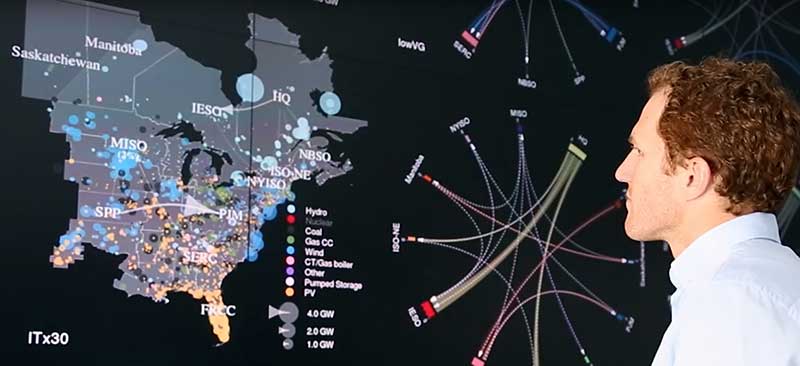
The NREL-provided maps identify high-resource-potential areas for each type of renewable energy. These resources are mainly located across remote central and western regions of the country. However, high consumer demand areas are located primarily along the coastal and southern states. Electricity generated from these remote regions must pass through several states to reach these load centers.
Unfortunately, transmission infrastructure projects, as a rule, do not generate the same high-paying, “green collar” jobs as renewable generation. And “pass-through” states have little motivation to support a sometimes unpopular infrastructure. However, some states have developed infrastructure legislation that facilitates transmission development and, in some cases, have designated a portion of the capacity to be used for renewable energy.
Renewable energy goals are in place and are growing at both the state and national level, including the Department of Energy’s 20% wind by 2020 initiative, but permitting and right-of-way access are local. State leaders and their constituents must understand and support the infrastructure that’s needed to achieve both local and national goals, regardless of where the energy is produced and ultimately used. A clear view of the big picture and extraordinary leadership at the state level is essential in driving the renewable energy surge.
Cross the Great Divide
The borders that separate the East, West, and Texas grids are no more than proverbial lines in the sand. Yet, because of the cost associated with synchronizing transmission to enable sharing, those borders may as well be as wide as the Grand Canyon.
A robust transmission backbone must cross the established East, West, and Texas grid boundaries to ensure renewable resources reach the areas of need. With much of our nation’s best wind resources located within the Eastern and Texas grids, we need an interstate transmission backbone designed to transverse these divides to connect our country’s vast energy resources to the high-demand areas.
Efficiency of DC technology
The greenest megawatts we have are the ones we have already made. But our existing transmission infrastructure needs to be improved to increase efficiencies and reduce system/line losses. In addition, an interstate transmission system should utilize more efficient high-voltage direct current (HVDC) technology for transporting bulk power over long distances. With HVDC technology, an interstate transmission infrastructure can cross established grid boundaries, providing utilities with access to new sources of generating capacity without building a single power plant.
The Pacific DC Intertie is a solid example of how HVDC enables the sharing of loads during specific regions’ peak and off-peak seasons. The Pacific DC Intertie provides power to Los Angeles from the Pacific Northwest during Southern California’s hot summers. When electric demand decreases in Los Angeles and increases in the Northwest during the winter, power can be redirected from the south to provide additional capacity for northern customers.
Now imagine the possibilities of several HVDC transmission lines that can interconnect abundant renewable resources across boundaries with other high-capacity alternating current transmission networks. The ability to send electric energy across the nation can enable sharing of resources during peak and nonpeak times, reducing our need to build additional generating capacity.
Significant investment in our transmission infrastructure will bring to market our country’s vast renewable resources, as well as enable us to utilize more of the power that is already produced. In order for this to happen, all stakeholders need to start viewing transmission as the essential link to our country’s future energy assurance.
—Dean Oskvig is president and CEO of Black & Veatch’s global energy business.