
The advent of the Smart Grid will bring a new driver for value creation to the electric power industry: economies of connection. In the future, the Smart Grid may offer our industry improved returns more typical of Internet-based businesses like eBay, Amazon, and Google to replace the diminishing returns typical of traditional “steel in the ground” projects that relied on economies of scale.
The Internet fundamentally changed the way people did business, and so will the Smart Grid. To understand the coming changes, it is important to understand the significance of economies of connection.
Economies of connection are related to Metcalfe’s Law, which states that the value of a network grows proportionally to the square of the number of active nodes on the network. Kevin Kelly, author of New Rules for the New Economy, explains, “As the number of connections between people and things adds up, the consequences of those connections multiply out even faster, so that initial successes aren’t self-limiting but self-feeding.”
The changes that have transformed the telecom industry are an example. Just as the rise of the Internet created new opportunities for innovative switch companies (Cisco) and entirely new businesses (AOL, Google, and eBay), we might expect analogous innovation when every generator, transmission line, substation, consumer, and wholesale market is connected through the Smart Grid. The consequences for the power industry are profound. Google, founded 10 years ago, has a larger market capitalization than the five biggest U.S. utilities combined.
The U.S. electric grid—tens of millions of wired miles connecting thousands of generators—is a marvel of engineering, but it is a marvel of the last century. When it was constructed, economies of scale ruled and the grid was a spectacular success. Today, economies of scale in the power industry have largely run their course due to physical, environmental, and societal constraints. Economies of scale result in arithmetic increases in value in good times but, ultimately, they obey the law of diminishing returns. Paradoxically, recent efforts to increase the scale of the grid by increasing the interconnections between our balkanized transmission networks has increased the likelihood of domino-effect blackouts, as we saw in 2003.
North America urgently needs a Smart Grid capable of processing and transmitting information among physical assets on the grid and energy consumers. A new market will emerge. To realize the promise of the new economies of connection, it will be imperative that utilities, regulators, and suppliers allow information from the grid to empower consumers and producers.
Self-balancing Smart Grid
The real-time flow of information from the Smart Grid will transform our electrical system into a self-balancing network, because the Smart Grid will put information in the hands of consumers. If we engage consumers, we can count on them to actively help manage the grid. We know they will react to price signals and modify their behavior if they are given access to real-time information.
A Smart Grid will help in other ways as well. Real-time condition monitoring of transmission and distribution assets such as transformers can extend the life of aging infrastructure by allowing dynamic rating and de-bottlenecking during periods of congestion. And we can’t count all the new opportunities we haven’t even thought of yet. No one imagined eBay before the Internet.
The fed as a catalyst for change
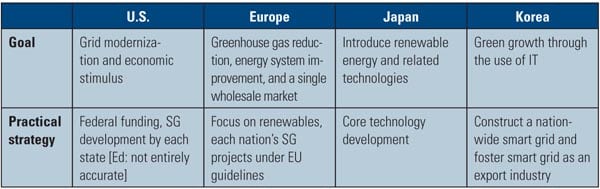
The Energy Independence and Security Act of 2007 will accelerate the Smart Grid, just as the Department of Defense incubated the Internet by creating Arpanet. The act appropriates $100 million per year from 2008 through 2012 to support development of the Smart Grid. Under this act, the government pays up to 50% of any utility’s demonstration project for the Smart Grid and provides federal matching funds of 20% for any Smart Grid implementation. The act also mandates that Smart Grid investment by utilities be included in their rate base. Perhaps most importantly, the legislation created the Smart Grid Advisory Committee to report on a regular basis to the secretary of energy on progress and challenges.
Our industry can benefit from this federal support for the Smart Grid. It is also imperative that Smart Grid appliance and software suppliers collaborate to create standards to accelerate the adoption of new technologies.
The time is now to embrace the Smart Grid and unleash the economies of connection. Not tapping grid information is tantamount to using rotary-dial, party-line telephones when the Internet and cell phones are available. Samuel Insull, the original architect of the grid, drew graphs of demand with pencil and paper. If he could see the tools we now have to process and exploit masses of data, he might remind us that the information hiding within the grid is the means to our own salvation.
—John A. Moore is the CEO of Acorn Energy, a publicly traded holding company for emerging energy ventures. Acorn created Comverge through the acquisition of Lucent and Scientific Atlanta’s energy intelligence assets.