The age-old adage “water and electricity don’t mix” does not apply to 21st-century infrastructure planning. The two entities can no longer be viewed as separate commodities. The demands on both are intertwined, so solutions for meeting new and growing challenges associated with water scarcity and carbon regulations must also be integrated.
Water is essential to the operations of thermal power generation, which accounts for approximately 90% of all U.S. electric generation. A telling figure from the National Renewable Energy Laboratory shows that the amount of water used to produce household electricity actually exceeds direct household water use.
In turn, treating, processing, and moving water is very energy intensive. According to The Alliance to Save Energy, energy consumed to supply water may easily “eat up half of a municipality’s total budget.” The U.S. Energy Information Administration reported that in 2005, municipal and industrial water supply and wastewater treatment systems’ electric consumption was equivalent to what was used to run refrigerators across the country.
Water Is a Fuel
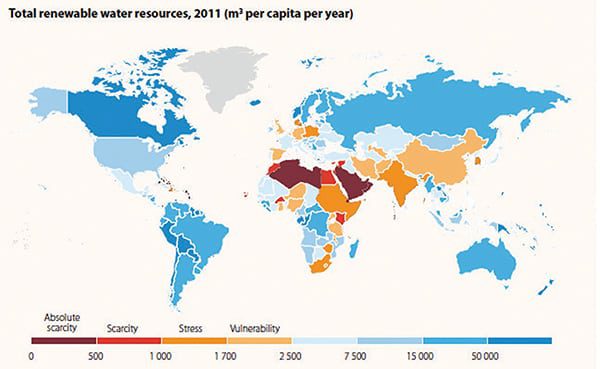
Today, water is a leading issue for power providers. In Black & Veatch’s 2009/2010 Strategic Directions in the Electric Utility Industry Survey, water supply was second only to carbon regulation as the most pressing environmental concern. This concern is validated by the Energy Law Journal’ s observation that water issues have complicated construction or operation of power plants in at least 14 states.
Regulations and restrictions on water resources will require new processes and planning for ensuring a sustainable power supply. One way to begin this new thought process is to view water as a fuel. Water is a fuel for generating electricity and for powering local, regional, and national economies.
According to the U.S. Geological Survey, water withdrawals for energy are approximately equal to those for agriculture, each making up about 40% of freshwater withdrawals. However, power generation only accounts for 3% of all water consumption, as compared to agriculture’s 85% of all consumption. Most of the water used for power generation is eventually returned to the source. As a result, national and state water discharge regulations can also impact the operations of a power plant, as do environmental regulations governing emissions and waste products.
Carbon emissions and climate change are central to planning for our nation’s future electric energy supplies, requiring providers to look at balanced generation portfolios. Nuclear, coal (assuming carbon capture will be part of future “clean” coal projects), solar thermal, and biofuels are widely viewed as key areas for addressing potential carbon and climate change legislation. According to The World Resources Institute, these are also the power plant technologies that withdraw the largest amounts of water.
Just as we look toward modified generation portfolios to lower carbon emissions, we also must look for a balanced portfolio that reduces water withdrawal and consumption. When we think about water as a fuel, we can readjust our thinking and change the conversation. We need to ask the same questions about water that we ask about fossil fuels. What are the conservation strategies? Where does it come from? Is it a sustainable resource? What are its most effective uses?
Addressing the Nexus of Energy and Water
Climate change legislation, if enacted, would have far-reaching impacts beyond the electric power industry. All industries, including the water and wastewater treatment sectors, must plan now on how it might impact their operations. In this regard, it is important for water and energy providers to work together. Integrated planning between water and electric utilities has achieved proven and sustainable results in reducing costs and freshwater usage.
One example of a successful collaboration is between the city of Mankato, Minn., and a power generator. The power generator needed water to cool its new plant near Mankato. The city needed to upgrade its wastewater systems in order to meet new environmental discharge regulations. The city offered its wastewater effluent to the power generator for plant cooling and, in turn, the power generator agreed to build a water reclamation facility that would address the stricter discharge regulations. By transferring treated wastewater to the power plant, both entities effectively cut costs and reduced demand on the local surface and groundwater supplies by nearly 680 million gallons per year and improved the quality of water that is returned to the river. (Editor’s note: See the Brandon Shores Top Plant story in this issue for another example.)
Taking Action
Perhaps the single most important point to remember is that there is no all-inclusive solution for addressing these complex challenges. Each city, watershed, and region faces unique challenges and opportunities as additional air, carbon, and water regulations are enacted at the local, state, and federal levels.
The convergence of new patterns in population, weather, energy production, and climate is demanding that we approach our water resource planning for power generation in a more holistic, integrated fashion. This requires a new mindset about water and its use, management, and value, and we must begin today.
— Edward Walsh (walshej@bv.com) is executive vice president of Black & Veatch Corp.’s global energy business.