Modern wireless systems improve productivity, monitoring activities, and safety at power plants by enabling the right people to be at the right place at the right time. Wireless technology can put hard-to-access process and asset information at your fingertips, wherever you are, to enable more accurate and timely decisions.
Wireless technology offers benefits beyond wiring cost savings. With a multifunctional, plantwide wireless network, utility and power generation facilities can improve safety, reliability, and efficiency through optimized employees, equipment, and processes.
This overview is intended to assist power industry companies in exploring the many possibilities of using wireless technology in plant automation. It will help end users understand what to look for when selecting a wireless network for their requirements and will help them get started with this innovative technology.
Wireless Networks’ Benefits
Wireless technology has revolutionized network connectivity in the IT world as well as the commercial and consumer markets. Substantial growth in wireless networks is driven by standardization, industry investment, and research and development. Modern wireless applications and sensors deliver powerful new capabilities, enabling end users to improve operational performance. Wireless systems not only provide advanced sensing but also help users make decisions positively affecting their overall business objectives.
The advantages of wireless technology include helping plant operators gather field data more easily, increase asset life through continuous monitoring, and improve the safety of their most important assets — their people. Wireless technology also promotes improved plant availability, reduced downtime, and increased productivity.
As wireless technology gains greater acceptance, the wired world is slowly fading into the background. Protocols such as Wi-Fi represent the future, not only for traditional wired IT network requirements but also for monitoring and control applications across the plant floor.
In order to take advantage of all the benefits wireless technology has to offer, power plants must adopt sound policies mitigating risks and ensuring adequate security for processes, personnel, and the environment.
Business Advantages
Power plants implementing wireless systems do so for the same reason the first telegraph system was developed: cost savings. Utilities look to wireless technology to add real business value, both in terms of installation costs and optimized operations from increased data availability.
Just as Guglielmo Marconi’s invention, the radio telegraph system, eliminated the need to erect poles for wired communication, modern wireless solutions simplify installation requirements when compared with conventional wired networking, while also improving reliability and productivity.
An ultra-secure and ultra-reliable wireless field infrastructure supports not just wireless instruments but also wireless local area network (WLAN) applications under the Institute of Electrical and Electronics Engineers (IEEE) standard 802.11 and mobile technology such as handheld computers and mobile human-machine interfaces (HMIs).
A single wireless network, supporting multiple wireless technologies and classes of service, can handle diverse tasks ranging from communicating sensor information back to a host system, to handling closed-loop control, information, HMI, video, communication, and enterprise applications. Wireless technologies developed for building management and security can also be utilized in process plants to support both asset management and personnel tracking.
Most importantly, wireless networks can be designed to support multiple communications protocols, as well as existing applications and standard transmission control protocol/Internet protocol (TCP/IP) communications, so that legacy investments do not have to be discarded.
Applications for the Power Industry
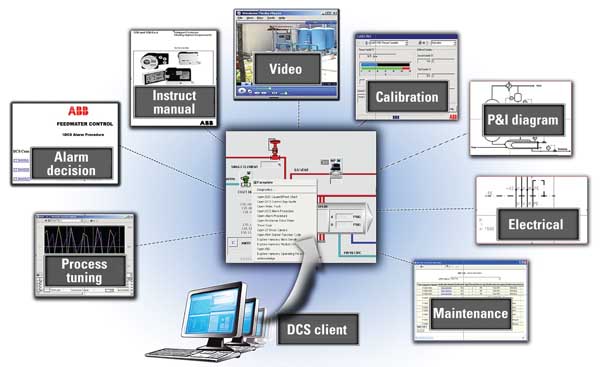
Access to the right process data can significantly enhance operational efficiency and extend access to critical process information beyond the control room. A wireless system can include anything from a network of transmitters monitoring a single, specific application to a full-scale wireless network deployed across an entire site to handle multiple applications, including monitoring and supervisory control (Figure 1).

1.On-site computing. Wireless mobility tools provide a fully functional PC environment that personnel can interact with directly from a handheld device while performing maintenance rounds, data collection, and inspections. Source: Honeywell Process Solutions
Modern wireless networks are formed by a series of wireless access points, or radio nodes, placed strategically in a facility. Many networks support a "mesh" infrastructure, in which each radio node communicates to at least one other node in range, providing backup communication should communication from one node be interrupted. The coverage area of the radio nodes working as a single network becomes a mesh "cloud."
The first generation of wireless products were sensor-specific and not designed to cover entire plants, which limited them to smaller implementations. Today’s generation of products is more appropriate for wider plant deployment. These systems are optimized for specific end-user applications, ranging from read-only access over an intranet by multiple casual users to secure system access for mobile operators. The wireless collaboration that such systems enable can improve decision-making, production uptime and process monitoring, and incident avoidance.
Handheld access to process data allows technicians in the field to view the latest plant information to help identify failures and causes that may previously have gone unrecorded. It also can open the door for further investigation of a system’s reliability. Users can integrate field data with data from multiple other sources, including production, control, and work management systems. Wireless systems also can provide mechanical and engineering data and support the calibration of instrument databases. Using wireless technology in the field helps management improve the tracking and reporting of inspections, tests, and repairs for pumps, actuators, valves, vents, pipes and other plant process equipment.
The new breed of wireless transmitters enables plant workers to obtain data and create information from remote and hazardous locations without the need to run wires, where running wire is cost-prohibitive and/or the measurement occurs in a hazardous location (Figure 2).

2. Wireless solution. An example of a transmitter installed at a facility. These wireless transmitters bring back data from remote areas of the plant into the control system to improve safety and efficiency. Source: Honeywell Process Solutions
There are countless remote applications in power plants that can benefit from wireless technology. For example, one Nebraska power plant is using wireless technology to monitor its remote oil tanks. In addition, plant staff are now able to efficiently monitor water run-off where electricity is unavailable. Battery-powered transmitters transmit data over long distances back to a powered node.
Other power plants are considering applications such as:
-
Supervisory control and data acquisition.
-
Emissions monitoring.
-
Flame sensing with transmitters, or even a remote wireless video.
-
Control applications, such as turbine control, boiler control, or motor control.
-
Monitoring the health of rotating assets.
Another example of remote usage is over large areas such as wind farms. Many have ineffective or no means to determine wind speed or kW/MW power production. Battery-operated wireless devices enable data collection and accurate power production calculations.
Furthermore, wireless multiplexers are a simple and reliable means of implementing a wireless solution for applications with high-density input/output (I/O) concentrations. They provide the lowest cost per wireless measurement point, which enables new applications that save millions of dollars on wiring costs. This can help with substation monitoring and communicating information back to a central monitoring station.
Wireless technology is also an innovative, cost-effective alternative for measuring the health of water or corrosion from fluid in tanks and pipes. For example, remote analytical pH readings enable plant operators to monitor water quality. And, with a wireless corrosion-monitoring system, online and real-time corrosion monitoring now becomes cost-effective.
A wireless system can carry process and maintenance data over the same network. Correlation with maintenance and operator tasks is possible by enabling mobile workers with wireless technology, which saves them from sifting through maintenance logs and matching tasks with corrosion data. All the information can be integrated into one set of data.
Most importantly, wireless technology improves safety. By enhancing new opportunities for integrating asset tracking, people location data, or real-time data and supervisory control, wireless technology can provide:
-
A real-time location system throughout a facility to monitor employee locations and ensure safe procedural operations.
-
Safety shower monitoring.
-
An infrastructure that supports emergency responders.
-
Wireless leak detection and repair support.
-
Integration with existing control and safety systems.
-
Continuous wireless monitoring of equipment and field devices for diagnostic equipment health assessments.
-
Voice-over-Internet protocol (VOIP) for in-plant voice communications.
Finding the Right Network
Power companies and other end users considering the implementation of wireless technology have identified a number of key wireless system requirements. These include high security, reliable communication, good power management, open platforms, multispeed monitoring, multifunction capabilities, scalability, global usage, high quality of service, multiprotocol support, and control readiness.
According to wireless technology experts, the emerging wireless infrastructure will be based on a universal mesh network supporting multiple wireless-enabled applications and devices within a single environment (Figure 3). With just one network supporting multiple applications, deployment, network maintenance, and security management will be simplified.
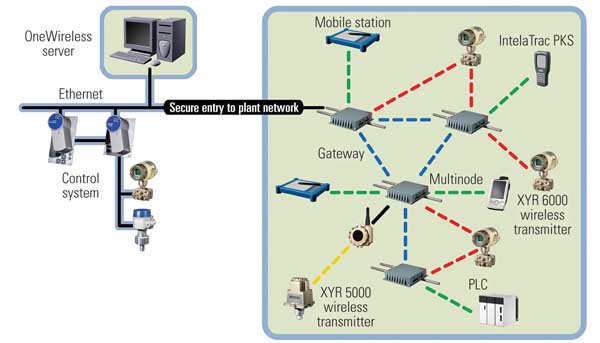
3. Once is not enough. A wireless mesh network has multiple paths between access points (nodes) to establish a redundant infrastructure. Source: Honeywell Process Solutions
A wireless network must be secure to ensure the entire facility is safe, offering one comprehensive and end-to-end integrated security system from the control or host system all the way down to the sensor. This means there’s only one wireless security system to manage. A layered approach to security means protecting the network from multiple risks.
Mesh networks use a self-propagating, self-healing network of nodes to achieve blanket coverage of an area. A node can send and receive messages, and in a mesh network, a node also functions as a router and can relay messages for its neighbors. If one node fails for any reason, including the introduction of strong radio frequency interference (RFI), the network can reroute data, and connectivity will not be lost.
With point-to-point signaling, the power consumption (and battery life) of each field device becomes more predictable. This efficiency helps extend the life of batteries so that they reach their standard shelf life (some up to 10 years), maximizing the time between battery changes. Changes in latency caused by routing changes to the network also are eliminated.
Wireless mesh networks optimize performance with efficient use of industrial, scientific, and medical (ISM) radio bandwidth and prioritizing messages so critical information is received first. Because communication devices using the ISM bands must tolerate any interference from ISM equipment, these bands are typically given over to uses intended for unlicensed operation. Unlicensed operation typically needs to be tolerant of interference from other devices. In the U.S., ISM band usage is governed by Federal Communications Commission rules.
Efficient wireless mesh networks mitigate signal interference in these limited ISM bands by employing a frequency-hopping spread spectrum (FHSS). This technique modulates the data signal with a carrier signal that periodically "hops" from frequency to frequency across a wide band. Through the relaying process, a packet of wireless data will find its way to its destination, passing through intermediate nodes with reliable communication links.
Installing a wireless network at a power plant can pose some unique considerations when one is trying to avoid the risk of electromagnetic field interference and RFI. Usually this problem can be easily mitigated with proper placement and antenna choices. Fortunately, wireless communication is not line-of-sight technology; it can reflect and bounce off metal in a facility. There are three main ways to mitigate the risk from interference:
-
Spatial diversity: Every device sends to two nodes in different locations to diversify the communication.
-
Temporal diversity: A device sends data, and if the data is not received by either node, it will retry two more times, as quickly as the next millisecond.
-
Frequency diversity: Every transmission is performed at a different frequency. Typical EMI interference is short, with scattered bursts, making it relatively easy to navigate around.
Matching multi-hop, wireless mesh communications with distributed control facilitates a new dimension of interactions between sensors or sensor clusters. Sensors can now communicate directly with other devices on the network. Plus, monitoring equipment can take readings from sensors without having to directly access them via wired connections. This is useful in calibration and troubleshooting.
By utilizing a single, universal, wireless mesh cloud, end users have access to one integrated platform supporting multiple field protocols and applications. With a high-speed and self-organizing mesh configuration, network users achieve flexible channel allocation and a robust architecture with latency control and redundancy for safe wireless control. They also have one scalable network that conserves power and spectrum. Best of all, plant personnel only have one system to learn, operate, and maintain.
How to Select a Supplier
Because most electric power companies are unwilling to act as system or platform integrators for their future plants, they look to their automation supplier to perform this function. The task includes not just providing equipment and support services but also managing the platform over the long term so that rapidly developing new technologies and applications such as wireless can be quickly and inexpensively added.
Plant operators also look to their automation supplier to manage embedded technology, so that process control systems remain up to date and skirt around technological dead ends without causing unnecessary cost and downtime.
When choosing a wireless technology supplier, consider whether the company provides:
-
Comprehensive and end-to-end security measures.
-
Documented best practices for a secure wireless system configuration.
-
A secure wireless network architecture.
-
The latest security fixes.
-
Qualification of anti-virus software.
-
Policies focused on high security.
-
Established services to help assess, design, implement, and manage a secure wireless environment.
Your supplier selection checklist should also ask:
-
Does the supplier tightly integrate process control with physical and cyber security?
-
Does the supplier provide a dedicated security response team to monitor and advise upon emerging security threats?
-
Does the supplier offer a security design service providing a detailed design of the security infrastructure connecting your wireless network to the company’s business IT network?
Getting Started with Wireless
Power industry operations can now benefit from a wireless technology that satisfies the multiple conflicting demands of redundancy, distributed communications, flexibility, and reliability. Furthermore, self-configuring, self-healing wireless mesh networks are inherently less expensive to install and maintain as radios and microprocessors become cheaper.
To begin using wireless technology and unlock the possibilities of this innovative technology, it is important to view your wireless implementation as a partnership between the plant operator, the company IT department, and the wireless technology supplier. Each party has a role in determining the outcome of this effort.
In addition, always consider safety first. If you can’t install wireless safely, it’s better not to do it at all. Fortunately, with the right technology and support, you can enjoy all of the advantages of wireless technology while protecting your plant information and ensuring safe operations.
—Jeff Becker (jeffrey.becker@honeywell.com) is the global wireless business director for Honeywell Process Solutions.