Greensburg was destroyed by an EF5 tornado on May 4, 2007. Instead of abandoning the Kansas town, the community quickly embraced the task of rebuilding it from the ground up, maximizing the use of renewable energy sources and energy efficient building techniques. Rebuilding continues, but the future of Greensburg has never been stronger.

BEFORE. Courtesy: Federal Emergency Management Agency

AFTER. Courtesy: Greensburg GreenTown
In 2007, a massive tornado touched down in the south-central Kansas town of Greensburg, destroying 95% of the town and killing 11 people. It could easily have been the end of the 1,400-resident rural farming town that was already in decline, but instead, the disaster brought the town together in an effort to make Greenburg’s future a green one.
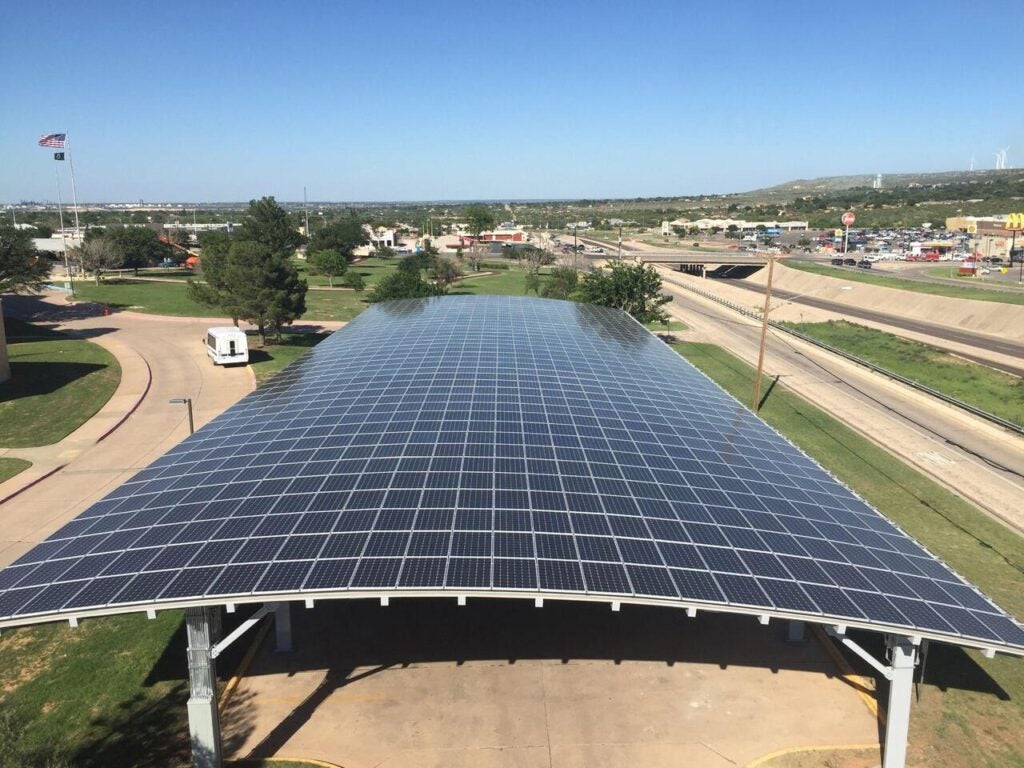
The U.S. Department of Energy (DOE) and its National Renewable Energy Laboratory (NREL) provided technical assistance to the community while dozens of other agencies and entities at all levels contributed many additional forms of support. As a result, the city of Greensburg and its many partners are rebuilding the town from top to bottom using the latest energy efficiency and renewable energy technologies. In addition to installing several ground source heat pump systems and small photovoltaic systems, the town is constructing a wind farm that will supply enough wind energy to power every house, business, and municipal and county building.
Too Tough to Die
Within days after the tornado, experts from the DOE, NREL, and other agencies came together with state and local officials and residents to help answer the big question: What will become of Greensburg? While the town was evacuated for three months, residents scattered and businesses evaluated their losses. No one was sure how many would return to rebuild.
"The planning process that grew out of that first tent meeting just snowballed," said Daniel Wallach, executive director and founder of Greensburg GreenTown, a grassroots community-based nonprofit formed after the tornado hit. "Community, family, prosperity, environment, affordability, growth, renewal, water, health, energy, wind in the built environment — these were all values that were identified that would construct a framework in which to move forward for Greensburg."
As the residents of Greensburg focused their energies on rebuilding, they kept these values in mind, and their vision took shape. The City Council passed a resolution requiring all new city buildings larger than 4,000 square feet to meet U.S. Green Building Council Leadership in Energy Efficiency and Design (LEED) Platinum certification and reduce energy consumption by 42% as compared to standard buildings. They set a goal of using 100% renewable energy for their new town. And they included brand-new technologies, such as light-emitting diode (LED) streetlamps, to reduce energy use.
Greensburg is becoming a net-zero-energy community with regard to its electricity — an energy efficient community that generates as much electricity from renewable energy as it uses. It sets a new standard, not just for its own citizens, but for other rural and urban communities as well (Figure 1).
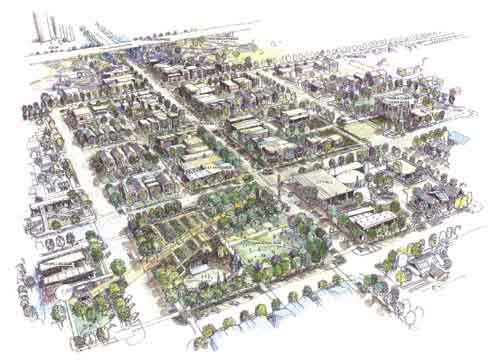
1. Plan for the future. A Greensburg master development plan was developed to guide the city’s recovery and growth over the next 20 years. Source: City of Greensburg, Kansas
First in Green Lighting
One of the town’s first completed green projects illuminates the downtown sidewalks and streets every night. Greensburg is the first city in the U.S. to use LED lamps for 100% of its street lighting.
By replacing the existing 303 sodium vapor lights with LED fixtures, Greensburg improved outdoor lighting energy efficiency by 40% and reduced the cost of related energy and maintenance by an estimated 70%.
As an added bonus, the new lamps reduce nighttime light pollution by focusing light where it is needed — on the ground rather than in the night sky.
A "Wind-Wind" Situation
One of the most remarkable aspects of the Greensburg project is the town’s commitment to renewable energy and, in particular, wind. Far from distrusting the force that destroyed their town, the townspeople have embraced it as the foundational building block of their new community, even donning t-shirts with the phrase coined by Greensburg GreenTown: "Greensburg — A Wind-Wind Situation."
The town is already home to a 50-kW turbine at the new hospital, two smaller turbines at the BTI-Greensburg John Deere dealership, and three small turbines at the 5.4.7 Arts Center. The new school also plans to install a 50-kW turbine.
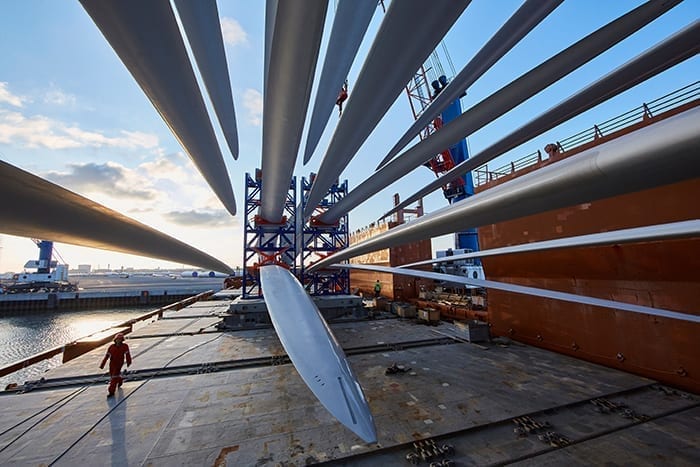
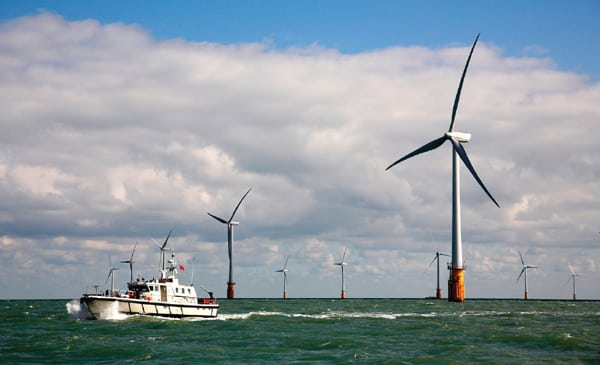
Construction is also under way for the Greensburg Wind Farm, which will consist of 10 Suzlon 1.25-MW wind turbines with a capacity of 12.5 MW of renewable power — enough energy to power 4,000 modest homes. It is planned for completion in the spring of 2010. The town expects to consume about a quarter of the electricity produced by the wind farm for its homes, businesses, and government buildings; the rest will be sold to the Kansas Power Pool, which is purchasing power from the project (Figure 3).

3. Harness the wind. Greensburg is using wind-generated electricity to supply much of the city’s needs. The city’s goal is to become electricity self-sufficient. Excess wind power generated is sold to the Kansas Power Pool. Courtesy: Joah Bussert, Greensburg GreenTown
With its 40 member cities and strong interest in increasing renewable energy in its generation mix, the Kansas Power Pool was a natural partner for the city of Greensburg. When the wind isn’t blowing and the turbines can’t generate electricity, the Kansas Power Pool will energize the town with as much clean power as possible from other sources, including hydropower, to work toward the community’s goal of being powered entirely by renewable sources. Greensburg will also own all the renewable energy credits from the electricity used by the city.
Other Greensburg Wind Farm partners include John Deere Renewable Energy, the owner and operator that led the project and provided an equity investment. It will also maintain the wind farm.
Native Energy, a Vermont-based company, furnished a portion of the upfront financing as part of its mission to help finance sustainable power projects that benefit family farms, community-based operations, and Native American projects. Native Energy is selling the renewable energy credits from the project so that anyone can "own" part of the Greensburg Wind Farm (see www.nativeenergy.com).
The total cost of the wind farm is projected to be $23.3 million. The remainder of the project financing is coming from the U.S. Department of Agriculture (USDA). In October 2009, Secretary Tom Vilsack announced a $17.4 million loan to the project through the USDA Rural Development program. John Deere Renewable Energy anticipates that the system will be paid off in under 12 years.
"This project will not only enhance our country’s long-term energy security by producing clean, renewable energy, but will also create green jobs and generate income in the local community," said Vilsack. "Greensburg stands out as an example of the promise and potential in communities throughout the country."
Vilsack isn’t the only administration official fond of the project. In his first address to a joint session of Congress, President Barack Obama said, "Greensburg… is being rebuilt by its residents as a global example of how clean energy can power an entire community — how it can bring jobs and businesses to a place where piles of bricks and rubble once lay."
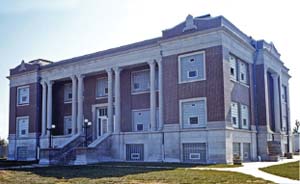
Green-Powered Government and BusinessesThe 95-year-old Kiowa County Courthouse (Greensburg is the Kiowa County seat), one of the few structures left standing after the tornado, has been renovated with sustainable features and is striving for LEED Gold certification — an especially admirable goal, because the facility is being modified rather than replaced. Today, the building is one of the greenest historic buildings in the country thanks to extensive use of reclaimed materials, state-of-the-art windows, and native landscaping (Figure 2). The courthouse uses a specialized multistage heat pump system that extracts both heat and cooling from the ground through a series of thirty-two 300-ft vertical wells. The ground source heat pumps are rated based on size, with an energy efficiency ratio ranging from 14.1 to 18.7 for cooling and a coefficient of performance ranging from 3.1 to 3.8 for heating. The heat pumps utilize high-efficiency motors and fans and exhaust energy recovery ventilators supply outdoor air to each heat pump. Growing Businesses with Green PowerThe two-story SunChips Business Incubator is home to temporary, low-cost office space for as many as 10 small businesses rebounding from the tornado or starting from scratch. Like all larger structures owned by the city of Greensburg, the facility is built to LEED Platinum standards. A 6.8-kW photovoltaic system supplies approximately 10% of the building’s total energy needs. The Business Incubator also features a specialized ground-source heat pump system that extracts both heat and cooling from the ground through 21 vertical well shafts, 340 feet deep each. As in the courthouse system, heat pumps are rated based on size; their energy efficiency ratings range from 14.1 to 18.7 for cooling while coefficients of performance range from 3.1 to 3.8 for heating. High-performance building materials provide maximum insulation and protection from high winds. Natural light illuminates most of the interior space, which minimizes the need for artificial lights. Water from sinks and showers is recycled and used to flush toilets. The recycled water (gray water) is supplemented by rainwater, which is collected and stored during rainstorms. |
Economic Development
In addition to powering the town, wind energy has become an important economic development strategy for Greensburg. Take, for example, Kelly and Mike Estes, owners of the BTI-Greensburg John Deere dealership, a prominent local business. The Estes brothers used a wind turbine to power the construction site when rebuilding their business, which now includes two wind turbines (4.2 kW and 1.9 kW) that provide electricity to the facility, offsetting an estimated 8% of the building load (Figure 4).

4. Deere wind. BTI-Greensburg, the local John Deere dealership, uses two wind turbines (4.2 kW and 1.9 kW) to provide about 8% of the facility’s electricity requirements. Courtesy: BTI-Greensburg
The Estes brothers had such a positive experience with Endurance Wind Energy, the Canadian company that built their larger turbine, that they saw a new business opportunity. BTI Equipment became the exclusive North American distributor for Endurance and formed BTI Wind Energy. In their first nine months of business, they built a North American dealer network across 32 states and four Canadian provinces, resulting in 120 new wind-related North American jobs (including wind specialists, service technicians, and installers). Nearly 300 existing sales representatives are learning the new business of wind energy.
"In the ag business we are pretty reliant on weather and crop for our survival," Kelly Estes said. "If we lose a crop or freeze or drought, then it’s real hard for our type of business to survive, so we were looking for something sustainable. You can harvest the wind pretty well year round."
Green Buildings in Greenburg
Greensburg residents have taken sustainability to heart, hearth, and home. Businesses like banks, car dealerships, and funeral homes, along with churches and a lodge have rebuilt using environmentally friendly materials and are saving energy and water. Per capita, the city has the highest concentration of LEED Gold and Platinum buildings in the U.S.
As noted earlier, the city of Greensburg passed a resolution that all city-owned buildings over 4,000 square feet would be certified LEED Platinum. Completed in May 2009, the city’s Business Incubator not only achieved LEED Platinum status with greater than 50% energy savings, but it also became the first LEED Platinum – certified municipal building in Kansas (Figure 5).
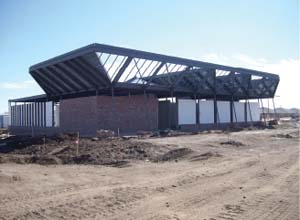
5. Energy efficient building designs. As part of the Greensburg master development plan, all city-owned buildings over 4,000 square feet must be LEED Platinum in design and construction, including Greensburg’s new City Hall building, shown here under construction. The new building design also integrates photovoltaic panels, geothermal technology, reclaimed brick, and recycled wood and other materials. Courtesy: City of Greensburg, Kansas
Other public and commercial buildings, such as the Greensburg School and the Kiowa County Memorial Hospital (see sidebars), are striving for LEED Platinum status; if awarded, the hospital will be the first critical access hospital in the nation to achieve the LEED Platinum rating. Greensburg is also home to the 5.4.7. Arts Center, the first LEED Platinum building in Kansas.
Greensburg’s business community is rebuilding with a major focus on energy efficiency and green building principles as well. The new John Deere dealership is a LEED Platinum building and has become the model for all future John Deere dealerships across the nation. In addition, the town’s grocery store, banks, churches, car dealership, senior center, and many other buildings are rebuilding green.
Of the 180 new homes that received building permits between May 2007 and March 2009, the designs of 95 were evaluated and should use 40% less energy on average than standard homes built to the International Energy Conservation Code (IECC) 2003 (with 2004 Supplement). This is an outstanding level of energy efficiency, especially considering that most were built by individual home owners and builders.
Two multi-family projects for affordable housing were also in the range of 40% to 50% energy savings. Prairie Pointe Townhomes, a new 32-unit complex for low-income renters, was awarded the first residential LEED Platinum rating in Kansas. Wichita, Kansas – based Mennonite Housing Rehabilitation Services, which helps low-income individuals build affordable, single-family homes with so-called sweat equity, built 20 highly energy efficient homes and plans to build 30 more using design recommendations from NREL.
Children Today, Greensburg’s Leaders Tomorrow
If anything can forecast the lasting success of Greensburg’s bold vision, it’s the way the town’s young people envision their own futures. Greensburg’s enthusiasm for renewable energy and energy efficiency has inspired young people, fed by extensive education and outreach efforts at several levels to give youth the opportunity to understand, embrace, and champion the alternatives to petroleum.
In addition to being designed to LEED Platinum standards, the K-12 campus and school building in Greensburg will become teaching tools. The school is expanding its curricula on energy and green technologies with hands-on educational experiences to help students understand the real world of energy and sustainability. The town is also encouraging youth to take leadership roles: under the sponsorship of Greensburg GreenTown, the community’s high school students operate a Green Club.
Seeing Green for the Long Term
Right after the tornado, one of the local visionaries, Daniel Wallach, started the nonprofit organization Greensburg GreenTown to assist the city with its green vision and advocate for sustainable rebuilding and growth. Nearly three years later, Greensburg GreenTown is still a major spark plug in keeping the vision alive and growing. Along with its precedent-setting policies and heroic efforts to embrace sustainability, Greensburg has high hopes for how others will respond to the community.
"We’d like to see Greensburg become the ecotourism capital of the world," said Mayor Bob Dixson. "Companies can bring their customers here to see sustainable building products and all kinds of eco-friendly businesses. We want to be a living laboratory."
Greensburg also hopes to attract companies that can draw on the resources of the prairie for a variety of green purposes, from research to entrepreneurial manufacturing. The town might very well meet its goals: Greensburg’s hard work and small-town values have struck a chord with both the national and international community.
And what did this do for the American taxpayers who funded the DOE and NREL to help Greensburg? First, NREL and its subcontractors provided unique and valuable assistance to influence, design, and implement energy aspects of the overall community direction and dozens of individual projects. This included all aspects of energy: energy portions of the new community master plan; energy efficiency strategies and tactics for residential and commercial buildings; specific information and design assistance for many individual buildings and homes; feasibility studies and recommendations for using wind, solar, and biomass technologies within the community; analysis and recommendations on advanced vehicles and fuels for transportation; and assistance with outreach and community education.
Second, this extensive effort was well documented publicly and within the DOE and NREL so that the lessons learned in the first three years of building a green Greensburg could be applied to similar communities across the U.S. — and perhaps the world.
—Lynn Billman (lynn.billman@nrel.gov) is a senior project leader for the National Renewable Energy Laboratory.