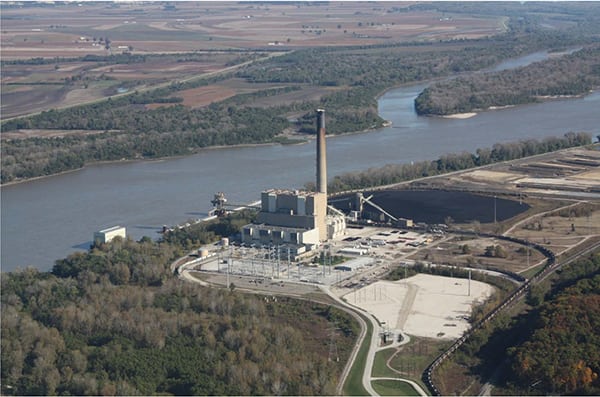
Although few Americans would characterize the affair this way, the U.S. has a love-hate relationship with coal-fired power plants. Fifty percent of the electricity generation in this country begins with a shovel full of coal and ends with a commodity that everyone depends on but takes for granted.
Natural gas contended with coal for a few years recently, and it still competes well in selected regions. But today’s average capacity factors confirm that high and volatile prices have knocked gas to the canvas: Gas-fired combined-cycle plant capacity factors average around 30%, whereas coal plants still rule at more than 80%. However, the price of coal—supplies of which are less susceptible than gas to curtailment during cold winter months—is slowly inching up, largely in response to increased demand for the low-sulfur variety from the Powder River Basin (PRB) of Wyoming.
Another indicator of the continued hegemony of coal-fired generation is the rush by developers and utilities to make it their preferred option for near-term baseload capacity. According to the U.S. National Energy Technology Laboratory, 153 proposed new coal plants totaling 93 GW are in some stage of development in 40 states. Industrial Info Resources Inc. (www.industrialinfo.com) puts the total even higher, saying it is tracking 180 coal projects. Conspicuous by their absence from the list are the six New England states, which generally oppose building just about anything that makes a kilowatt.
If the past is in any way predictive of the future, not all of those projects will be built. But it’s generally agreed that the pulse is getting stronger in an industry segment that has been on life support for a generation.
Nevertheless, there are plenty of land mines remaining if building a new coal plant is on your to-do list. One is potentially unreliable fuel supply. The two mid-May 2005 derailments on the southern rail line out of the Powder River Basin jointly operated by Burlington Northern Santa Fe and Union Pacific, and ongoing coal transportation constraints, are facts of life that potential PRB users must consider. Another risk is a consequence of the law of supply and demand. There’s nothing to stop railroads from raising their coal shipment fees as more PRB-firing plants come on-line—including more than a few in eastern markets.
In his May 25, 2006, remarks to the U.S. Senate’s Committee on Energy and Natural Resources, David Wilks, president of energy supply for Xcel Energy (and speaking on behalf of the Edison Electric Institute) skillfully used the "R" word to lobby the federal government to ride herd on the railroads. Noting that it is "critical that electric utilities be able to depend on reliable, affordable coal deliveries," Wilks added that "reliable rail coal movement . . . is integral [to] . . . electric reliability [and] . . . inextricably linked to the economic health of the nation." Wilks went on to testify that "The North American Electric Reliability Council (NERC) is taking very seriously the potential impact that coal delivery problems could have on electric reliability," explaining that "NERC has placed the PRB issue on its ‘Watch List.’ "
Reservations about coal
Building a coal plant in western states, and especially on or near the Colorado Plateau, is becoming very problematic. Case in point: The 1,900-MW Intermountain Power Plant (IPP) in western Utah—which sells 45% of its output to the City of Los Angeles—announced in 2002 its intention to join a partnership to add a third 950-MW unit. In August 2004, then-Mayor James K. Hahn pulled the plug on L.A.’s participation in the project and directed the city’s Department of Water and Power to spend the money instead on purchases of renewable energy for the city. How do you anticipate a curveball like that? IPP 3 now looks to break ground in 2008 and be commissioned in 2012—a full decade after the original project announcement.
To accelerate the development of the $2.5 billion, two-unit, 1,500-MW Desert Rock Energy Project it hopes to build in northwest New Mexico, Houston-based Sithe Global Power has taken a different approach: short-circuiting lengthy state and local project reviews. Because the site proposed for Desert Rock is on the Navajo Reservation, EPA Region 9 and the Bureau of Indian Affairs are the lead agencies in the permitting process.
Sithe’s co-developer, the Navajo Nation’s Diné Power Authority, is quick to note that the coal-fired plant will contribute $50 million a year in taxes and royalties to the tribe—or about one-third of its annual budget. Significantly, Desert Rock won’t have to depend on rail deliveries for its fuel: Coal will come from BHP Navajo Coal Co.’s mine adjacent to the 560-acre project site. Permit applications began in 2004, and commercial operation is slated for 2010, although that seems a bit optimistic.
First in a decade
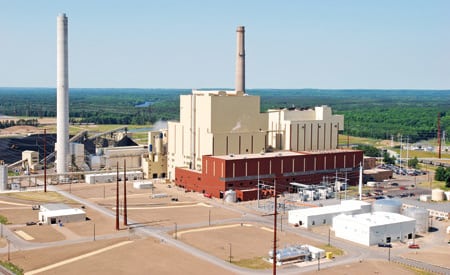
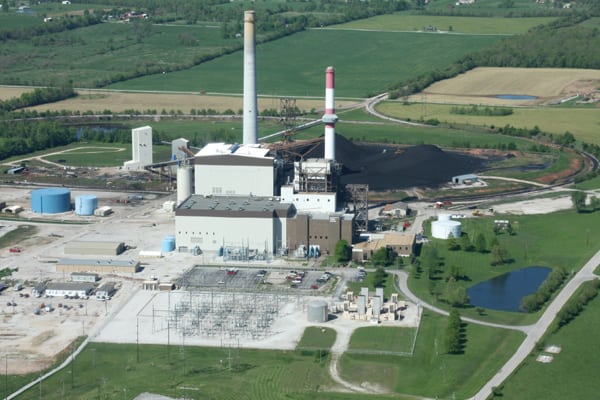
About 100 miles south of the proposed site of the Desert Rock plant is Unit 3 of Springerville Generating Station (Figure 1), POWER magazine’s 2006 Plant of the Year. Springerville Units 1 and 2 are owned by Tucson Electric Power (TEP), a subsidiary of UniSource Energy Corp. TEP is the second-largest investor-owned utility in Arizona, and over 80% of its installed capacity is fired by coal.
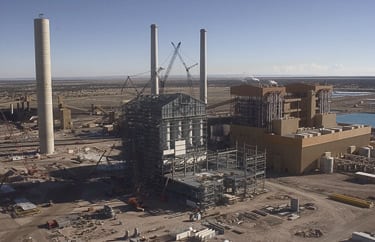
1. Blessed event. Springerville Units 1 and 2 (right) are rated at 380 MW apiece. Unit 1 entered commercial service in May 1985; Unit 2 followed five years later. Unit 3 was deemed "substantially complete" on July 19, 2006, less than 33 months after Bechtel Power received notice to proceed with the project. Courtesy: Bechtel Power
The 418-MW (net) Unit 3 entered commercial service on July 28, 2006, just in time to provide peaking power to a region experiencing searing summer temperatures. James S. Pignatelli—chairman, president, and CEO of TEP and UniSource—noted that the unit is coming on-line at the perfect time, "with natural gas prices remaining volatile and the Southwest’s energy demands continuing to rise. Years ago, we recognized the value of the affordable, reliable power this generator would produce," he said.
The timing of Springerville 3’s debut was just as opportune for the editors of POWER, who consider the unit worthy of the magazine’s highest accolade based largely on one criterion: It is the first sizable pulverized coal–fired power plant to come on-line in the U.S. since Bechtel Power Corp. completed the Indiantown Generating Plant in Florida in 1996 for the independent power producer U.S. Generating Co., later acquired by Cogentrix Energy Inc. Final acceptance testing of Springerville 3 is scheduled to be completed this month.
Although demand for new coal-fired plants waned in the U.S. in the mid-1990s, Bechtel continued to hone its expertise on a number of major overseas projects. They included:
- Millmerran Power, a two-unit, supercritical, 800-MW mine-mouth operation in Queensland, Australia.
- The two-unit, 724-MW Meizhou Wan project in China’s Fujian Province—the country’s first wholly foreign-owned power plant.
- The 440-MW Quezon Power plant on Luzon Island in the Philippines—the first privately owned plant in the country to sell power to a privately owned utility.
Bechtel’s team of solid-fuel engineers tapped their considerable experience to solve a number of problems that Springerville 3 faced during construction. More on those challenges in a moment.
Following the money
Springerville Unit 3 was developed by Tri-State Generation and Transmission Association (www.tristategt.org), a Denver-based wholesale power cooperative with member distribution systems in Colorado, New Mexico, Wyoming, and Nebraska. "This new unit will meet a growing need for affordable, reliable power in the West, while contributing to the region’s fuel diversity," said Jeff Stevens, Tri-State’s project director.
The financing of Unit 3 (arranged by Credit Suisse First Boston) consisted of 20% of lease equity funding from GE Structured Finance (Stamford, Conn.) and 80% in long-term bonds. Some 10% of the total price tag was earmarked for reducing pollutant emissions from Units 1 and 2—specifically, upgrading their existing SO2 scrubbers and low-NOx burners.
The key to obtaining the air emissions permits for Unit 3 in a timely fashion was what Bechtel Project Manager Todd Whorten calls the "bubble concept." Now that upgrades of the older units have been completed, the three Springerville units combined put out less NOx and SO2 than Units 1 and 2 did before Unit 3 broke ground. Even the most cynical regulator couldn’t refuse such a sweet deal.
The complex arrangement under which Springerville 3 is controlled and operated demonstrates that multiple gencos can work together for the common good. Tri-State has leased SGS Unit 3 from GE Structured Finance and will control its entire output. The wholesale co-op will use 200 MW to serve existing load and projected growth in its southwestern Colorado and New Mexico service territories. According to J.M. Shafer, Tri-State’s executive vice-president and general manager, "Our investment in this new resource improves our ability to successfully carry out our core mission—ensuring that our member co-ops receive reliable and affordable power for years to come."
On the management side, TEP (which runs Springerville 1 and 2) also will operate Unit 3. Under separate power-purchase agreements with Tri-State, TEP will receive 100 MW for up to five years beginning this month, with Phoenix-based Salt River Project (SRP) buying the remaining 100 MW under a 30-year contract (Figure 2). SRP is also currently developing and will own Springerville Unit 4, a unit identical to Unit 3 in design and capacity (see box). TEP plans to be commercially operating the new unit no later than the fall of 2009.
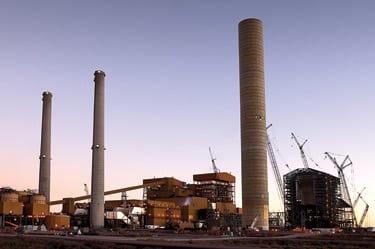
2. Share the wealth. The power generated by Unit 3 is shared, with 200 MW going to Tri-State Generation and Transmission Association, 100 MW to Tucson Electric Power, and 100 MW to Salt River Project. Courtesy: Bechtel Power
Core of cleanliness
To allay local concerns about the new coal-fired unit’s airborne emissions, Tri-State, TEP, and Bechtel made sure to use best available pollution control technologies. For example, Unit 3’s steam generator—from Foster Wheeler Corp.—is specifically designed to burn low-sulfur western coal, Springerville’s fuel of choice. The boiler’s wall-fired design includes a parallel-pass heat-recovery area to maximize efficiency (Figure 3).
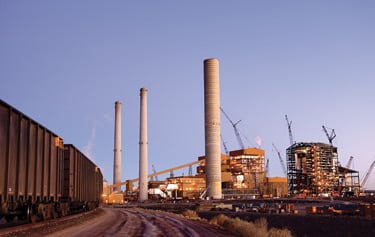
4. Chain of fuels. Peabody Energy delivers PRB coal to Springerville Generating Station via two Burlington Northern Santa Fe railroad lines. Courtesy: Bechtel Power
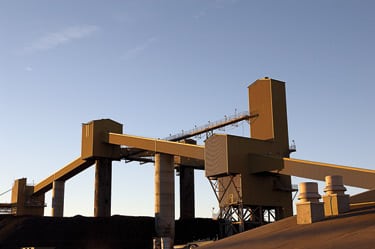
5. Taking a Powder. Springerville’s coal-handling facility. Courtesy: Bechtel Power
A seven-stage feedwater heater (from the Ecolaire Division of Yuba Heat Transfer) warms the working fluid of the boiler, which can deliver 2,889,000 lb/hr of steam. The steam enters a Mitsubishi Heavy Industries turbine-generator at 2,400 psig and 1,000F (MHI). At the reheat steam inlet of the turbine, the flow rate is 2,548,000 lb/hr.
Emissions control at Springerville begins with Foster Wheeler’s Vortex series of split-flame, low-NOx burners in the boiler. Downstream, a selective catalytic reduction system (from Hitachi) further reduces NOx emissions. Also processing flue gas are two 50%-capacity spray dryer-absorbers (from Alstom Power) that minimize SO2 emissions and one full-capacity pulse-jet baghouse (also from Alstom) that captures particulates. Ash by-products are collected by equipment from Allen-Sherman-Hoff and stored on-site in existing landfill facilities. Table 1 lists those and other suppliers of Unit 3’s major systems.
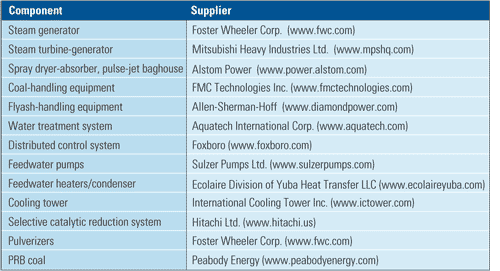
Table 1. Major equipment suppliers to Springerville Unit 3. Source: Bechtel Power
Common plant facilities include a field of 1,000-foot-deep wells about 6 miles from the site that supply all water for all Springerville generation and two on-site ponds for storage and pretreatment of makeup. Springerville 3 is designed to discharge no wastewater. Because the new unit is an expansion of an existing facility, there was no need to build any major transmission infrastructure to send Springerville 3’s output on to its three destinations.
Need for speed
Although Bechtel provided only engineering and procurement services to TEP for Springerville Units 1 and 2, it added construction to the slate for Unit 3. Bechtel built Unit 3 under a lump-sum, turnkey contract for all three EPC services, plus start-up and performance testing.
Change orders are inevitable on any project of this size. In the case of Springerville 3 they were limited to 1% of the contract and the largest was originated by the customer, to incentivize Bechtel to complete the project within 33 months of its notice to proceed. Significantly, that was five months earlier than the date stipulated in the EPC contract—December 21, 2006. To meet the earlier deadline, Bechtel tightened its schedules and work procedures, optimized the balance of skilled/unskilled construction labor needed, and pushed equipment vendors to deliver on time.
The fast-tracking worked: Bechtel declared and owners accepted "substantial completion" of Springerville 3 on July 19, 2006—two days shy of 33 months following the October 21, 2003, notice to proceed (Table 2). Notably, Bechtel didn’t sacrifice safety for speed to meet the early deadline; construction crews logged more than 4.1 million hours on the project without a single lost-time accident.
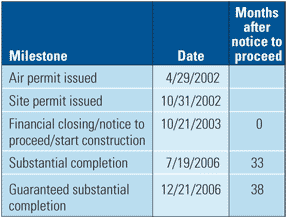
Table 2. How to expedite a project schedule. Source: Bechtel Power
Five hard pieces
It would be easy to assume from Bechtel’s ahead-of-time performance that the entire project went off without a hitch. In fact, the company faced and met five major challenges (three involving equipment procurement, one related to shop fabrication, and one involving construction) over the 33-month period. Each crisis threatened to bring the project to a standstill, but all were overcome by good management, planning, and execution.
The first challenge presented itself in the spring of 2004 as Bechtel was placing foundations for major equipment and beginning to erect structural steel. Out of the blue, the steel supplier for Springerville 3 announced that it had begun bankruptcy proceedings, after just having delivered its first shipment for the boiler building (Figure 6).
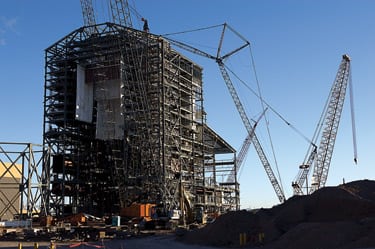
6. Steeling time. Springerville Unit 3’s original steel supplier went bankrupt after making just one delivery. Bechtel assumed control of steel subcontractors and found new sources to maintain the project schedule. Courtesy: Bechtel Power
Within one month, the project management team:
- Mobilized the vast resources of Bechtel’s global procurement group.
- Took over the steel supplier’s subsupplier work.
- Found new sources of steel for part of the boiler/silo bay structure.
- Located a new supplier/fabricator (Structural Steel Services Inc.) for both the air preheater and steam turbine structures, which earned Structural Steel Services a place on Bechtel’s list of approved vendors for having delivered product to the job site on a very compressed schedule.
- Reached agreement with the bankruptcy court and the original supplier on terms of terminating the original purchase order.
- Shuffled the construction schedule to reflect what had been turned into only minor delays in procurement.
A few months later, the second challenge arose when testing of Springerville 3’s three 50%-sized, 7,600-hp boiler feed pumps revealed a vibration problem for those three pumps. Bechtel immediately engaged with Sulzer Pumps, which responded with an accelerated schedule for reengineering and manufacturing replacements, which arrived on-site within a couple of months. Bechtel again had to tweak the project schedule and construction sequence to accommodate the delay.
The third challenge involved the delivery of Unit 3’s steam turbine-generator from Japan. Bechtel, anticipating heavy freight traffic during the December 2004 holiday season, convinced MHI to have the unit arrive on-site early that month, rather than later. The turbine reached the Port of Long Beach without incident and on time, but then bad luck set in. A month of record rainfall, problems with permits that were thought to be in order, and a shortage of escorts severely reduced the number of travel days the convoy carrying the stator spent heading for the Arizona border. Once in Arizona, the stator again was pulled over, this time for a few days by Bureau of Indian Affairs engineers worried that a bridge would collapse under its great weight. After Bechtel structural engineers furnished data that convinced them otherwise, the stator finally made it across Arizona, up to the plant site at an elevation of 7,100 feet—after one month on the road.
The fourth obstacle should have had a significant impact on the project schedule. A visual inspection of Unit 3’s steam generator revealed nothing out of the ordinary. However, a routine hydro test of Unit 3’s steam generator identified a few weepers, which were quickly repaired. Erring on the side of caution, Bechtel’s QA staff sent the cracked T-91 tube samples to the company’s metallurgy lab for further analysis. The project staff was surprised when the results came in. Problems with shop post-weld heat treatment caused cracks in the shop-fabricated fillet welds along the roofline of the boiler’s superheater and reheater sections. QA examination of the welding records identified the culprit: The post-weld heat treat was not held for the specified period required by Foster Wheeler.
The area to be repaired was almost inaccessible. The problem areas caused repair work to occur just above and below the roofline. Making the situation difficult, the welders had to work outside during winter at 7,100 feet in close quarters because the boiler house and furnace could not yet be enclosed. Deciding how to rig each tube bundle as it was cut loose tested the design team’s minds as well. Although some of the best welders were needed for this work, a trickle-down effect on other work at the site—delaying the project’s overall duration beyond 33 months—was never considered.
The fifth and final challenge was one that isn’t unique to coal-fired projects such as Springerville 3. It is, however, likely to become more problematic for the electric power industry if construction work in general continues at its current pace nationwide.
Springerville’s remoteness (five hours from Phoenix and four hours from Albuquerque) made attracting and retaining a skilled workforce quite difficult (Figure 7). In response, Bechtel thought and acted creatively to execute the company’s first direct-hire merit shop labor agreement. To build Springerville 3, direct-hire union craft workers worked alongside open-shop subcontractor and non-union craft workers with no work stoppages or slowdowns.
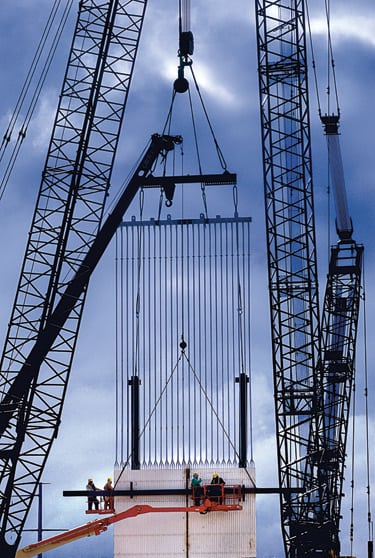
7. Good help is hard to find. Bechtel signed a unique direct-hire merit shop agreement allowing union craft workers to work side by side with non-union workers. Shown are boilermakers removing rigging beams on a boiler tube panel. Courtesy: Bechtel Power
With the cooperation and support of the project’s signatory unions, Bechtel also modified the project’s labor contract within its first five active months to incorporate two programs called "Helping Hands" and "Helmets to Hardhats." The former program improved productivity by allowing craft workers from one union to help craft workers from another. The latter facilitated the assimilation of military veterans coming off active duty into building trades unions. Eight Helmets-to-Hardhats apprentices and journeymen were hired during the Springerville 3 project.
Never satisfied
The risk of delaying a project schedule for unforeseen reasons is foreseeable by a good project manager. At Springerville, Bechtel introduced a number of innovations that improved the design of the project and shortened its construction schedule. For example, Bechtel relied more on shop fabrication and on-site preassembly, thus enabling a few large components to be erected more quickly (Figures 8 and 9).
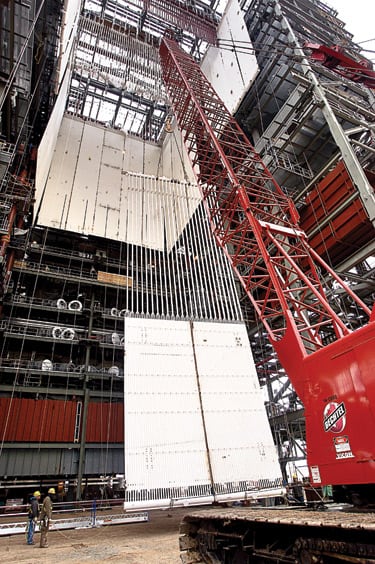
9. Erector set. The steam generator’s front wall being walked into the boiler cavity. Courtesy: Bechtel Power
Another aspect of project design—this one patent-pending—was developed for the Meizhou Wan project, advanced at Millmerran, and refined further by the Springerville team. Its salient feature is the use of trusses to create a combined structure for supporting the boiler and roof. The approach significantly reduces the number of traditionally framed members and transfers the load of the suspended boiler to the steel columns more efficiently. Another innovative part of the design enables large platforms, panels, and stairway tower components to arrive at the site complete with grating and metal decking. After rebar is installed and concrete added, the platforms are lifted into place and connected, providing safer and faster access to upper levels of the structure.
"By using shop modularization and increasing ground fabrication, we’ve greatly reduced the number of crane picks," said Greg Wagner, Bechtel’s site manager at Springerville. "This allows us to shave our schedule and reduce costs. More importantly, we improve safety by reducing the amount of work done at height and getting earlier access to finished platforms for all subsequent work."
Get with the program
I suspect that Bechtel’s solid-fuel project team’s dance card will be filling up quickly. You might want to get in the queue early so you can cross "build a coal plant" off your to-do list. There is no substitute for success in this business.