Known for its beautiful glaciers, fjords, and mountains, Norway is a country of contradictions, especially when it comes to its citizens’ attitude toward energy.
On one hand, many Norwegians support strong environmental policies to protect their nation’s abundant natural resources. On the other hand, these same people have the highest per capita energy consumption in the world, which is due to their heavy reliance on electricity for home heating systems in the cold Nordic climate.
Furthermore, demand for electricity is increasing by approximately 2% per year. The country’s current population is estimated to be 4,644,400. Meeting the country’s growing appetite for energy will require Norwegian power companies to use innovative approaches to generate more electricity in an environmentally sustainable manner. The combined-cycle Kårstø plant, north of Stavanger, is a step in that direction.
Norway’s power industry
Nearly all of Norway’s power comes from renewable sources: Over 99% is generated by hydroelectric facilities. Opportunities for developing additional hydropower infrastructure, however, have been almost fully exploited, and during dry periods, Norway imports power mainly from coal-fired and nuclear power plants.
Norway also has substantial fossil fuel resources and is the world’s second-largest oil exporter. Oil and natural gas production has been increasing steadily. And Norway still owns approximately half of the remaining reserves of oil and gas in Europe. In the future, gas will play an even more dominant role in Norway, especially in light of the nation’s continually rising demand for electricity.
By 2050, electricity production in Norway is expected to be supplemented by a growing number of gas-fired power plants. Current domestic consumption of natural gas will increase correspondingly, but only if CO2 emissions reduction measures are implemented simultaneously. Norway was one of the first countries to exhibit very high public sensitivity toward global warming and is endeavoring to adapt policies to meet its emissions targets. Greenhouse gas emissions reduction remains an ongoing goal in the national environmental policy and, if the technology is available, it will be installed accordingly.
Project timeline
The Kårstø gas-fired combined-cycle plant, the first constructed in Norway, is located in Rogaland, western Norway. Its owner is Naturkraft, a Norwegian power company. Naturkraft is owned jointly and equally by StatoilHydro and Statkraft. The partners supply Naturkraft with fuel gas (Kårstø is also the name of the larger industrial site where natural gas is processed) and then receive the electrical power produced (Figure 1).
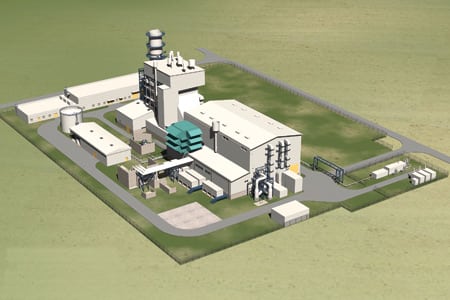
1. Blueprint for success. This architect’s rendering shows the entire Kårstø power plan site. Siemens Energy constructed the plant under the terms of an engineering, procurement, and construction contract. It also provided the SGT5-4000F gas turbine, the steam turbine, and the generator. Courtesy: Siemens
Due to the national debate on the environment, especially in the context of global warming, it took 10 years to obtain all permits for the Kårstø gas-fired plant. In 1996, Naturkraft was issued permits by the Norwegian Water Resources and Energy Directorate to build the $385 million plant (Figure 2). In 1997 these permits were confirmed by the Norwegian Ministry of Petroleum and Energy. In 1999 the permit for emissions was granted by the Norwegian Pollution Control Authority and was confirmed by the Norwegian Ministry of the Environment in 2001.
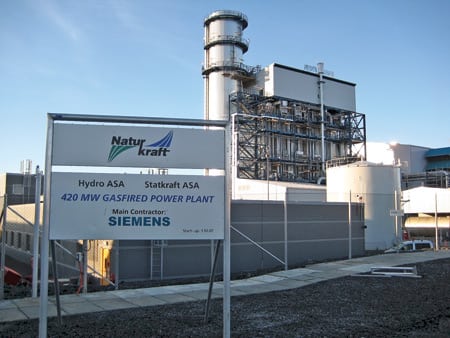
2. Green operations. All emissions-related technologies installed at the Kårstø power plant are rated as the most advanced emissions control technology available. As a result, the plant has achieved NOx values lower than 2 ppm. The plant also meets high environmental requirements for water treatment. Courtesy: Siemens
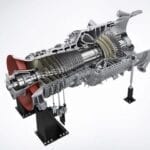
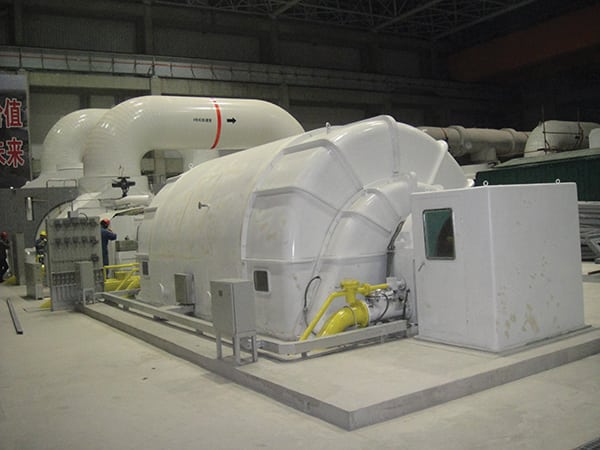
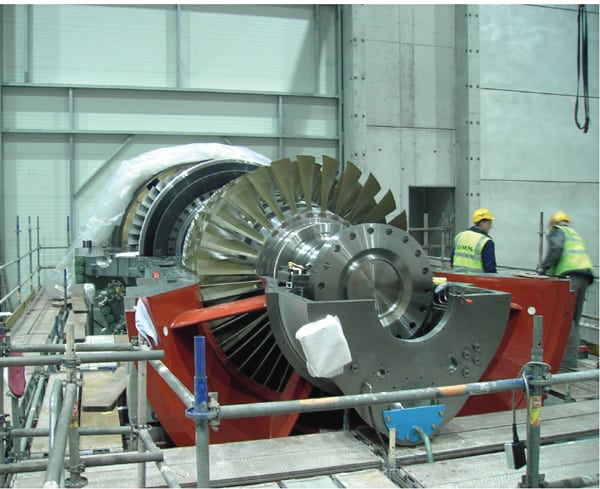
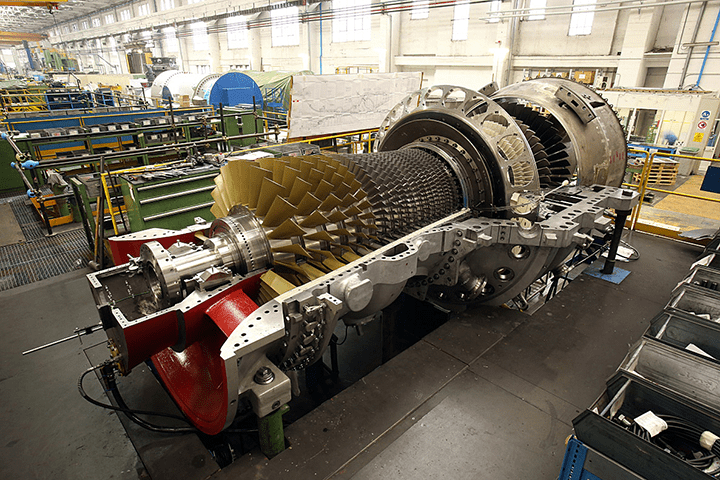
In 2005, Naturkraft signed the engineering, procurement, and construction (EPC) agreement with Siemens Energy, which agreed to provide its SGT5-4000F gas turbine, the steam turbine, and the generator. In early 2006, Siemens started construction. In late 2006, lift-in of the main components was performed and, within a short time, Kårstø’s first firing was achieved in the summer of 2007. The plant began commercial operation on October 14, 2007 (Figure 3).
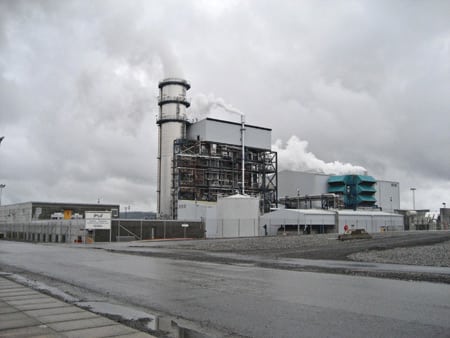
3. Nordic know-how. The Kårstø plant has been in commercial operation since October 14, 2007. It has a capacity of 420 MW and an efficiency of 58.5%. Courtesy: Siemens
Anatomy of the new plant
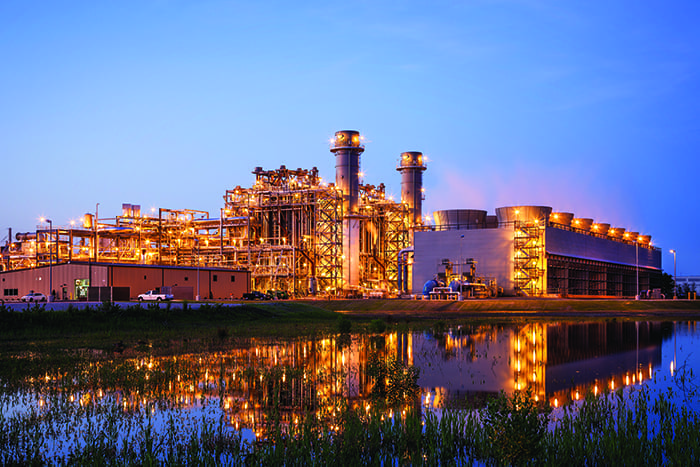
Siemens installed the most advanced emissions reduction technologies available for their ability to control standard air pollutants, especially NOx. Siemens also equipped the gas turbines with dry low-NOx-systems, which ensure compliance with European environmental regulations. In addition, Naturkraft decided to include a selective catalytic reduction system as secondary measure. As a result, the plant has achieved NOx values lower than 2 ppm (Figure 4). In Norway, emissions standards are very stringent and, as a result, minimizing measuring errors assumes high significance. Consequently, the devices installed at Kårstø for measurement purposes are truly high-tech: For NOx, the plant uses a chemiluminescent device, and ammonia is measured with a LDS6 laser device.
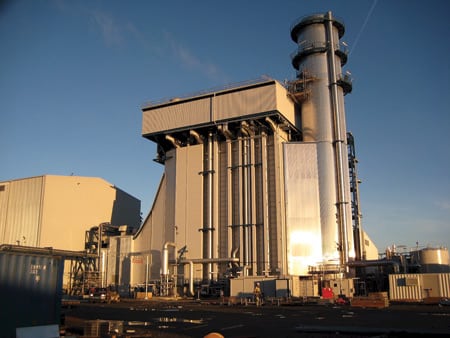
4. Nixing NOx. The Kårstø combined-cycle power plant is one of the most efficient and environmentally friendly gas-fired power plants in the world. It has achieved one of the lowest NOx emissions levels for a fossil-fueled power plant in Europe. Courtesy: Siemens
The plant also meets high environmental requirements for water. For example, in Norway cooling water may not be chlorinated. Freshwater is withdrawn from deeper-than-usual sea levels (260 feet below sea level) to comply with the requirements of the processing technology, which include avoiding algae formation. The cool water also helps to raise the plant’s efficiency a bit higher than would be possible in warm climates.
In addition, the project has an environmental management system that is aligned with the international standard ISO 14001. A corresponding work plan was created to meet the guideline’s strict separation of waste on the building site.
Key plant data and technical parameters include the following:
- Single-shaft combined-cycle power plant: SCC5-4000F 1S
- Gas turbine: SGT5-4000F
- Efficiency: >58.5%
- Installed capacity: 420 MW
- Annual production capacity: almost 3.5 TWh
- Gas: supplied directly from Europipe II, a natural gas pipeline that runs from the Kårstø gas processing plant to Dornum, Germany, near the North Sea coast.
- Fuel consumption: 21.2 billion cubic feet per year
- Annual energy production: 3.3 TWh
- CO2 emissions: Installation of the latest combined-cycle power technology reduces CO2 emissions. At full output, CO2 emissions will total approximately 1.2 million tons per year, and they will be eligible for trading under Europe’s new emissions trading scheme.
Plans for future carbon capture
To achieve global carbon reduction targets of 50% by 2050, the European Union (EU) requires greenhouse gas emissions to be reduced by 30% by 2020. Reduction targets increase between 2020 and 2050. EU legislation currently under consideration calls for capture-ready design of coal-fired power plants in 2015 and mandatory capture in 2020.
Norway is not currently a member of the EU. However, the Scandinavian country still has a strong relationship with the EU and its member states that enables it to maintain a high level of economic integration and political cooperation with EU nations. Norway is a signatory to the European Economic Area European Free Trade Association (EEA EFTA), which enlarges the EU market to include all nations that have entered into the agreement.
The EU’s “Proposal for a Directive of the European Parliament and of the Council on the Geological Storage of CO2,†made in January 2008, calls for capture-ready designs for all power plants larger than 300 MW. This could have a significant impact on how future European power plants will be planned.
To prepare for possible carbon legislation, Siemens is developing capture-ready concepts that strike a balance between low additional upfront investment and minor changes for later conversion to carbon capture.
In Norway, steam power plants that are constructed in the near future will be required to have the ability to incorporate a carbon capture plant at a later date. Siemens is reviewing the plant layout of its reference steam power plant SSP5-6000 in order to incorporate measures that would make it capture-ready.
“Capture-ready†is defined as having the following requirements:
- Enable or facilitate later integration of a carbon capture plant.
- Avoid lock-ins that exclude or hinder use of future capture developments.
- Delete aspects that make retrofit of a capture plant impossible.
This definition results mainly in space and access requirements for additional equipment and auxiliaries, necessary energy supplies, and provisions for cooling requirements.
Power plant areas that are affected to varying degrees by capture-ready measures are:
- Overall plant layout with rearrangement of components and sufficient space.
- Steam turbine building with space for modifications, pipe routing, and heat exchangers.
Steam turbines must be able to be rebuilt to accommodate a number of future carbon capture plant necessities:
- Flue gas systems that are ready for tie-in of the capture plant.
- Cooling systems with sufficient space for additional capacity.
- Electric auxiliary power supplies and cable routing prepared for expansion.
- Preparation for enlargement of raw water and wastewater handling.
To further reduce the emissions from Kårstø, the Norwegian government intends to build a CO2-capture plant in connection with Naturkraft. Until a formal investment decision for building such a plant is made by the Parliament, an ongoing governmental initiative is being conducted to study different possible solutions. At the time this article was written in July, the projection was that Parliament would make the decision some time in September 2009. For the moment, the four qualified vendors are starting their front-end engineering and design studies. In parallel, Naturkraft is studying possible tie-in solutions.
The future addition of a CO2-capture plant will further prove Kårstø’s leadership in using innovative technology to protect the environment.