Wireless technology is a mostly untapped resource in the power generation industry that can have a significant impact on the way business is done. It enables a greater degree of connectivity among devices for enhanced monitoring and asset utilization and has led to the development of new applications that improve productivity, uptime, and overall business performance.
Industrial automation is one segment of the global economy that, to date, has failed to take advantage of wireless technology. Major industries such as oil and gas, chemical, power, and water and wastewater treatment continue to operate their plants mostly with older, hard-wired control systems. A typical process facility will have well over 1,000 measurement points, none of which currently uses wireless technology, and many additional points that go unmeasured because of the cost of running wires to each one. This overview focuses on the need for standards-compliant, wireless, sensor-based technology in these industries for enhanced plant asset management and the benefits that will result.
Most, if not all, industrial plants use networks to link devices and instruments to their control and management systems. Although these systems are complex, the majority work with simple analog information, such as temperature, pressure, level, and flow readings. Though they are effective, these control and management systems could add significant value if they were able to access data that would allow them to do much more than receive process measurements from a device or send commands such as "on/off" and "open/close," or respond to setpoints that essentially tell the plant how to operate.
Many of the devices and instruments in a plant actually collect and maintain intelligent digital data about their own performance, individual processes, or the overall operation of a plant. That data can be extremely valuable. For example, it can help managers predict when a problem might occur that would force a plant shutdown. Unfortunately, most of this data is trapped in devices. There is no easy way for plant operators to access the treasure trove of data and put it to good use.
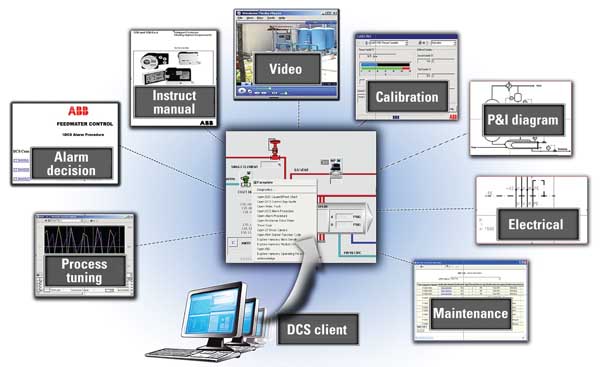
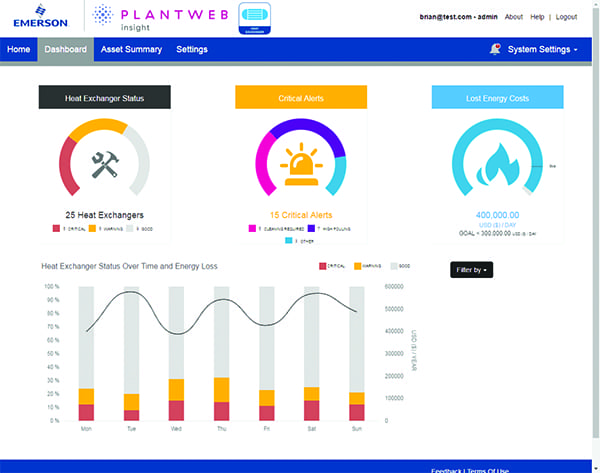
One plant application area that could benefit from using wireless technology to take advantage of previously trapped highway addressable remote transducer (HART) data is plant asset management (PAM). The use of PAM systems is considered a best practice for asset performance management. PAM applications facilitate improved performance and increase the availability and reliability of plant assets by maintaining contact with all aspects of the plant, ranging from process, mechanical, and electrical equipment to field devices, analyzers, and networks. The PAM system’s role is to monitor asset health, predict potential problems and failures, and make the most of maintenance and operations decisions. PAM is about optimizing the performance, availability, and reliability of specific plant assets, which for the purpose of this article would be machinery, production, and automation.
PAM as a practice involves:
-
Monitoring asset health. In many cases, this ideally involves real-time sensing to detect potential problem conditions, but frequently sensing actually occurs weekly, monthly, quarterly, or even yearly.
-
Assessing asset health data to predict potential problems.
-
Deciding on the optimal course of action for handling specific problems.
-
Acting to prevent and resolve problems, such as issuing a work order to fix an instrument.
PAM application functionality usually includes:
-
Plant start-up and commissioning management.
-
Calibration and compliance management.
-
Monitoring of smart field devices.
-
Analysis of field data, such as for vibration patterns or valve signatures.
-
Integration with enterprise asset management and computerized maintenance management systems.
The popularity of PAM systems is driven by several factors, including a rapidly growing number of plant assets, smaller field staffs, and an increasing rate of retirement for the aging baby boomer workforce. There are now more loops for a technician to maintain and less expertise per technician. PAM systems are a major supplement to the workforce and enable assets to be managed effectively. Given these drivers, process manufacturing companies are realizing that maintaining competitive returns on plant assets takes more than just manual workforce efforts.
PAM systems go well beyond improving maintenance, according to the ARC Advisory Group, which is a consulting firm that specializes in helping utilities deal with power operations management and technology strategies. ARC estimates that by employing PAM systems, the number of unplanned plant breakdowns could be reduced by nearly 45%, while production downtime could be cut by slightly more than 20%. In addition, plant managers could reduce their spare parts inventory costs by 25% and product defects by about 10%. On top of this, ARC estimates asset performance could be improved by almost 40%, while workforce efficiency would increase about 20% and plant availability would improve by about 15%.
Another use of wireless access to a HART instrument is remote field device management. For instance, plant maintenance staff can cut time and effort by remotely adjusting configuration parameters, such as damping of upper and lower range settings, through their wireless PAM system. There is no need to physically locate instruments or do handwritten reports.
Using Wireless Technology to Retrofit Instrumentation
The power generation industry is one that has continued to operate plants mostly with older, hard-wired control systems. Owners have opted to upgrade plants rather than build new ones. In an environment where new construction isn’t an economical option, they have been retrofitting aging equipment. One new industrial technology that they should be considering for retrofit projects — wireless sensor networking — is emerging as a tool at the field device level to economically upgrade a plant for improved operational productivity.
Every plant has a list of measurement points to be added to the control scheme when budget and time allow. Using wireless technology to retrofit existing hard-wired instruments with smart wireless instruments, while adding wish list measurement points as wireless sensors, allows plants to minimize downtime and production interruptions without the expense of implementing an entirely new wireless implementation. However, unless new instrument measurement points are being added, the wiring for the old instruments is typically already in place, which may make it difficult to justify the premium for an entirely new wireless field device and networking infrastructure. The specific configuration and data monitoring needs of your plant will determine the actual cost of moving from a wired to a wireless infrastructure.
For years, plants have been replacing older 4-20 mA field instrumentation with intelligent HART instrumentation. Intelligent devices, such as HART instruments, collect and maintain valuable digital data about their own performance, commissioning, condition, calibration, and production processes. Ready access to this data can help managers predict when a problem might occur that would force a plant shutdown. However, with older control systems, because of the expense of adding HART modems to the systems, the diagnostic and digital capabilities of HART instruments were never enabled for continuous access (Figure 1). Such HART instruments were essentially used as 4-20 mA analog field instruments.

1. HART trouble. In the past, all too often power plants failed to take advantage of the capability of heuristic and analytical reporting tool (HART) technology to provide continuous access to important digital data. Courtesy: ISA
To address this problem, the wireless industry (see sidebar) has been developing standards. Emerging wireless standards — such as the recently released WirelessHART and the soon-to-be-released International Society of Automation (ISA) 100.11a standards — support the design of wireless adapters that can be retrofitted onto existing 4-20 mA loops. That enables the extracting of digital performance data and wireless transmission of this information to plant applications, such as a PAM system or process data historian. Such information, in turn, drives operational improvements.
An adapter can connect anywhere on a 4-20 mA loop to immediately retrofit existing HART devices for wireless transmission of intelligent data to critical plant and enterprise applications. By retrofitting wireless infrastructure onto existing HART devices, that data can bypass legacy control systems (Figure 2).
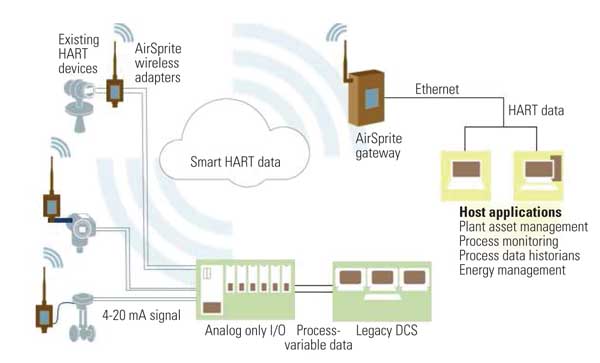
2. Bypass surgery. Wireless adapters can be connected in such a way that they bypass legacy control systems and enable previously installed heuristic and analytical reporting tool (HART) instrumentation to handle wireless transmission of data. Courtesy: ISA
Beyond PAM, wireless retrofits of intelligent instruments can be valuable to control room operations. For example, digital process values can provide operators with an alternative to their analog 4-20 mA signals, especially when the analog signal has problems. These wireless retrofits can also provide completely new measurement points; if field power is available, any 4-20 mA wired instrument in combination with a wireless adapter can readily add a new measurement that is valuable for making advanced control decisions.
It is estimated that as many as 85% of the 25 million HART devices in use today cannot directly connect their digital data to systems that manage, monitor, and control industrial plants. One goal of these new standards is to enable the development of products that can unleash the power of this trapped, intelligent data, allowing easier access to information about plant assets by directly connecting many more sensors.
How Wireless Standards Are Changing the Landscape
The rapid adoption of wireless technology is being driven by the emergence of new wireless standards such as ISA100 and WirelessHART. These two standards currently under development are aimed at industrial wireless sensing solutions.
The HART Communication Foundation (HCF) is working on the WirelessHART standard, which is aimed at leveraging the information collected by the nearly 25 million installed HART devices. HART is a very popular industrial protocol, and WirelessHART will be geared specifically to the process industry, with a goal of enabling reliable, robust, and secure wireless communication in real-world industrial plant applications.
The second standard is ISA100, which will support multiple protocols, including HART, as well as process and factory automation applications.
The two groups are cooperating, to ensure continuity and uniformity with wireless standardization.
Today’s typical wireless deployment in an industrial setting usually requires the purchase of proprietary wireless instrumentation and systems from a single vendor. The headaches accompanying this strategy include dependence on that vendor, added complexity for plant staff, and escalated project and maintenance costs. A goal of both standards is to alleviate these headaches by allowing vendors to build infrastructure products that work with products from other vendors and with what is already installed in the plant. When wireless retrofit products are based on open standards, they will work with installed systems and devices and enable a lower-cost, lower-risk way to encourage more widespread use of wireless sensing.
A major benefit of the WirelessHART standard is that it will allow vendors to develop adapters that will be able to connect directly to installed HART devices — without changing anything on the device. These adapters will extract the intelligent HART data and then wirelessly transmit it directly to plant and enterprise applications, such as plant asset management, energy management, or monitoring and control systems. There the data are used to do a better job of predictive maintenance, as well as to avoid major problems such as unplanned plant shutdowns.
It is estimated that each HART device contains 35 to 40 data items that can be used to improve the performance of an industrial plant. The number varies by instrument, but the data identifies a device, its properties, its calibration settings, measured process variables, and a good number of diagnostic alerts related to the device. Retrofitting makes all of these variables continuously available to plant applications, enabling dramatic improvements in the management of plant assets and plant operations.
Demand for wireless technology is growing in this typically conservative industry due to needs for plant efficiency and competitiveness. Given the WirelessHART and ISA100 standards coming closer to fruition, end-user concerns over security, reliability, and interoperability will abate, and adoption rates are expected to increase. In a recent analyst briefing, Venture Development Corp. took the position that wireless growth is being driven by monitoring and measuring applications, as well as the prospect of seamless integration with existing devices and networks (Figure 3).
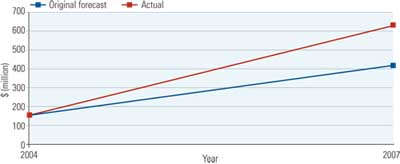
3. Growth spurt. Investment in wireless automation in the process industries continues to exceed projections. Source: Venture Development Corp.
Wireless Is the Wave of the Future
It is widely understood in the industrial world that relying on degrading, failing, or poorly configured systems leads to higher operating and maintenance costs. Well-designed wireless retrofits that comply with the emerging wireless standards will bring new levels of productivity, uptime, and overall superior performance to the generation industry. Wireless applications that transcend any specific industry segment are already being deployed.
For example, operator mobility is enhanced with handhelds and tablet personal computers that are wirelessly connected to plant control systems, allowing operators and maintenance personnel to roam their control room; wireless video adds process and plant security; and a host of new real-time location services for plant assets and people are just around the corner.
To take advantage of these emerging applications requires a secure and robust industrial wireless infrastructure. The latest technologies and emerging standards are enabling implementations in a highly secure and robust fashion across the enterprise. It’s critical that wireless communications — like any wired networking — be properly engineered, constructed, and maintained in order to perform reliably.
Maintaining a Wireless System
Once a secure and robust wireless infrastructure is constructed, it must be maintained and managed to keep it functioning correctly. Wireless networks, although offering huge savings versus their wired counterparts, by their very nature require more management. Maintaining security keys, responding to incidental or malicious interference, and managing rapidly changing technology and standards are just a few of the functions that require an expertise not necessarily available within the local IT organization of the typical power plant.
Many organizations are finding that it’s more cost effective and more secure to contract out the real-time management and optimization of their wireless infrastructure. Unfortunately, many organizations simply allow their wireless networks, which contain multiple technologies, protocols, and frequencies, to grow in an ad hoc fashion. That is a sure way to have an unsuccessful wireless experience.
The key to a fully functional wireless platform that can enable solutions, such as retrofitting existing instrumentation for PAM, is to engineer and manage those networks from the top down.
—Paul Sereiko (psereiko@gmail.com) is president of AirSprite Industrial Wireless LLC. He is also cochair of the ISA SP100 Marketing Working Group and member of the HART Communication Foundation.