Owner/Operator: Alliant Energy
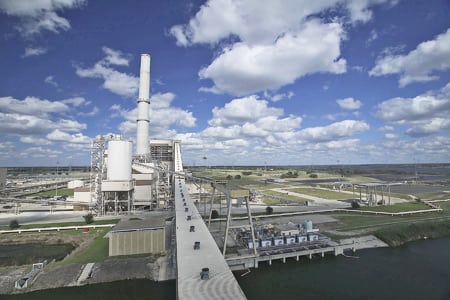
Top Plant: Alliant Energy’s Dubuque Generating Station is a fine example of why small doesn’t mean insignificant in the power generation industry. This winner of the EUCG Best Performer award in the small plant category shows that its operating excellence towers over that of many larger and much newer coal-fired power plants.
POWER has been privileged to report on the excellent benchmarking studies conducted by the EUCG’s Fossil Productivity Committee over the past several years. Another important function of the committee is to recognize its members’ top-rated plants with suitable awards at the group’s biannual meetings. The fall meeting recognizes members’ best-performing large (>250 MW) and small (<250 MW) coal-fired plants during the previous year. We reported on Alliant Energy’s Lansing and Edgewater Generating Stations’ sweep of the two awards, respectively, in the February 2008 issue of POWER. The spring meeting looks beyond a plant’s single good year to sustained operating excellence over a five-year period. Alliant Energy scored a hat trick when its Dubuque Generating Station (DGS) took those five-year honors in the small coal-fired plant division at the April 2008 meeting in San Antonio, repeating its win two years earlier. (The best performer in the large coal division is also profiled, see Cover Story, "J.K. Spruce Power Plant, Unit 1, San Antonio, Texas".)
Details of the EUCG’s performance- and cost data-driven selection process were thoroughly discussed in our earlier article, with one exception: Instead of using the equivalent unplanned outage factor, the five-year evaluation uses the equivalent forced outage rate (EFOR). For award purposes, the EFOR is defined as forced outage hours, plus equivalent forced derated hours divided by the sum of service hours, plus forced outage hours, plus equivalent forced derated hours during reserve shutdown.
Costs included in the analysis are operating and maintenance (O&M) costs (excluding large leases), measured in $/MWh. Finally, the methodology dampens variances in net generation, capacity factor, rating, or number of units so that all entrants are gauged against a common norm. Individual plants are then compared against this norm, and the best plant takes home a trophy. The 2008 award was granted based on data reported by more than 80 plants from 2002 to 2006.
This data-driven approach to an awards program is appropriate in a market where the best performers make money and the also-rans tend to their cold iron. However, excellence in plant operations can’t be explained by just a few summary stats or graphs. Rather, it derives from the good work of a well-led, dedicated staff that takes pride in their plant’s success.
Identifying how a plant achieved great numbers also requires understanding the plant design, because the equipment operated often defines the challenges faced by the operating staff. It’s also much more interesting than dry statistics alone.
Unique design
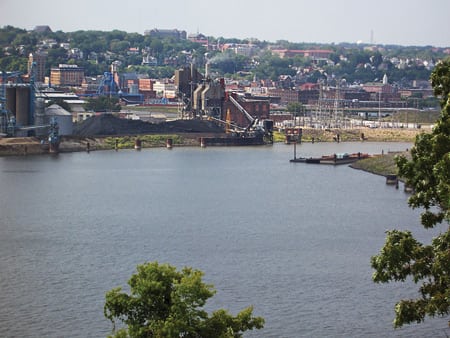
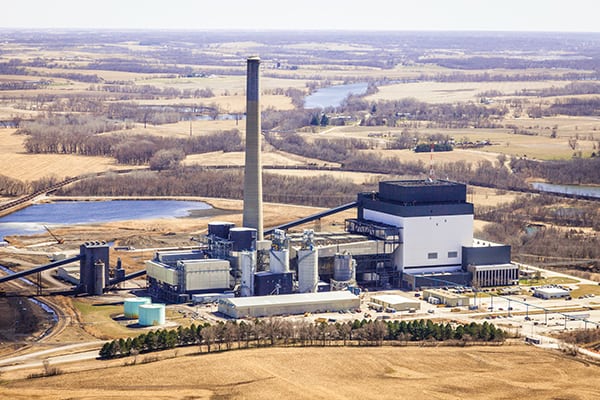
1. Best in class. Alliant Energy’s Dubuque Generating Station won the EUCG’s five-year Best Performer award in the small coal class (<250 MW) this past spring. Courtesy: Alliant Energy
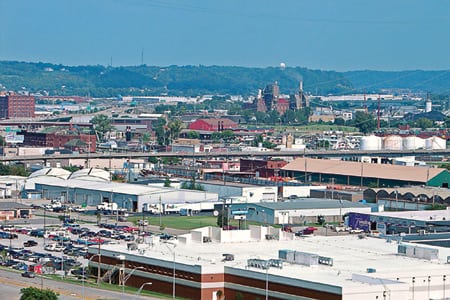
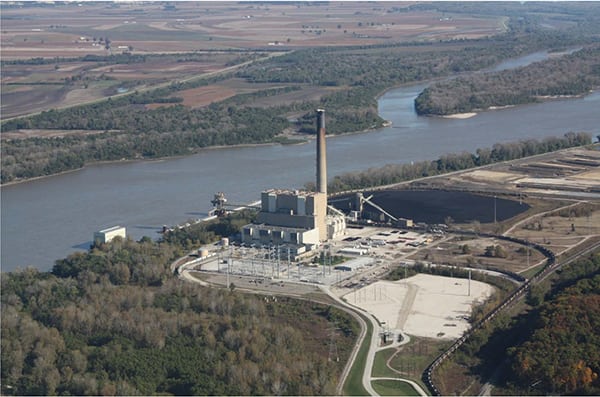
2. Urban sprawl. Dubuque Generating Station has been producing electricity at this site for over a century. Though originally sited in open, industrial environs, the plant now finds itself in the middle of a city. Courtesy: Alliant Energy
Alliant Energy’s 83-MW Dubuque Generating Station, the second-oldest in Alliant’s system, is located in downtown Dubuque, Iowa, along the Mississippi River (Figure 1). The plant site dates back to the turn of the 20th century, when newer units replaced older units as they were retired. In fact, DGS’s previous owners were generating power at this site when little other than lumber yards and saw mills operated on the banks of the river. Today, the power plant is engulfed by an urban landscape (Figure 2).
According to Plant Manager Craig Crawford, DGS’s three operating units include well-seasoned coal-fired boilers and even a steam turbine that dates back to 1929 that can still answer the bell in an emergency. The rest of the equipment was installed in the 1940s and 1950s—most before the operating staff was born.
An accurate description of the still-operating plant hardware is important when discussing this plant’s operation (Figure 3). Boiler 1 is a Riley-manufactured, 850-psi pulverized coal (PC) boiler installed in 1959. Unit 5 is also a PC unit supplied by Riley in 1951, but it operates at 600 psi. Boiler 6 is the oldest and smallest of the three operating boilers and also operates at 600 psi. Boiler 6 was supplied by Combustion Engineering in 1941. None of the boilers has an economizer or reheat section, but they all have electrostatic precipitators that were added in the 1970s.

3. For the common good. The steam produced by the three boilers can be combined into a common steam header and sent to any of the three steam turbines. The electrostatic precipitators installed in the 1970s are visible to the left of the brick building. Courtesy: Alliant Energy
DGS’s three steam turbines don’t match up with the boilers in this plant’s unconventional numbering scheme:
- Turbine 4, a 33-MW Westinghouse design that began service in 1959, is rated at 850 psi and usually is fed by Boiler 1.
- Turbine 3, a 25-MW GE unit rated at 600 psi, is usually fed by steam from Boiler 5.
- Turbine 2 is a manually operated 15-MW GE steam turbine designed to operate at 250-psi steam pressure. It was installed 79 years ago.
DGS is a unique “common header” plant, so conceptually, any boiler can supply steam to the header, and any turbine can use the header steam to make power—a not uncommon design practice 50 years ago and one still used by steam-powered ships of the U.S. Navy. The operating flexibility this arrangement gives the plant are obvious, but the operating challenges multiply with the possible equipment combinations. At DGS, Boiler 1 can supply steam to any or all of the three steam turbines by using a pressure-reducing valve to match turbine pressure needs. Boiler 5 can supply steam directly to Turbines 3 and 4 through pressure-reducing valves, and so on.
In essence, plant operators must mix and match turbines and boilers to find the economic sweet spot to meet the system’s power needs at any time. A typical day will find Turbines 3 and 4 running along with the most efficient combination of boilers. Crawford explained that Turbine 2 has a poor heat rate, requires an additional operator, and is only used in a system emergency.
More fuel options
All the plant’s boilers were originally designed for Illinois Basin coal, but the plant made a fuel switch to Powder River Basin (PRB) and Colorado Basin (West Elk) subbituminous coals about 10 years ago for the familiar economic and emissions-reduction reasons (Figure 4). PRB coal was first burned in 2000 and now makes up some 75% of the coal consumed.

4. Frozen assets. Barge coal deliveries are curtailed during months when the river is frozen. If the stockpile sinks too low, coal must be trucked to the plant. Courtesy: Alliant Energy
Coal-fired boilers have their peculiarities when it comes to selecting the right coal, and Dubuque is no exception. Boiler 6 now burns 100% high-Btu western coal (currently West Elk), Boiler 5 burns 100% PRB, and Boiler 1 burns a 50/50 blend of PRB and West Elk.
Crawford reported that DGS burns approximately 225,000 tons of coal per year, all of which is delivered by barge. When the river freezes or barges are in short supply, the plant must truck coal from a rail delivery point about 10 miles away. The winter 100-day coal stockpile is usually in place by December 1.
DGS boilers can also burn more-expensive natural gas, although the normal supply limits the plant to 80% of full-load power, as has frequently occurred during winter high-demand periods. Crawford noted that DGS has experienced several gas curtailments in past years when power generation must compete with other industrial customers along the river during the winter months.
Dedicated people power a winning plant
A description of the plant parts is interesting, but the shafts don’t turn without a well-trained operator pushing the right buttons at the right time, or without a maintenance tech who has the right feel for the rotating machinery. Crawford was quick to promote the quality of his staff when asked to list the key reasons for DGS’s performance successes of late. “Our experienced and seasoned workforce is the main reason our plant performs so well,” he said. “The employees are dedicated to reducing and preventing unplanned outages. Our people deserve all the credit.”
When pressed for details, Crawford stayed on point: It’s the people. DGS is typical of this industry, in which employees often have worked their entire 40-plus-year career at a single power plant. He also pointed out the value of these seasoned workers to high plant reliability and for training a new generation of workers.
DGS has a very lean workforce of 30 hourly and only five full-time salaried employees: 17 operators, four mechanical maintenance techs, four electrical/instrumentation and control (I&C)/ lab techs, four coal yard techs, and one person running the warehouse. Only two of the staff are in the training pipeline to eventually replace the two employees with more than 40 years of service when they retire. The average worker has 20 years of service and is 51 years of age.
DGS has more in common with a large family than a for-profit business. Everyone knows everyone else and their business, when someone is going to retire, or why someone is going to bid into a different workgroup. New employees typically begin with a position either in the operations work group as a relief assistant operator or in the coal yard workgroup, but there is room for good employees to follow their own interests. For example, an operator with more than 10 years of experience recently bid into and was accepted into the I&C workgroup as an apprentice because he had an interest in controls. It’s not often you find someone in their mid-40s entering an apprenticeship program, but their experience wins them instant credibility with the operating staff, and everyone benefits. About half of the recent new hires come with military (usually Navy) experience.
Crawford was also quick to note that the plant staff is willing to work together, regardless of their positions, to solve problems in the plant, and they always find a way to get the work done on time. Social scientists may say this work ethic is common in the baby boomer generation, but it’s also an inherited trait in the DGS family culture, regardless of age. Crawford says DGS people genuinely want to do the right thing and that job titles are unimportant when operators and coal yard employees all put on their maintenance hard hats during a planned or forced outage.
Long-term challenges
Most of the staff members have worked at the plant long enough to have experienced the lean times, which makes today’s power demand boom all the more pleasant. In the early 1990s, then-owner Interstate Power negotiated a number of lucrative power purchase agreements (PPAs), which meant the DGS units were off-line for long periods of time and were daily-cycled when they were needed. Capacity factors in the mid-20% were common in those dark days that extended into the mid-1990s. By 1998, the three-way merger of IES Industries, Interstate Power and Light Co., and Wisconsin Power and Light Co. to form Alliant Energy—and the expiration of those PPAs—put DGS back into the power market overnight. Ownership changed, but the pride employees had in their plant didn’t change.
Today, repair of boiler tube leaks—an artifact of those lean, plant cycling years—remains the biggest challenge for plant staff. Repairs are frequently made during weekend outages, but maintenance workers still have to remove asbestos insulation to access the boiler tubes, slowing what is otherwise a time-sensitive repair. Even with tube leaks, the plant is still challenged to run 24 x 7, with Turbines 3 and 4 on-line for much of the year.
A typical capacity factor today is a demanding 70%. Nonfuel O&M expenditures have averaged approximately $4 million a year. Even more important, the plant produces electricity at an average cost just under $30/MWh (fuel + O&M), and has for a decade.
DGS has also embraced a number of software tools to improve O&M tasks. For example, Alliant uses Maximo as its fleetwide maintenance management system, EtaPRO for real-time performance monitoring, and a computerized lock out/tag out system. Predictive maintenance tasks are the usual ones: thermography, lube oil analysis, vibration monitoring, and on-line and off-line motor testing.
What lies ahead?
Alliant is making significant capital investments in a plant that has shown its worth over the years. Today, Unit 1 (Boiler 1 plus Turbine 4) is undergoing a distributed control system (DCS) upgrade project with an Emerson Ovation system plus upgrades to the Boiler 1 burner management system. Until only two years ago, the plant operated with two control rooms—one for the boilers and one for the turbines, as was common in the day when plants were manually operated and operators specialized in boilers or turbines. Even with a common control room, many of the key control functions, such as damper drives and valve operations, remained manual. Dual-fuel operation on gas has also revealed the need for a more robust, reliable, and automatic burner management system. The cutover to the DCS is planned during a January planned outage. Similar control upgrades to Boiler 5 will follow in a couple of years.
DGS will continue to battle the slow squeeze of urban development. The power plant is located in downtown Dubuque, three blocks away from a multi-million-dollar harbor restoration project featuring a new convention center, hotel, museum, and the obligatory casino.
Another unanswered question is, What happens to DGS when the next bigger, newer, or more economical power plant is built, or when more stringent environmental regulations force expensive retrofits at a plant without room to grow?
These questions aren’t theoretical, given the recent announcement that two of the three coal-burning units at the Lansing Energy Station will be retired and DGS will switch to gas if Alliant Energy is allowed to build a new $1.5 billion coal-fired 630-MW Sutherland Unit 4 in Marshalltown, Iowa (conditional approval for which was granted Aug. 25). These proposed changes would take place when the new coal plant begins service, possibly as early as 2013. Given our current regulatory environment, any new coal-fired plant will face many known and unknown challenges before the first shovel of dirt is turned, and the new Sutherland unit is no exception.
But DGS does have a unique advantage: It is situated in a region with limited transmission capacity and few electricity resources. DGS may have to make a fuel switch in the coming years, but I expect this station will be a valuable resource to Alliant Energy for many years to come.