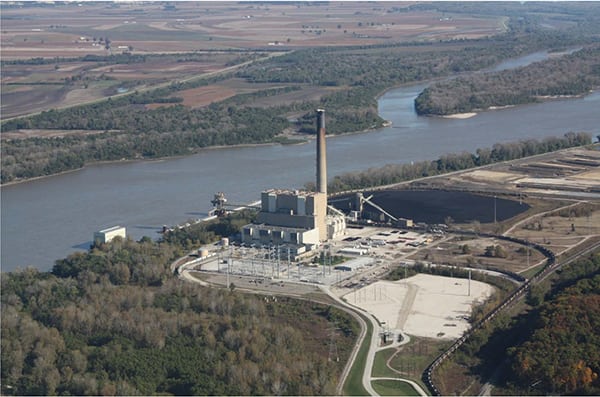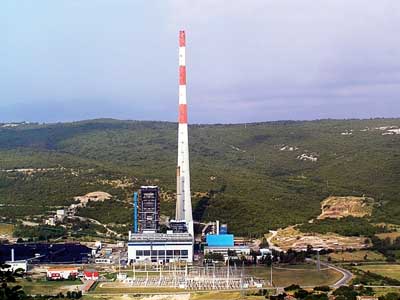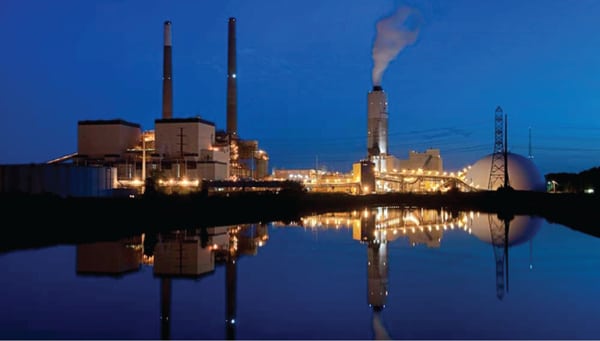
Although coal continues to fuel about 50% of U.S. electricity production, coal-fired generation has spent the past few years in the wilderness. Burning coal has become synonymous—at least in public discourse—with poisoning the air with SO2, NOx, and mercury and generating huge amounts of carbon dioxide, a greenhouse gas now considered a major contributor to global warming.
Recently, however, coal has regained popularity among utility resource planners. To comply with Clean Air Act and other mandates, billions of dollars are being spent to retrofit gigawatts worth of old coal-fired units with flue gas desulfurization systems—scrubbers. The first sizable new U.S. power plant fueled by pulverized coal in a decade has come on-line (see the cover story in POWER, September 2006). A few utilities are planning to build integrated gasification combined-cycle plants powered by coal (see this issue’s story on IGCC), and others are sure to follow.
All types of coal-fired plants benefit from being able to blend and burn different kinds of coal. The rationale for blending may be cost reduction, higher plant output (mixing in coal with a higher heating value), or reducing emissions of SO2. The best example of the last rationale is the ongoing wholesale switch to low-sulfur Powder River Basin (PRB) coal by power plants in eastern states.
Most plants cannot switch from burning only high-sulfur Eastern coal to burning PRB coal exclusively without derating units and incurring excessive modification costs. Why? PRB coal has a lower heating value than Eastern coals, and its higher friability results in the formation of more slag on boiler and furnace surfaces. As a result, many plants are choosing to blend Eastern coal with PRB or another low-sulfur coal at the maximum reasonable percentage.
For a new power plant, keeping the blending option open requires considerable attention during the design of its coal-handling facility. It may be economically beneficial to blend a small percentage of a second fuel with the design coal. The second fuel may be an out-of-specification coal either received in error or purchased at a substantial price advantage, a coal with a higher heating value, or even a non-coal fuel such as recycled tires or wood chips.
Coal-handling systems have three major subsystems that must be considered both individually and collectively for their compatibility with blending: the unloading system, the stockout system, and the reclaim system.
Unloading upgrades
Traditionally, more than half of the total coal tonnage received by U.S. power plants has arrived by rail. That percentage continues to rise. With the switch to PRB coal, plants along major rivers such as the Mississippi and Ohio that used to have their fuel barged in from local mines now get it delivered by railroad.
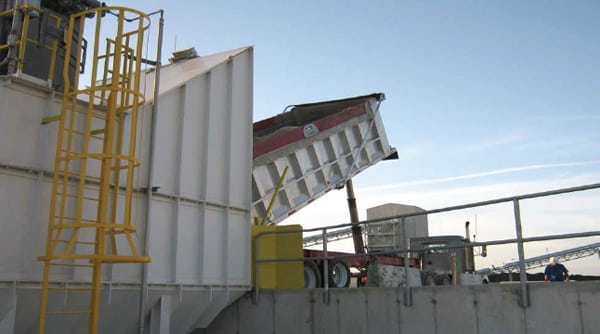
Many PRB coal-burning plants either have had to add new facilities for unloading coal from rail cars or upgrade their existing rail-unloading facilities to handle higher-capacity railcars and more railcars per train. An example of the unloading system modifications required is switching from a rotary car dumper or a conventional bottom dump hopper to a high-capacity, rapid-discharge bottom dump system.
Staying stocked
Some existing coal stockout systems can immediately accommodate stockout and storage of a second coal type, but others must be modified to do so. Generally, those in the former category can stock out two or more coals in segregated piles. Such systems normally form piles whose relative size matches the blending ratio. It’s usually good practice to set aside enough space for each pile to accommodate an entire shipment of its coal type.
Following are the most common configurations of blending-ready stockout systems and recommendations for modifying existing systems for handling multiple fuels:
- Two stacking tubes (lowering wells) or fixed stockout conveyors. This configuration produces two storage piles of equal height, ideal for a blending ratio of about 50/50. If your plant has only one stacking tube or fixed stockout conveyor, add a second one of the same type. The addition can be a separate system deployed at a transfer point or a modification of the discharge of the existing system, so it can feed the second system.
- One radial stacker can produce two piles of any size for any blending ratio.
- One traveling stacker can produce two or more storage piles of any size, suitable for any blending ratio.
- Two stacker/reclaimers, which normally produce two equal-size storage piles (based on travel length), are also suitable for a near-equal blending ratio. To widen the range of possible blending ratios, use your existing stacker/reclaimer to create two piles of different size and a secondary method for reclaiming from the smaller pile. Add a second stacker/reclaimer only if a near-equal blending ratio is the objective.
- Two coal yard silos or domes normally produce two equal-size storage capacities (based on height) for a near-equal blending ratio. Add a second silo or dome to increase the blending flexibility.
Reclaiming your pile
As with stockout systems, some coal reclaim systems can immediately accommodate blending, but others must be modified. Those in the former category can reclaim two or more coals at specified rates and at the same time. The arrangement of the stockout piles and the type of reclaim equipment used determine the percentage of the active pile that can be automatically reclaimed without resorting to the use of mobile equipment (a dozer). The blending proportions and accuracies achievable are a function of the type of reclaim equipment used. Following are three typical configurations.
Two or more individual reclaim hoppers with belt or vibratory feeders. This hopper/feeder arrangement will reclaim an inverted cone shape from the active storage pile above the hopper. The remaining active pile will require mobile equipment to completely reclaim the pile. For a coal yard silo, the hopper/feeder arrangement will reclaim all of the silo capacity (active storage). The feeders will normally be variable-capacity, with a 5:1 range. This would produce a blend from 20% to 100%, or from 10% to 50%, depending on the feeder specifications. For PRB coal, belt feeders will typically produce a more accurate blend than vibratory feeders. The blend can easily be varied in 5% increments. Less than 5% variances are possible but may be difficult under some weather conditions that affect the pile’s flow rates.
Two or more rotary plow feeders in a reclaim tunnel. This tunnel/feeder arrangement will reclaim an inverted triangular cross section from the active storage pile above the tunnel for the full length of the plow travel. Depending on the stockout equipment arrangement and the active pile area boundaries, either 100% of the active pile will automatically be reclaimed or the remaining active pile will require mobile equipment to completely reclaim it. The rotary plow feeder will normally be variable capacity, with a 5:1 range. Rotary plow feeders have a capacity range, blending accuracy, and increment ratio similar to those of belt feeders, +/-5%
.
Two stacker/reclaimers. This arrangement will reclaim a full trench-shaped active storage pile. The active pile trench is bounded by the reserve pile and the stacker/reclaimer berm. Stacker/reclaimers reclaim best with a full bucket at full capacity. Due to flow variations across the active coal pile, it is difficult to reclaim at a low percentage using only a partially filled bucket. The stacker/reclaimer bucket wheel drive can be equipped with a two-speed motor for 100% or 50% capacity reclaim. A variable-speed motor also can be used, but reclaiming at less than 30% capacity will remain difficult. Stacker/reclaim capacity is the most reliable between 50/50 and 30/70.
Reclaim systems can be modified as follows to accommodate reclaiming of the second coal type from the second storage pile for blending with the same blending ratio accuracies described above:
- One reclaim hopper with a belt or vibratory feeder requires placement of a second hopper system to facilitate segregation of the two stockout piles. The second system can represent a continuation of the reclaim conveyor tunnel or constitute a separate reclaim conveyor that meets the existing system at a transfer house or the crusher house.
- One rotary plow feeder in a reclaim tunnel requires a second rotary plow feeder in the same tunnel—assuming the existing tunnel and stockout system are long enough to accommodate two segregated piles. If they are not, the existing tunnel may be able to be extended to host the new plow.
- One stacker/reclaimer system requires the installation of a second stacker/reclaimer (as an extension of the berm/trackage) or a second parallel berm/trackage to facilitate a near-equal blending ratio. For a minimum/maximum blending ratio, stockpile the minimum coal type at one end of the existing stacker/reclaimer travel, near the secondary reclaim hopper. Use the stacker/reclaimer to reclaim the maximum portion of the blend and the reclaim hopper to reclaim the minimum portion.
Blending 101
When blending two or more coals, the relative sizes of the two coal piles should be comparable to the relative burn rates. This will keep the turnover rates of the active coal storage piles about the same—an important consideration for PRB and other coals that are prone to spontaneous combustion. The active coal storage pile should also be made large enough to stock out one complete coal shipment without dozing, to avoid affecting delivery schedules.
For both new and existing power plants, the coal-handling facility can accommodate coal blending with a range of new or modified system components. Obviously, the extent of blending will largely determine the extent of required changes. For existing power plants, a manual method of coal blending can usually be devised by using the existing coal-handling system to deliver a test burn of the blend.
For example, at a small (<500 MW) power plant the stockout system may consist of a single stacking tube or fixed stockout conveyor, while the reclaim system may use a single- or dual-reclaim hopper. To provide the test burn, the second coal type could be stocked out and dozed to a separate pile. The reclaim method would depend on the blending ratio and the hopper configuration. With only one reclaim hopper/feeder, the two coals could be carefully dozed to the hopper at the same time, trying for a near-equal blend. A more accurate method would be to use a temporary dozer trap and conveyor to the reclaim system for the second coal type. With a dual hopper/feeder arrangement, a temporary barrier could be placed between the two hopper sections to keep the two coals segregated. Then each feeder could withdraw the correct blend ratio.
A large (>500 MW) power plant would probably have primary and secondary coal stockout and reclaim systems. The primary stockout system may consist of a radial stacker, traveling stacker, or stacker/reclaimer. The primary reclaim system would typically consist of one or more hopper/feeders, rotary plow feeders, or stacker/reclaimer. The secondary stockout/reclaim system would probably be a stacking tube or fixed stockout conveyor with a hopper/feeder. For a coal-blending test burn, the major coal portion would be stockpiled and reclaimed with the primary system, and the minor coal portion would be stockpiled and reclaimed with the secondary system. This would allow for an accurate blend of any ratio.
For new power plants, coal blending may be either an initial design consideration or an option for future fuel flexibility. Depending on site-specific criteria, the blending function of the coal-handling facility may be fully automated for two or more coals or only have provisions for a second coal source for future blending.
A new small plant with coal blending should be designed with a stockout system consisting of two stacking tubes or fixed stockout conveyors. The site arrangement and the stockout transfer point should provide for system expansion if blending is only a future option. An economical option is to use a radial stacker for the stockout, enabling the number of segregated piles to be varied as required. The reclaim system would consist of two separate reclaim hopper/feeder arrangements. Again, the second reclaim hopper could be installed initially or in the future with preplanning, depending on initial or future blending requirements.
A new large plant would typically be designed with primary and secondary coal stockout and reclaim systems. For initial blending, the primary stockout system may consist of a radial stacker, traveling stacker, or stacker/reclaimer. The radial stacker and traveling stacker are compatible with stockpiling two or more coals for blending. The stacker/reclaimer is only suited for blending if there are two machines or if a second reclaim method is used for the second coal. The primary reclaim system would consist of hopper/feeders or rotary plow feeders. These are compatible with reclaim for blending.
For future blending with an even blending ratio, the number of hopper/feeders or rotary plow feeders could be increased to match the number of coals in the blend if the equipment was not initially installed. For future blending with an uneven blending ratio, the primary systems could handle the major coal portion of the blend, and the secondary systems could handle the minor coal portions.
The active coal pile is normally defined as a three-day supply of coal at the maximum burn rate that can be reclaimed without the use of mobile equipment. This coal is noncompacted, so if it is PRB coal, it must be reclaimed on a first-in first-out basis to avoid problems related to spontaneous combustion. A traveling stacker for stockout and rotary plow feeders for reclaim could comprise a fully automated system with an active coal pile trench arrangement. Such a system would only require the use of mobile equipment to handle the variances between coal delivered and coal usage (coal into/out of reserve storage). A traveling stacker for stockout and hopper/feeders for reclaim would represent a semiautomated system that would require mobile equipment to reclaim coal that does not flow by gravity into the hoppers. The amount of this coal would depend on hopper spacing.
Learning by example
To give specificity to the options outlined above, this section discusses and illustrates how 12 power plants—three new and nine existing—configured their coal-handling systems to accommodate blending now or in the future (see table).
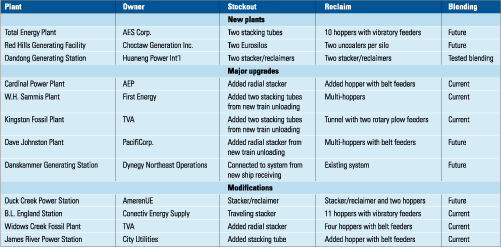
Twelve power plants that have configured their coal-handling systems to accommodate blending. Source: Roberts & Schaefer
Total Energy Plant. This plant, in Guayama, Puerto Rico, receives its coal from self-unloading ships. The original coal-handling stockout and reclaim systems were designed to handle one coal type but were made compatible with future coal blending (Figure 1). Two stacking tubes were provided for stockout and storing the coal. The tubes are spaced 160 feet apart, and the two overlapping piles have a total capacity of 98,000 tons. Two segregated piles could be formed to facilitate blending in the future. Reclaim from the piles is by 10 vibratory feeders spanning 360 feet beneath the two stockout piles. Each feeder has a variable capacity up to 360 tons per hour (tph); because that is one-half of the reclaim conveyor’s capacity, two or more feeders would be in service at any one time for coal reclaim.
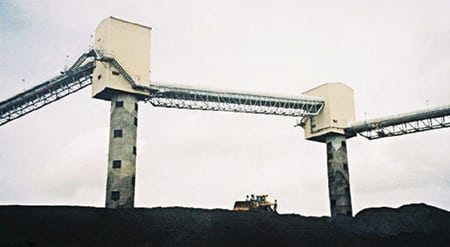
1. Total Energy Plant. Two stockout stacking tubes receive coal at 3,000 tph and form a total 98,000-ton storage pile. Provisions for future coal blending were included in the design. Courtesy: Roberts & Schaefer
Red Hills Generating Facility. This plant, in Ackerman, Miss., has its coal delivered by 165-ton trucks. The coal-handling stockout and reclaim systems were designed to handle lignite but were given the capability for coal blending in the future (Figure 2). Two Eurosilos with a capacity of 20,000 tons apiece are used to store the coal. After being received and crushed, coal is conveyed to the silos at a rate of 1,800 tph. Reclaim from each silo is by two un-coalers at a variable rate of up to 750 tph. One uncoaler per silo feeds one of two reclaim belts to the crusher house.
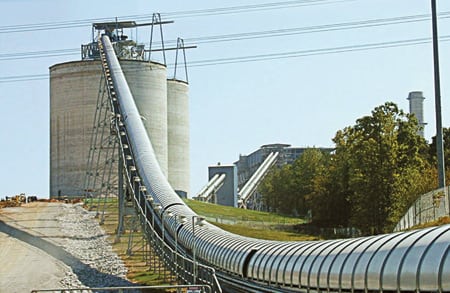
2. Red Hills Generating Facility. Coal is delivered to the plant by truck. Each coal storage silo has a capacity of 20,000 tons. Courtesy: Roberts & Schaefer
Dandong Generating Station. This Dandong, China, plant receives its coal by ship. The coal-handling stockout and reclaim systems were designed for future blending. The station currently burns Columbian coal, but it has experimented with blending. Each of the plant’s two stacker/reclaimers has a stockout capacity of 1,800 tph and a reclaim capacity of 720 tph (Figure 3). One stacker/reclaimer stockpiles on both of its sides, while the other stockpiles only on the side facing the other stacker/reclaimer.
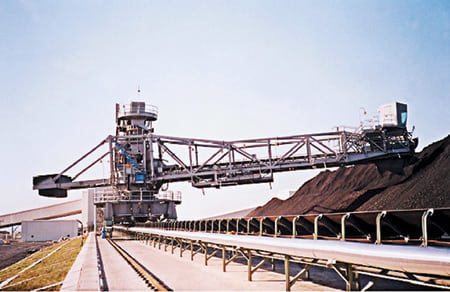
3. Dandong Generating Station. The 1,800-tph stacker/reclaimer system receives coal from ships. Courtesy: Roberts & Schaefer
Cardinal Power Plant. Brilliant, Ohio’s Cardinal Power Plant receives its coal by barge or train. A radial stacker and second reclaim system are being added to enable blending. To access the existing system the long 2,500-tph conveyor from the bucket ladder barge unloader to stockout will have a transfer house added. At the transfer house, the belt will be split and a diverter gate added to feed coal to the new radial stacker. The 60-inch radial stacker will be able to stock out 20,000 tons in a 90-degree pile at 2,500 tph. The new reclaim system consists of a hopper with a belt feeder and one reclaim conveyor below one end of the new stockout pile. The reclaim conveyor will transfer the coal back to the existing system, where it will be blended with coal from the existing reclaim system.
W. H. Sammis Plant. This plant, in Stratton, Ohio, receives coal by barge from several mines in Pennsylvania as well as PRB coal by trains. The addition of a rapid-discharge, bottom-dump train unloading system rated at 4,000 tph greatly increases the unloading capacity and enables blending of PRB coal. The train-unloading system had to be located 2,350 feet from the coal yard reclaim area due to site constraints. The unloading conveyor discharges to a stacking tube, forming a 30,000-ton storage pile near the train-unloading system. Four hoppers with vibratory feeders reclaim this pile and feed coal onto a 1,000-tph transfer conveyor (Figure 4). The 1,900-foot-long transfer conveyor moves the coal to a stacking tube, forming a 15,000-ton pile in the coal yard reclaim area. This dual-stacking tube system allows for both rapid unloading of the railcars and a reasonable conveying rate to the coal yard area, on an as-needed basis. The recent addition of a mid-transfer point to the transfer conveyor allows PRB coal arriving by rail to be sent directly to the existing radial stacker. With stockout at the stacking tube and the radial stacker and multi-hoppers for reclaim, coal can be custom blended as required for each of the plant’s coal-fired units.
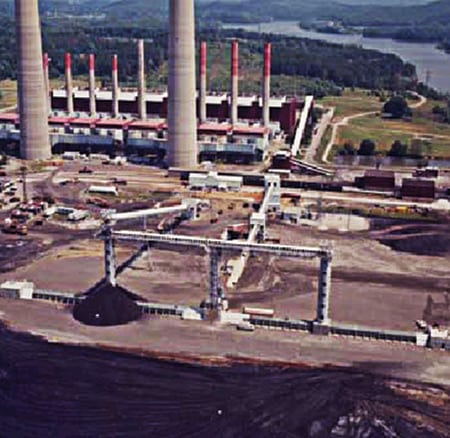
5. Kingston Fossil Plant. The stockout system’s stacking tubes form coal storage piles, each of which can weigh 62,000 tons. Courtesy: Roberts & Schaefer
Dave Johnston Plant. This Glenrock, Wyo., plant received coal by short bottom-dump trains from a local mine. The addition of a rapid-discharge, bottom-dump unloading system rated at 4,400 tph increased the unloading capacity for PRB coal. From the unloading area, a 2,900-foot-long overland conveyor delivers the coal to a large radial stacker with a 240-foot boom (Figure 6) that replaced a small, fixed stockout conveyor. The radial stacker forms two segregated piles over existing reclaim hoppers. The two piles have a total capacity of 161,000 tons. Both piles are currently used for PRB coal, but blending is a future possibility. The reclaim hoppers were modified with new belt feeders.
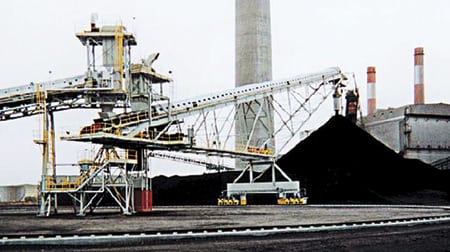
6. Dave Johnston Plant. The plant’s rail-mounted radial stacker receives coal from a rapid-discharge, 4,400-tph bottom-dump unloading system. Courtesy: Roberts & Schaefer
Danskammer Generating Station. This plant in Roseton, N.Y., used to receive all of its coal by unit trains. A self-unloading coal-receiving system capable of handling ships as heavy as 30,000 dwt (deadweight tons) was added to enable deliveries of coal from the Hudson River (Figure 7). A 2,700-foot conveyor system connects the ship receiving area to the plant’s coal yard. At a transfer tower, a coal shipment either can be sent at 2,200 tph to an 8,300-ton stockout pile or sent at half that rate to the plant’s existing reclaim system.
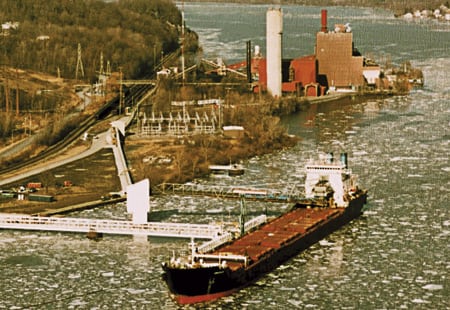
7. Danskammer Generating Station. A self-unloading ship-receiving system can transfer 2,200 tph of coal to the plant coal yard. Courtesy: Roberts & Schaefer
Duck Creek Power Station. Canton, Illinois’ Duck Creek Power Station receives its coal by train. The station’s rotary car dumper was modified for handling PRB coal. Roberts & Schaefer modified the conveyor system to increase its capacity from 2,000 tph to 3,000 tph by adding new drives, 45-degree idlers, and other components to the conveyor system. The existing stacker-reclaimer boom conveyor also was modified. The primary reclaim system is a stacker/reclaimer, and the secondary system is a dual hopper with vibratory feeders. The reclaim hopper allows for future blending of a major/minor coal blend.
B. L. England Station. The coal supply for this plant, in Beesley’s Point, N.J., arrives by train and is unloaded by a rotary car dumper. The conveyor system was modified throughout to handle PRB coal for blending. The stockout system is a traveling stacker that forms two segregated piles: one of PRB and the other of bituminous coal. The reclaim system consisted of two reclaim belts in series with eight hoppers and vibratory feeders per belt. For better pile segregation and blending ratio, five of 16 feeders were removed from service and blocked off. The current blend is normally 30% PRB coal and 70% bituminous coal. The system allows for this blend ratio to be considerably altered.
Widows Creek Fossil Plant. Coal for this plant, in Stevenson, Ala., arrives by train and is unloaded by a bottom-dump system. Roberts & Schaefer added new drives, 35-degree idlers, and other components to the conveyor system through stockout to increase its unloading capacity from 1,400 to 2,200 tph and to accommodate receipt of PRB coal for blending. Modifications included the addition of transfer conveyors between the existing crusher building and a new crusher house. To facilitate stockout and blending, a short, fixed stockout conveyor was replaced with a pedestal radial stacker rated at 2,200 tph. The radial stacker (Figure 8) forms two segregated piles: one of up to 21,500 tons of PRB coal and another of up to 19,200 tons of Eastern coal. The reclaim system for each pile is a dual hopper with belt feeders.
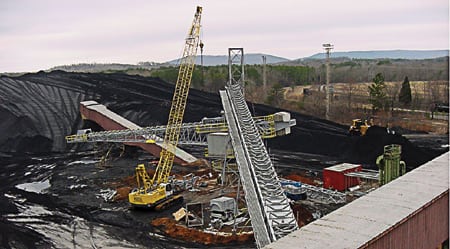
8. Widows Creek Fossil Plant. A 2,200-tph radial stacker feeds two coal storage piles: one of 21,500 tons for PRB coal and the other of 19,200 tons for Eastern coal. Courtesy: Roberts & Schaefer
James River Power Station. This plant, in Springfield, Mo., had a single stockout/reclaim system. The addition of a second system enabled coal blending. The addition of a diverter gate with a transfer conveyor at the discharge of the existing, fixed stockout conveyor provided access to the existing system without increasing load to the existing conveyor. The transfer conveyor has one center support and terminates at a new stacking tube (Figure 9), where the second segregated storage pile is formed. The new reclaim system consists of a dual hopper with weigh-belt feeders and one reclaim conveyor below the new stockout pile. The reclaim conveyor sends the coal back to the existing system, where it is blended with coal from the original reclaim system. The existing programmable logic control system was expanded to accommodate the new stockout/reclaim system. The initial blend was of two Eastern coals, but it now is a blend of PRB and Eastern coals.
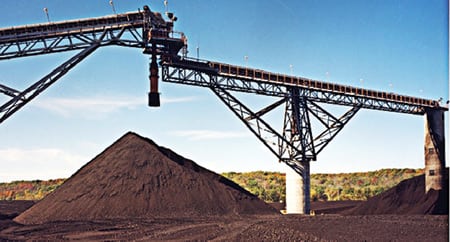
9. James River Power Station. A second stockout/reclaim system and storage pile were added to enable blending of Eastern and PRB coals. Courtesy: Roberts & Schaefer
—Richard H. McCartney, PE, is a senior materials handling engineer for Roberts & Schaefer Co. (www.r-s.com). He can be reached at 505-890-8548 or richmc@eni.com.