In order to operate aging nuclear power plant instrumentation and control systems for up to 60 more years or longer, there must be a smooth transition from existing analog technologies to advanced digital platforms. For this to occur, electromagnetic compatibility concerns related to both qualification testing and the electromagnetic environment must be addressed to ensure safe and reliable operation of these systems within the plant’s electromagnetic and radio frequency interference environment. By understanding the regulatory requirements and sharing implementation experience, digital system upgrades can be installed successfully.
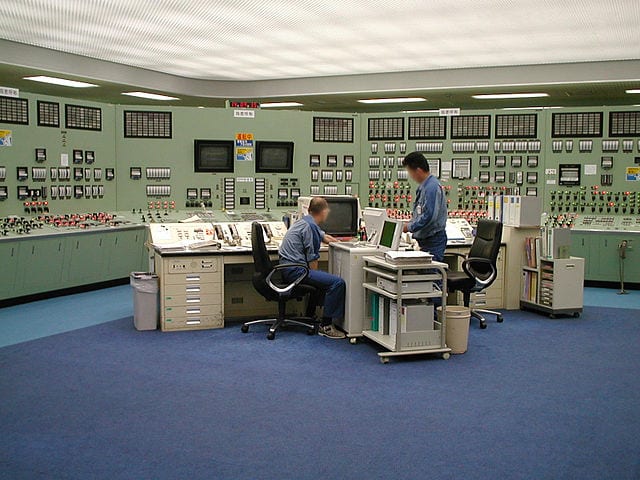
As nuclear power plants continue to operate beyond their design life, maintenance of their instrumentation and control (I&C) systems is becoming increasingly important. Most of the I&C systems that monitor and control processes in today’s nuclear power plants are based on analog technology designed in the 1950s and 1960s. As technological advances have been made over the past several decades, a shift away from analog technology toward digital technology is occurring in the I&C industry. This shift is happening for a number of reasons, some of which are:
-
Obsolescence of installed analog I&C equipment.
-
Increased performance and functionality provided by digital technology over analog technology.
-
Cost reductions presented by digital technology over analog technology.
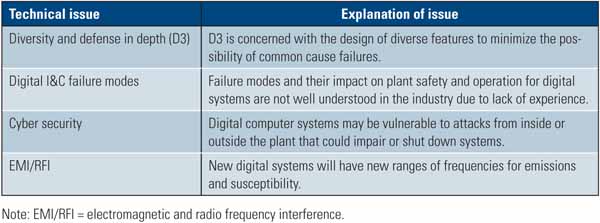
However, several technical issues are preventing a smooth transition from analog to digital I&C. Table 1 lists examples of some of these issues along with an explanation of each. Of particular concern when addressing digital I&C upgrades is the issue of electromagnetic compatibility (EMC), which encompasses the effects of electromagnetic and radio frequency interference (EMI/RFI). Consequently, organizations such as the U.S. Nuclear Regulatory Commission (NRC), the Electric Power Research Institute (EPRI), and the Institute of Electrical and Electronics Engineers (IEEE) have developed requirements and guidelines with respect to EMC for the installation and use of digital instrumentation in nuclear power plants.
Table 1. Technical issues surrounding digital I&C upgrades. Source: Analysis and Measurement Services Corp.
Digital Upgrades and EMI/RFI in Nuclear Plants
Obsolescence of analog I&C system components and the lack of replacement parts for I&C systems that are no longer supported by the manufacturer are leading to the increased use of digital instrumentation in nuclear power plants in the form of upgrades or completely new installations. The shift toward digital technology, however, is not entirely due to factors beyond the control of the nuclear power plant such as obsolescence. Many advantages are offered by the new digital I&C systems, including these:
-
Self-checking features such as power supply monitoring, communication channel testing, and cyclic redundancy checks of memory
-
Online diagnostics
-
Improved accuracy
-
Fault tolerance
-
Improved human-machine interface
-
High data handling and storage capacities
The advantages offered by digital technology and the challenge of obsolescence issues make a digital I&C system an attractive upgrade for a nuclear power plant’s process control. Consequently, several digital I&C systems have been developed and installed in nuclear power plants over the years. Table 2 lists examples.
Table 2. Digital I&C system installations. Source: Analysis and Measurement Services Corp.
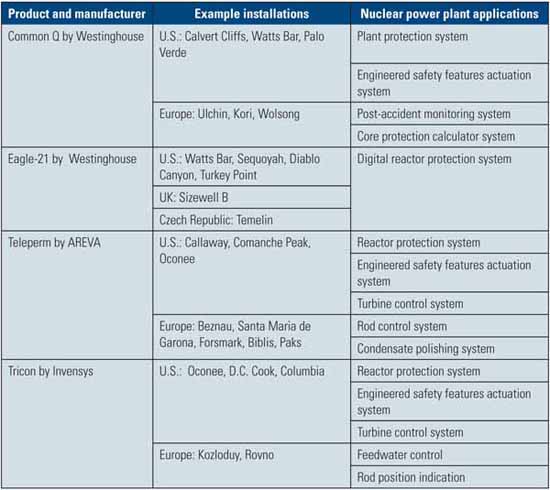
[Editor’s correction 2/16/10: The Common Q plants identified in this table as being in Europe are in South Korea.]
However, the transition to digital instrumentation in a nuclear power plant is not trivial. There are numerous regulatory and technical hurdles to overcome. As mentioned previously, EMC is of particular concern. Equipment installed as part of an upgrade needs to be compatible with its environment, so EMC qualification must occur to ensure that the new equipment does not introduce EMI/RFI problems and affect plant safety and reliability. In addition, the new equipment must be protected from the emissions of currently installed equipment.
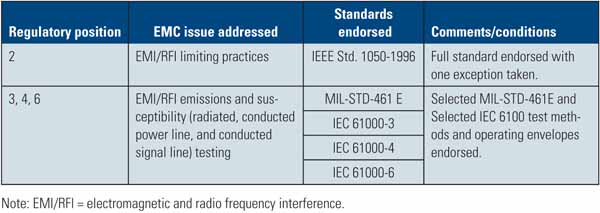
Table 3. Specific RG-1.180 regulatory positions for EMC guidance. Source: Analysis and Measurement Services Corp.
The operational behavior of equipment in the presence of EMI/RFI is defined as its immunity or susceptibility. Immunity is the ability of equipment to remain operationally "immune," or unaffected, in the presence of defined levels of EMI. Susceptibility is the degree to which the equipment’s operation is unintentionally affected when in the presence of a defined level of EMI. The immunity or susceptibility of equipment is determined by performing various EMC tests. These tests are divided into two types: emissions testing and susceptibility (or immunity) testing.
Emissions testing is used to determine the EMI/RFI profile of the equipment under test, which identifies the frequency and magnitude of any emissions from the equipment. Emissions can occur in two forms — radiated and conducted:
-
Radiated emissions are transmitted via noncontact mechanisms, such as the magnetic field that radiates from a current-carrying wire. The radiated magnetic field can couple into adjacent circuits and interfere with the operation of those circuits. The effects of radiated emissions can be reduced through shielding and filtering.
-
Conducted emissions are transmitted through contact mechanisms such as plant wiring or an instrumentation cabinet acting as a ground path. Conducted emissions are coupled directly into other circuits and can be reduced by filtering.
Regulatory Requirements and Guidelines for EMC Qualification
The design of safety-related I&C equipment is required to conform to the standards set forth by Part 50 of Title 10 of the Code of Federal Regulations (10 CFR 50). This includes defining the operating characteristics of the system and performing testing on the system to verify that it meets the requirements. The goal of the testing is to be reasonably sure that the system will not adversely affect any other safety-related equipment in the plant and that the system itself will not be adversely affected by other equipment already present at the installation location in the plant.
Any new safety-related I&C systems, along with any modifications to existing systems, must be evaluated before they are placed in the nuclear power plant environment. Part of this evaluation involves measuring electromagnetic emissions and susceptibility. The systems discussed here include digital, advanced analog, and hybrid analog-digital I&C systems. The guidance provided is meant to be a compilation of approved practices for the EMC qualification of safety-related I&C equipment. The purpose of this guidance is to accelerate the approval process of permits and licenses, and of proposed plant modifications, by the NRC.
The NRC has established guidelines for addressing the effects of EMI/RFI on safety-related I&C systems in nuclear power plants. Regulatory Guide 1.180 (RG-1.180), Guidelines for Evaluating Electromagnetic and Radio-Frequency Interference in Safety-Related Instrumentation and Control Systems, was written to provide operating nuclear power plants and license applicants with a set of guidelines to use for EMC testing of safety-related equipment. This regulatory guide recommends that its information be only one part of a total package of tools combined with other good engineering practices. The guide recommends that, whenever it is feasible, the EMC practices applied to nonsafety-related I&C systems should be held to the same high standards as those applied to safety-related I&C systems.
The IEEE developed a standard, IEEE Std. 1050-1996, that describes theoretical and practical methods of grounding practices for I&C equipment and its associated circuits. IEEE Std. 1050-1996 details guidelines for controlling upsets and malfunctions in safety-related I&C equipment exposed to EMI/RFI and power surges. The standard has been endorsed by RG-1.180 with only one exception related to radiation coupling field strength, as noted in Regulatory Position 2 of the guide. The regulatory positions of RG-1.180 and the associated standards are shown in Table 3.
Until the NRC first released RG-1.180 in January 2000, the only EMC guidance for the nuclear industry was a safety evaluation report recommending the Electric Power Research Institute topical report EPRI TR-102323R1 as a method of addressing EMC concerns about safety-related I&C systems. For the testing of EMI/RFI emissions and susceptibility, RG-1.180 endorses the applicable testing methods of the Military Standard MIL-STD-461E. Applicable testing methods in the International Electrotechnical Commission (IEC) standard IEC 61000 have also been endorsed. In addition, the methods of the topical report EPRI TR-102323R1 retain their endorsement from the NRC.
EPRI TR-102323R1 defines limits for EMI/RFI emissions and susceptibility testing levels for use in establishing EMC guidelines for the nuclear power industry. The limits in the report were developed based on both existing standards and empirical data collected from several operating nuclear power plants. The result is a set of generic EMI/RFI emissions and susceptibility levels, along with the identification of emissions sources in nuclear power plants. MIL-STD-461E contains methods for EMI/RFI emissions and susceptibility testing for a variety of frequencies and environments. IEC 61000 also has parts that define generic envelopes and limits for EMI/RFI emissions and susceptibility testing. IEC 61000 Part 6 defines methods dealing with conducted and radiated emissions testing. Part 4 contains testing information pertaining to conducted and radiated EMI/RFI susceptibility.
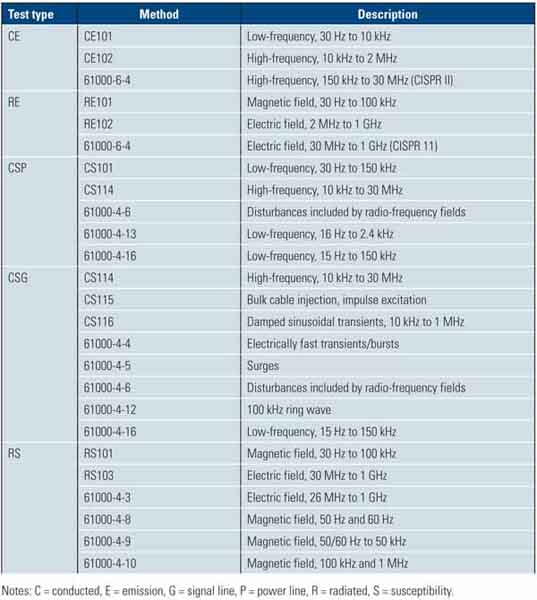
The types of EMI/RFI tests and their applicable testing methods are shown in Table 4. The descriptions are the same as those given in RG-1.180; therefore, the frequency limits given are the endorsed limits and not necessarily the limits of the standard listed. The standards are grouped by whether they are for conducted or radiated tests, emission or susceptibility tests, and (for conducted susceptibility) power or signal line tests. An illustration of the frequency ranges as they appear in the table for the different standards is shown in Figure 1.
Table 4. EMI/RFI tests, applicable methods, and method descriptions. Source: Analysis and Measurement Services Corp.
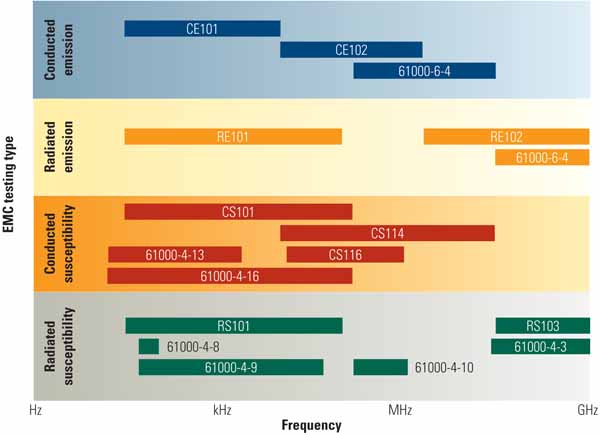
1. EMC testing standards endorsed by Regulatory Guide 1.180 and their associated frequency ranges. Source: Analysis and Measurement Services Corp.
Depending on the needs and characteristics of the I&C system under consideration, a suite of EMC tests is determined that will be required to satisfy the NRC requirements. Although there are several different sources for the testing standards, it should be noted that the testing methods are mutually exclusive and cannot be mixed and matched. Methods from multiple standards sources cannot be mixed to provide full testing coverage; one standard must be applied in its entirety. RG-1.180 also provides the option of applying alternative test suites from the most recent versions of the MIL-STD and IEC guidelines.
Addressing the EMC Requirements During a Digital Upgrade Installation
As stated in the NRC Regulatory Guide 1.180, "this guidance recommends design and installation practices to limit the impact of electromagnetic effects, testing practices to assess the emissions and susceptibility of equipment, and testing practices to evaluate the power surge withstand current (SWC) of the equipment." In addition, "the electromagnetic conditions at the point of installation for safety-related I&C systems should be assessed to identify any unique EMI/RFI sources that may generate local interference." Therefore, the recommended process involves more than the EMC qualification testing of the digital or advanced analog system to be installed; the system must also be compatible with the environment at the point of installation, which requires a review of the specific plant’s electromagnetic environment (EME).
To address both the qualification of the equipment and the testing of the environment in which it will be installed, the Figure 2 flow chart should be followed. This flow chart provides a framework for the digital upgrade process with respect to EMC and involves three main components: the plant’s EME characterization, the system’s EMC qualification, and installation of the system at the plant. Each component can be broken down into a subset of tasks, as explained in Figure 2.
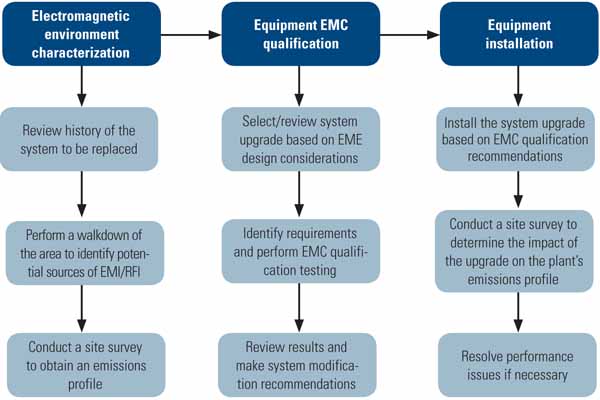
2. Implementation process for a digital upgrade with regard to EMC qualification. Source: Analysis and Measurement Services Corp.
Electromagnetic Environment Characterization
The first step in determining the effects of EMI/RFI on a new digital upgrade is to review the performance history of the existing system that will be replaced. Have there been any previous issues caused by EMI/RFI that could affect the new digital system? If there have been any issues, what modifications were made to prevent the disturbances, and should those considerations be integrated into the new system design or left in place during the new system installation?
Performing a walkdown of the affected areas of a digital upgrade can identify the location of typical plant sources of EMI/RFI in the vicinity. If significant EMI/RFI sources are identified, it may be possible to avoid potential interference by selecting a different location for installation of the digital upgrade. Once a location is selected, a site survey can be performed to capture an emissions profile of the area. There are several advantages to having this information from a site survey, including these:
-
The emissions data will provide a baseline measurement of the specific location’s EME.
-
The site survey can locate the source of significant emissions and either recommend addressing the emissions in the design of the new system to increase its immunity, or modifications can be made to the existing equipment to minimize its emissions.
-
If the measured plant emissions from the site survey exceed the EMC qualification susceptibility test limit, the higher level can be used during immunity testing to ensure that the equipment will perform its intended function given the plant’s EME.
-
During qualification testing, if the measured equipment emissions exceed the allowable equipment limit but would not increase the site’s emissions profile at the point of installation, it could be justified that since the existing plant equipment has operated reliably in its current EME, the emissions due to the installed system should not impact operation of the existing equipment. However, an assessment of the characteristics of the added emissions is necessary.
Equipment EMC Qualification
Once the EME of the installation location has been characterized, the digital system can be selected based on these design considerations. If the system has already been selected, then its design can be reviewed to determine if it complies with the EME specifications.
Next, the regulatory requirements regarding EMC qualification testing must be identified. They determine whether emissions and susceptibility tests are required (such as for safety-related systems or systems that could impact safety functions) or if only emissions testing is required (such as for systems in the vicinity of safety-related equipment) to ensure that the new system will not increase the plant’s EME in that area. In certain cases, plants choose to perform immunity testing on nonsafety-related equipment even though it is not required because the system may be deemed important to plant operation.
EMC qualification testing is performed to determine the new equipment’s ability to withstand the plant’s EME (susceptibility testing) and the impact the equipment will have on the EMI/RFI at the point of installation (emissions testing). This requires that the equipment setup for testing must be as similar to the in-plant installation as possible. If an emissions or susceptibility test fails to meet the acceptance criteria, then an EMC expert should review the data to determine the ability of the system to perform its intended function in the presence of the plant’s EME without affecting the existing plant equipment. If it is determined that the equipment must meet the equipment test criteria, then the system must be modified to limit its emissions or increase its immunity through techniques such as filtering and shielding. The testing process must be performed until it is demonstrated that the equipment meets the acceptance criteria.
Besides qualification of the equipment, the goal of EMC testing is to provide recommendations and requirements of the system and its installation in the plant to ensure a successful implementation. This information would include requiring that any modifications made to the equipment during the EMC qualification testing in order to meet the acceptance criteria be included in the final design for site installation. A recommendation may also be made for ways to improve the immunity or reduce the emissions of a piece of equipment if results of qualification testing approach the acceptance limit.
Equipment Installation and Follow-up
The system must be installed as close as possible to the final test setup during EMC qualification and must include modifications to the system made to gain a passing level. The installation should also adhere to the recommendations provided by the EMC testing and best practices for minimizing EMI/RFI.
After the upgrade, a site survey can be performed to determine if installation of the digital system caused an increase in its emissions compared with the qualification testing or if it raised the plant’s EME from the previous site survey. If the emissions are determined to potentially affect the operation of the surrounding equipment, or if the system has caused or experienced performance issues, then troubleshooting techniques can be used to identify the cause of the disturbance. Modifications can then be implemented to prevent its reoccurrence. After resolving all of the issues, the system should continue to be monitored for malfunctions that could indicate degradation in its immunity to EMI/RFI or an increase in surrounding EME levels.
—H.M. Hashemian (hash@ams-corp .com), C.J. Kiger, J.C. Seibel, and R.J. Wunderlich work for Analysis and Measurement Services Corp., AMS Technology Center, in Knoxville, Tenn. R.D. Meininger (richardm@emifix.com) works for CHAR Services, a division of AMS Corp. in Annville, Pa.