By regenerating the catalyst of its selective catalytic reduction (SCR) system instead of purchasing a new one, the typical 500-MW coal-fired power plant can save about $500,000 to $1,000,000 annually. Because a regenerated catalyst has a life equal to or longer than than the original, the cost of regeneration is capitalized in the same accounting manner as would be used for new catalyst.
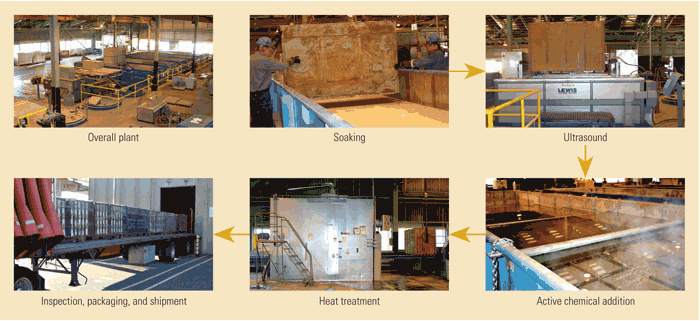
Catalyst regeneration is a multistep procedure. Charlotte-based SCR-Tech (a subsidiary of Catalytica Energy Systems), for example, uses a patented ultrasonic process to remove physical and microscopic pluggage (Figure 1). Next, chemicals remove poisons that have contributed to deactivation of the catalyst. Chemical reactivation of the catalyst is followed by the final step, heat treatment.
graph
Courtesy: SCR-Tech
1. New lease on life. SCR-Tech’s patented catalyst cleaning and regeneration process.
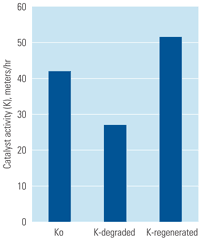
Process advances have made it possible to fully restore a catalyst’s activity—and its SCR system’s NOx-reduction efficiency—to their original levels. By increasing the number of catalytic sites available for reaction, SCR-Tech’s process has been demonstrated in certain cases to increase catalytic activity beyond the original level (Ko) by as much as 25% (Figure 2). This article will not include this extra activity in comparisons; however, a significant economic upside could be realized.
graph
Source: SCR-Tech
2. Better than new. By increasing the number of catalytic sites available for reaction, in certain cases regeneration boosts a catalyst’s activity by as much as 25% over the original level.
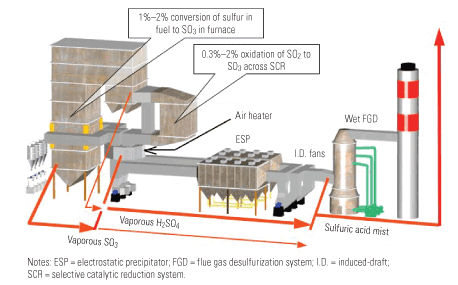
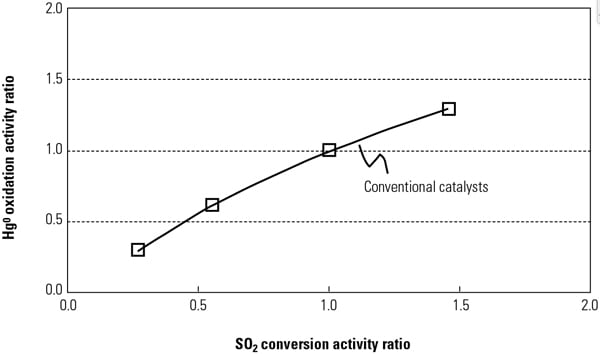
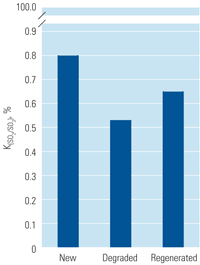
For sulfur dioxide (SO2) to sulfur trioxide (SO3) conversion, regenerated catalyst has been demonstrated to achieve a lower conversion rate than new catalyst (Figure 3). Southern Company, American Electric Power, and SCR-Tech are participating in a joint effort to quantify this reduction in conversion rate; results are expected early this year.
graph
Source: SCR-Tech
3. Cure for the blues. Compared to new catalyst, regenerated catalyst converts less sulfur dioxide to sulfur trioxide (SO3). This is important because, although SO3 is not a regulated pollutant, in sufficient concentration it forms a visible blue plume that does not dissipate following its release from a power plant stack.
Next we examine differences in the process, economics, and reliability of new catalyst versus regenerated catalyst.
Eliminating disposal cost
Whether replacing or regenerating catalyst, an SCR operator must first remove the spent catalyst and replace it with an active catalyst. If purchasing new catalyst, the spent catalyst must be shipped to a landfill or other disposal site. This costs about the same as shipping the catalyst out for regeneration.
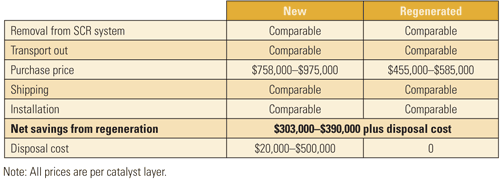
However, the added cost of placing the spent catalyst in a landfill or disposal site can be significant. Whether the catalyst can be deposited in a normal landfill or must be treated as hazardous waste depends on the state and/or county where the landfill is located, the type of catalyst, the type of coals the power plant has fired, and the poisons present on the catalyst. Experience shows that the cost of disposal can vary from $50/ton to more than $2,000/ton. For just one layer of catalyst used in a 500-MW unit, this can amount to between $20,000 and $500,000 (see table).
Source: SCR-Tech
Comparing the costs of regenerating and buying new catalyst
By extending the useful life of spent catalyst, regeneration eliminates the need for catalyst disposal. If some catalyst is too damaged to be reused and must be disposed of, it can be ultrasonically cleaned to remove all poisons. In nearly all cases, this can render the spent catalyst acceptable for a normal landfill, avoiding the potentially high cost of hazardous waste disposal.
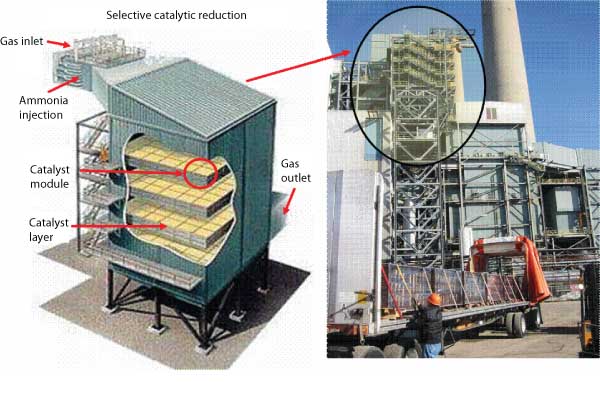
The cost of shipping regenerated catalyst back to the power plant and the labor for reinstalling catalyst in the reactor is about equal to that of shipping and installing new catalyst. In either case, the same number of modules must be reinserted.
New vs. regenerated
Now let’s compare the life and deactivation rates of both new and regenerated catalyst. Experience has shown the deactivation rate to be similar when both the new and regenerated catalysts start out with equal activity levels. However, because new activity (beyond its original) can be added to the regenerated catalyst, both its life and NOx-reduction potential can be greater.
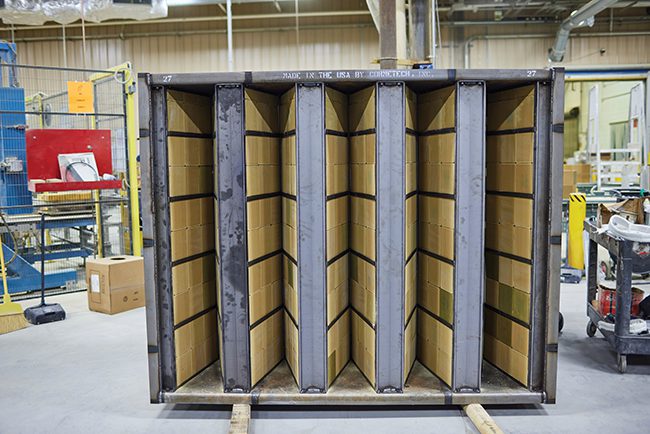
A typical 500-MW unit has about 650 cubic meters (m3 ) of catalyst. For illustration purposes, let’s consider 450 modules arranged in three layers of 150 modules each. The cost of purchasing new catalyst varies between $3,500 and $4,500 per m3 , depending on catalyst type and manufacturer. The cost to regenerate catalyst is approximately 60% of this price. As the table shows, the total cost to purchase an entire layer of new catalyst is between $758,000 and $975,000, versus the regeneration cost of between $455,000 and $585,000. This represents a savings of between $303,000 and $390,000 per layer. If all three layers are regenerated rather than replaced, the total savings would be $910,000 to $1.2 million.
If an SCR unit runs year-round—as many do now or will do soon—assuming a three-year catalyst life, regeneration can offer approximately $300,000 to $600,000 in annual savings for a 500-MW unit. That’s a significant amount, considering today’s tight budgets and lean staffs.
It has been demonstrated that catalyst can be regenerated between three and seven times, depending on its condition, type, wall thickness, the treatment in the reactor, handling, and pluggage. Some catalyst manufacturers make catalyst walls thinner to reduce their costs. This makes the catalyst much less robust and more susceptible to erosion, handling damage, and pluggage. It also shortens its regenerated life, compared with more-substantial catalyst.
For accounting purposes, the costs of regenerating catalyst can be treated the same as the costs of purchasing new catalyst. If an SCR operator typically capitalizes new catalyst on its books, a regenerated catalyst may be capitalized as well, because the life expectancy of each is consideredto be the same. Discussions with auditing firms and various public utility commission staff members confirm that this accounting treatment should be applied. Such accounting ensures that ratepayers and investors receive their share of the cost savings that regeneration provides.
Rejuvenation vs. regeneration
In some cases, rejuvenating catalyst may be more cost-effective than regenerating it, especially if the catalyst life is fairly new or if its SCR system doesn’t operate year-round. Rejuvenation is much more than cleaning pluggage and flyash from the catalyst. In addition to cleaning the catalyst, rejuvenation removes blinding layers and some poisons; this recovers some activity but adds none. Regeneration includes cleaning and rejuvenation, plus the addition of active ingredients to restore the catalyst to 100% or more of its original activity.
Onsite cleaning has been used in a number of instances where pluggage is the only concern. Depending on the amount of blinding and poisons present, it is usually better to go with deeper ultrasonic cleaning and exercise the option to reactivate the catalyst. Doing so eliminates onsite handling, the use of chemicals, and outage coordination activities—but it does incur transportation costs.
The comparative economics of the two options depend on the following:
- The plant’s dispatch economics.
- How long the catalyst has been in service.
- The design margin and effectiveness of the SCR system.
- The costs of removing and replacing the catalyst.
- The impact on the catalyst of the fuels fired.
Even if the catalyst has not plugged precipitously and retains most of its activity, the costs of catalyst removal and reinstallation often make regeneration the more economical approach. Alternatively, in-situ cleaning may suffice to correct certain fouling conditions.
Catalyst management: Still a must
The most effective way to operate catalyst is via a thorough catalyst management program (see p. 26). There are a considerable number of options for optimal catalyst management: add a layer; replace a depleted layer with new or regenerated catalyst; or mix and match plate, corrugated, or honeycomb catalyst in the same reactor. All of these options will change with year-round SCR operation.
No matter which catalyst type is being used, there are many possibilities for minimizing costs associated with a fleet of SCR systems. Other considerations include trying to match the use of catalyst to scheduled outages—the intervals between which are getting longer. This alone may mean planning for catalyst replacement in multiple layers.
There are also possibilities for managing or avoiding catastrophic catalyst failure. Pooling spare catalyst within the fleet and even within the industry at a central location can provide a safe margin for avoiding long, unplanned, and economically devastating outages. This strategy can be accomplished without a large investment.
SCR-Tech has developed many programs that can evaluate nearly any catalyst management scenario. These programs can predict catalyst life, allow for the mixing and matching of different catalyst types, handle multiple fleet SCRs, and evaluate site-specific economics associated with each scenario. They also provide risk assessment associated with extending catalyst life, based on previous experience. These assessments are always backed by independently verified third-party catalyst testing.