Asset “virtualization” extends and combines the technologies of 3-D visualization and virtual reality to a new, practical level for the life-cycle management of power industry equipment. All pertinent data for a component, subsystem, or plant is associated with, stored, and accessed through as-built 3-D digital models of the actual plant that are constructed using laser scanning techniques.
The next wave in digital technology and power plant knowledge management is integrating complex plant operations and maintenance (O&M) into the virtual reality environment, or asset virtualization (AV).
The value of earlier initiatives applying variations of AV is already evident. Entergy, for example, applied the technology for moving huge, complex pieces of equipment during outages at its nuclear plants, converting paper-based procedures and processes to digital ones, and reducing worker radiation exposure. Other nuclear plant owner/operators have also applied the technology for similar objectives (see “Laser Scanning Produces 3-D Plant Database,” November 2008 and “Modeling and Simulation Tools Reduce Plant Outage Duration,” November 2009 in the POWER archives at https://www.powermag.com).
The vision articulated in this article is to anchor the power plant’s overall asset management program with 3-D models of the as-built equipment.
The Vision of Asset Virtualization
Imagine being able to walk through your power plant in virtual reality, “touching” an asset and having everything that is known about that asset appear before you. Furthermore, imagine mixing and matching information from different sources so that you achieve insights never before possible—for example, dynamically color the plant equipment based on the probability of failure versus the consequence of failure (Figure 1).
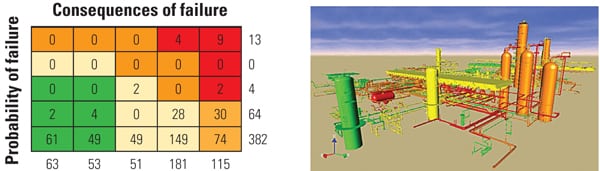 |
| 1. More information made available. This example illustrates how it is now possible to dynamically view risk profiles across an industrial complex using color. Source: INOVx |
INOVx and others have mastered a highly precise 3-D representation of the physical world and extended it to include complete access to all available data. Experience to date shows that the greatest value of AV is enabling new work processes to improve daily work habits for safety, compliance, operations, and maintenance.
Safety aspects are of particular interest given the recent events in Japan and catastrophic events at energy facilities in the U.S. Being able to clearly see plant conditions during a crisis—before it happens—improves planning and emergency response, especially when addressing previously unexpected circumstances. Having a virtual world in which to review actions allows the best plan to be put forward and then rehearsed away from immediate danger and damage.
3-D Virtual Models in Engineering. Although 3-D technology in computer-assisted design (CAD) systems has been used for over a decade, the models and documentation created in the design do not serve O&M tasks over the life of the assets. This is because the “as-designed” CAD representations almost always deviate from “as built” or field conditions. Over time, they become less and less representative of the actual plant and equipment. The 3-D models typically are not updated as modifications are made to the process equipment, nor is it cost effective to maintain these CAD models.
A plant requiring a major planned outage recently faced this exact situation. Documentation of the facility was substantially out of date. To support the upgrade project, a high-fidelity, location-accurate 3-D model of the facilities and equipment was created by on-site laser scanning and subsequent modeling. Every object was identified and labeled in accordance with the actual equipment. The model served the project in many important ways:
- Engineers “walked” the scanned images of the as-built model and identified discrepancies in existing process and instrumentation diagrams (P&IDs). The P&IDs were corrected and made suitable for engineering work at a fraction of the labor otherwise required.
- Using the 3-D virtual model, engineers were able to identify and clearly communicate throughout the upgrade process.
- When new plant components were designed, these were “clashed” against the laser scan images (also referred to as point clouds) to ensure no interference.
- Tie-in points were accurately determined from the 3-D virtual model, and the new design was fabricated and installed with zero rework.
These benefits were not only experienced at this specific plant but also have been repeated at other plants. Importantly, with accurate 3-D virtual models, many engineering tasks can be converted from a field exercise with paper and pencil to an office task, where field conditions can be explored, accurate measurements taken, and general productivity dramatically improved. Consider the desire to limit the exposure of workers to radiation at nuclear plants as a means of immediately monetizing the value of converting field work to office work.
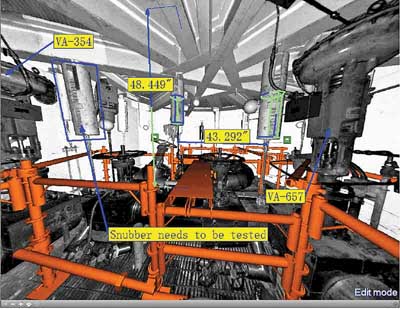
Figure 2 shows two accurate laser images of a plant. These are full 3-D images with every pixel accurately known in 3-D space to better than 5 mm. Though the images can be rotated, panned, and zoomed to any perspective, the included images represent a small sample of what is possible.
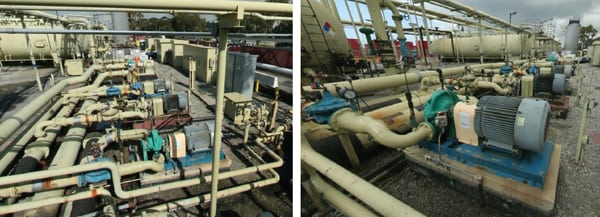 |
| 2. Believe it or not. Yes, these are laser scans, not photos. Courtesy: INOVx |
3-D Virtual Models for Outages. Plant outages are complex endeavors with myriad distinct work packages involving significant internal staff, and often hundreds (and sometimes thousands) of contractors and suppliers. 3-D virtual models of the affected facilities enhance communications and ensure team familiarity with tasks and their environment without time-consuming walkthroughs of the facility.
Specific views that support and inform each individual work package are easily isolated from the clutter of the real world and the full 3-D virtual model. These are shared with the staff, supporting workers, and contractors. They capture and share knowledge about the plant and planned work tasks. These views are also combined for added perspective. For example, structural steel views are combined with piping views so that proper access and routing can be planned and communicated to outage staff. When needed, scaffolding plans can be overlaid on the views to ensure suitability. Nuclear plants have already documented significant savings in scaffolding alone in applying 3-D virtualization. In petroleum processing plants, savings have been documented on the order of 10% of the total cost of the outage. This includes being able to reduce the total down time by one-tenth.
3-D Virtual Models in Plant Maintenance. In one petroleum refinery the issue of temporary leak repairs was addressed. The specific concern was, “How to ensure that the temporary repairs are made permanent in the most efficient manner, by taking full advantage of both planned and unplanned outages?” Before the virtual model, it was very challenging to identify all eligible temporary leak repairs. With the virtual model, a temporary repair database is dynamically linked to the 3-D virtual model, and all opportunities for permanent repair are immediately highlighted within the boundary of any outage activity.
Other applications of the 3-D virtual model for plant maintenance are many and varied. The impact on best practices is significant. Maintenance personnel are able to quickly locate lines, equipment, and instrumentation and familiarize themselves with components’ location before going to the field to perform their work. Work orders are precisely linked to the target equipment or system and, through that connection, to the most current asset data. The model is a natural tool for organizing and visualizing maintenance history, operational data, test results, and analysis.
Work order planning is greatly facilitated by the 3-D model. Planners can develop libraries of work packages for routine tasks that are supported by their respective views of the 3-D model. The net result is greater productivity and quicker repairs, resulting in shorter downtimes and greater utilization of the plant.
3-D Virtual Models in Inspection and Plant Integrity. In the past, inspection circuits were documented using 2-D isometric drawings with manual placement of the thickness or corrosion monitoring locations (TML/CML). In parallel, a database was kept showing corrosion rate, date of last inspection, and other data for each point. The challenges in coordinating and maintaining accuracy under this system should be obvious.
Today, inspection circuits are generated in 3-D as a subset of the overall virtual model. TML/CML points are called out in their exact geospatial location and linked dynamically to the source data. Even more important, these inspection points are determined by using the 3-D virtual model, permitting risk-based techniques to be used that reduce the number of inspection points by over 50% without increasing plant operating risk. This has a double benefit of reducing the total hours spent inspecting the plant by 20% to 30% while increasing its reliability and safety (Figure 3).
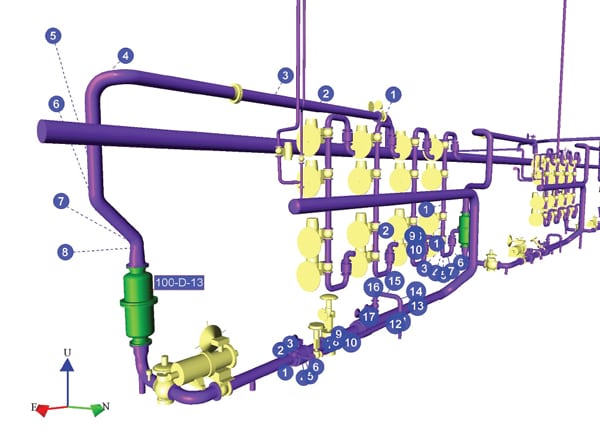 |
| 3. A 3-D model of a corrosion inspection loop. The computer rendering has replaced hand-drawn 2-D isometrics drawings. Courtesy: INOVx |
Inspectors use the 3-D virtual model to determine scaffolding needs as well as access limitations and safety requirements. As one inspector from Shell Oil put it, “One hour using the virtual model saves me 8 hours in the field.”
3-D Virtual Models in Plant Operations. There are many opportunities to utilize the 3-D virtual model in operating a plant. Operating procedures can be more easily created and reviewed because the model provides a true “in plant” perspective at the user’s desktop. Familiarizing personnel with facilities and procedures is greatly simplified. How many times have we been in the plant discussing an operating change when nobody can hear what anyone is saying because of ear plugs and rotating equipment noise?
Safety procedures, including isolation device locations, can be documented in full 3-D and full context. Hazard and operability (HAZOP) analysis can be performed with greater clarity and with accurate asset documentation. The location of persistent alarms can be visualized in their physical context. Creating work orders is a much more precise activity because the virtual model provides an easy way to tie the work order to the piece of equipment of interest instead of the unit level. Importantly, the virtual model also provides a common basis for communication between operations and maintenance.
How It Works
The path to AV is surprisingly easy. The steps are:
- Identify the specific uses that will be improved with AV, and plan the implementation.
- Create the 3-D virtual model of the plant facilities.
- Add intelligence to the model by naming all the components and connecting them to the existing enterprise information stores.
- Establish the new work flow and processes.
- Assess the implementation and explore new potential uses.
Start by reviewing the area of potential benefits, understanding the priorities and value, and planning the implementation. This involves reviewing current work practices, as well as suspected areas of improvement. Plant personnel are intimately involved in this step.
Next, the “as-built” 3-D virtual model of plant facilities and assets is created. If a 3-D design model is available, it is used, but only as the starting point. If one does not exist, then conventional laser scanning technology (widely available from many vendors) is used.
Modeling software is employed to convert the laser scan point cloud into 3-D objects. The end result is a visual, navigable, multi-perspective 3-D model that accurately and precisely reflects the actual facilities. The 3-D virtual model software must be capable of accepting updates at any time from new laser scans, altered CAD information, and direct model changes to reflect field conditions. Furthermore, changes must be automatically propagated (or inherited) to views, documents, and integrated systems to ensure that all asset information and the 3-D virtual model accurately reflect the plant.
By tagging objects, components, structures, circuits, and sub-systems, the model shapes gain context and can be used for searching, sorting, and linking to relevant data from all other enterprise information systems. Data is not copied, but accessed dynamically. O&M systems are tapped, resulting in a comprehensive digital asset management environment anchored by 3-D graphics of the actual equipment
There are several very valuable by-products of this step. For one, the existing documentation is reviewed and redlined. For example, P&ID are traced and redlined. Experience tells us that, on average, one to four errors are discovered on each P&ID. Indeed, many facilities commission projects just to update their P&ID, which often cost millions of dollars just for this work.
Another by-product is the breakdown of existing information silos. One has immediate access to information that crosses the silos with minimal effort. There is only one “version of reality” for all to access.
Once the AV environment is in place, we are ready to establish the new work flow and practices. These will flow naturally as plant personnel and managers make use of the system.
Market and Application Drivers
In addition to the application drivers noted earlier, industry standards, safety, and economics will accelerate deployment of AV in the power industry. Some of these include:
- An emerging international standard for asset management, PAS 55, effectively mandates AV “best practice.” Publically Available Specifications (PAS) are available from the British Standards Institution.
- Compliance with North American Electric Reliability Corp.’s reliability standards can be facilitated with AV.
- Utilities and owner/operators of large portfolios of power stations are actively rationalizing their equipment databases, which are often in multiple and confusing paper and digital formats.
- The fossil-fired power industry—especially large, baseload assets—will likely take the cue from nuclear plants and begin using AV for many facets of outage planning and conduct.
- AV helps plants deal with the “brain drain” issue by providing ways to capture tribal and expert knowledge before it “leaves the door” (retires).
- Safety programs and inspections will only increase in the wake of recent energy facility disasters (including the Gulf oil spill last year, the gas pipeline rupture and explosion in California last year, the power plant explosion in Connecticut, the nuclear plant crisis in Japan this year, and so on).
Issues and Challenges
As with implementing anything new, one can expect issues and challenges in adopting and implementing AV. Here are some of them:
- The general state of as-built asset information is poor. We have already noted that most P&IDs have errors. In fully implementing AV the inconsistencies must be addressed, which is challenging. But the end result is a new level of accuracy and confidence in asset information.
- The varying level of detail in existing 3-D virtual models. Even starting with an engineering 3-D CAD model, one will find different organization and level of detail. For example, are pipe supports modeled? Are small bore lines included? How are internals modeled? The needed detail must match the application or need. Achieving the right level for each use requires effort.
- Resistance to change is ever-present. Young staff expect to use 3-D models; experienced staff resist.
What to Expect in the Future
AV is in its infancy. The technology will keep improving, largely driven by the consumer market, where economies of scale come into play. Laser scanning technology will become cheaper, faster, and more accurate. Modeling technology will become more automated. New technologies such as “augmented reality” will permit the merging of 3-D virtual models with live video feeds, thus providing an intelligent live view of the plant. Equipment will be annotated and linked. Staff, who will carry radio frequency identification badges, will also be identified in the video. Plant information can be overlaid, for example, with manufacturer’s name and real-time conditions (such as temperature and name of the fluid in the pipe). We expect many new and unexpected uses will emerge in the years to come.
— Costantino Lanza is CEO of INOVx Solutions Inc. Jason Makansi (jmakansi@pearlstreetinc.com) is president of Pearl Street Inc. This article is based on a conference paper presented to the 54th Annual ISA Power Industry Division Symposium, May 2011.