One of the great successes of the power generation industry over the past two decades has been the significant increase in nuclear plant reliability and other performance standards. However, there is reason to be concerned that the design, operation, and maintenance practices used by the current fleet of plants do not leverage all the possible advantages from a digital controls upgrade. Perhaps past success is the biggest barrier to future success.
Nuclear utilities continue to upgrade aging instrumentation and control (I&C) systems with modern digital-based systems to address reliability and obsolescence concerns. In addition, the industry has demonstrated that these systems can be successfully developed and deployed even for highly safety-significant applications, such as reactor protection.
However, three factors have retarded wide-scale implementation of digital technology for plant modernization and business innovation:
- Large-scale digital upgrades entail considerable risk.
- The upgrades are very costly and have not led to bottom-line business improvement, financial or otherwise.
- Cybersecurity concerns discourage wide-scale digital integration.
A new national research program is now under way in the U.S. to address these concerns and finally break through these barriers to achieve a true digital transformation of operating nuclear plants.
Missed Opportunity
The industry approach to digital upgrades has always been one-for-one replacements, that is, new systems replaced the earlier control system functions. Consequently, such replacements fail to completely leverage the increased capabilities of new digital replacements. The common theme of these upgrade projects has been to minimize cost and risk by avoiding large changes to the plant operating infrastructure, including plant operating procedures, training, operator familiarity, design basis, and licensing basis of the controls system. Often, digital upgrades were designed to be completely transparent to the operators, some going so far as to retain the board devices from the previous analog systems.
By forcing digital systems into the footprints of their analog predecessors, the inherent capabilities of digital designs to improve business performance are lost. Beyond plant control and protection functions, digital systems can also facilitate communications, support automated work processes, enforce human performance expectations, detect and correct errors, provide enhanced understanding through visualization techniques, and provide many other useful capabilities. By fully exploiting digital technology, it is possible to lower the cost of conducting plant operational and support activities while improving quality, efficiency, and nuclear safety.
The approach the nuclear power industry has taken with digital technology stands in contrast to that of other industries. We have seen digital technology literally redefine industry operating models by automating and greatly improving even routine tasks such as package delivery. We have also seen it successfully implemented in safety-critical applications—from flight deck avionics to advanced medical procedures—where it not only replaces the control functions but also substantially transforms how the operational activities are performed, making them much more efficient and accurate.
Consequently, the digital migration in the nuclear power industry has been somewhat disappointing. It has not led to bottom-line business improvement; instead, a good case can be made that digital control upgrades actually increase operating costs. We are simply not getting the performance dividend out of digital implementation that other industries are enjoying. To fully understand why this is such a lost opportunity, the larger context of industry’s performance needs to be considered.
Standardizing Can Be Limiting
The U.S. nuclear power industry has enjoyed impressive performance improvement over the past 15 years. It was in the mid-1990s when the industry accelerated the standardizing of plant processes and conduct of operations. This emphasis on standardization was made through the concerted efforts of utilities and the Institute of Nuclear Power Operations (INPO) to set challenging performance targets and to undergird these efforts with standards of excellence, comprehensive process templates, and human performance expectations.
Performance improvement became evident in virtually every aspect of plant operations and support, particularly improving key performance indicators such as capacity factor, scram rate, forced loss rate, dose, refueling outage length, and overall cost performance. The performance targets were met. This achievement was even more remarkable because the goals for operational excellence included both profitability and nuclear safety.
However, sustaining this rate of performance improvement has proven to be difficult. Within the past five years or so, the industry has experienced a reduction in the rate of performance improvement such that today, several of the important measures have shown virtually no year-to-year improvement.
This flattening of the performance curves was not unexpected. Every operating model is subject to the classic “S” curve in the relationship between effort and performance, as illustrated in Figure 1. In the early years of the current operating model, roughly the mid-1990s to the mid-2000s, the industry was below the knee of the curve and enjoyed highly leveraged performance improvement relative to effort. As the operating model matured, much of the low-hanging fruit was picked, and it became increasingly difficult to maintain the rate of improvement experienced in earlier years, particularly with fleet capacity factors, scram rates, and forced outage rates. The operating point had moved out to the flat part of the performance curve, the region of diminishing returns.
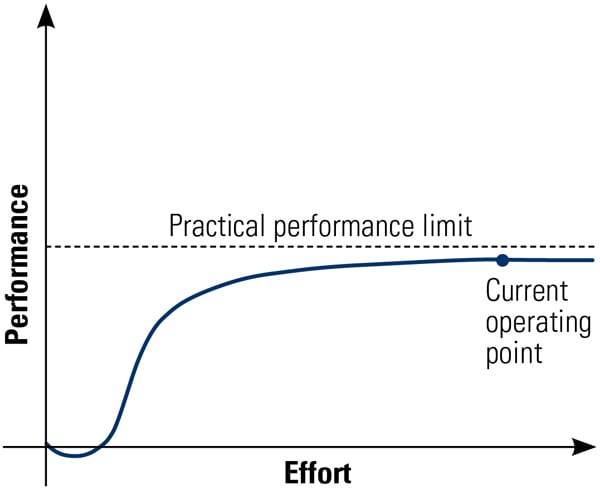 |
| 1. Old model. This performance curve is based on the current operating model. Source: Ken D. Thomas |
A survey of the staff at nuclear utilities would surely find general agreement that the industry continues to increase its performance expectations at the same time as the industry is making plant processes more complex. In addition, further reductions in consequential human error are proving difficult to achieve because improvements rely mainly on correct worker behaviors and barriers to prevent events—both difficult to manage. Technology is greatly underutilized in the quest to reduce human error, as has become the norm in other safety-critical industries.
Again, these factors confirm that the industry’s operating model has largely exhausted its potential for substantial performance improvement in future years.
New Operating Model Needed
Ironically, the operating model that has enabled the nuclear power industry’s remarkable success may become a major barrier to further performance improvement. It is my opinion that the industry requires a new operating model that provides an expanded framework for future performance improvement.
To be clear, a new operating model would not discard the valuable standards, processes, and operational principles that have been so instrumental in the notable performance achievements to date. Rather, the new operating model builds on these past successes by moving from a performance system based on human skill to one based on digital automation with human oversight. This paradigm shift has the advantage of exploiting the inherent, and underutilized, capabilities of integrated digital systems to perform tedious and error-prone tasks while allowing workers to maintain better oversight and situational awareness of the entire plant operation. This approach to plant performance, in all its forms, would draw a new performance curve where the current operating point is located, back below the knee of the curve, where highly leveraged performance improvements are possible for reasonable effort (Figure 2).
 |
| 2. New model. This curve shows potential performance improvement based on a digital transformation of the operating model. Source: Ken D. Thomas |
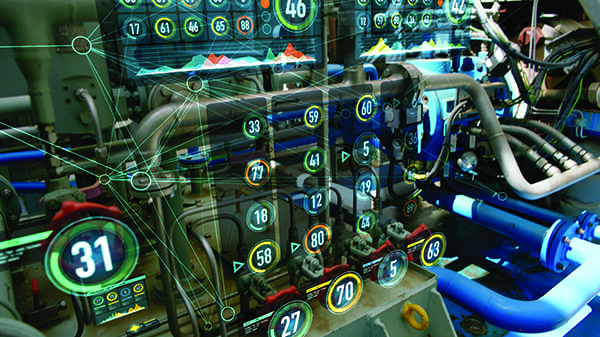
The theory of this new operating model may sound complex, but the practical aspects are reasonably simple. The main goal of the new model is to develop a digital architecture for nuclear power plants that encompasses all aspects of plant operations and support, including integrating plant systems, plant work processes, and plant workers in a seamless digital environment (Figure 3). This digital environment would serve as the platform for business innovation across the entire range of operational and support activities conducted in a nuclear plant.
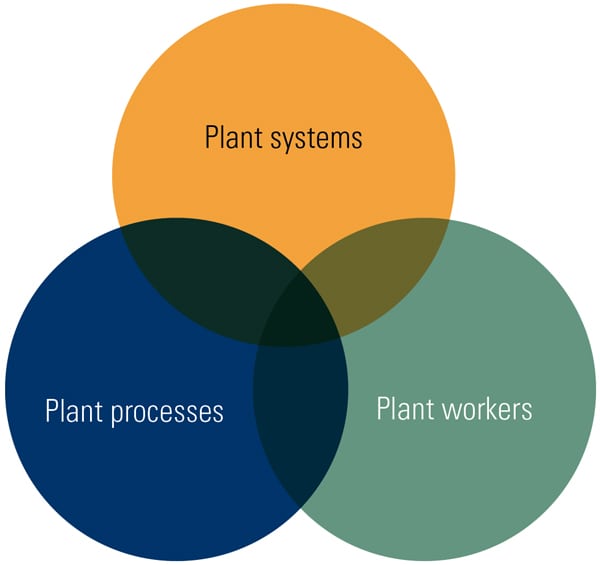 |
| 3. The vision of a seamless digital environment. Source: Ken D. Thomas |
Consider how the new model might operate, one day in the future. Workers conducting plant surveillance tests would have direct access to plant data via computer-based procedures. Acceptability of test equipment and worker qualifications would be automatically verified by the computer-based procedures. In turn, the test equipment would feed data directly into the computer-based procedures. Computations and test acceptance verifications would be performed automatically. Concurrences and permissions would be obtained electronically through wireless connections to controlling or supporting organizations (including video streaming from the job sites). The completed test procedures would automatically be routed for review and approval of results, and then archived. Engineering data would be posted to associated processes, such as the system health program. Job performance data (for example, duration) would be posted to the work management system.
Many plant engineering and operating activities could be substantially streamlined in this manner, including tasks performed by control room operators. There is the additional advantage that plant data that is normally the domain of the I&C systems and plant computer would be seamlessly integrated into plant operational and support activities in need of this information, all the while maintaining requirements for cybersecurity and Class 1E separation. There would be substantial increases in efficiency and accuracy in obtaining, processing, and validating plant data.
A secondary goal then becomes apparent: Transform the current model of nuclear plants from one that relies on a large staff performing mostly manual activities—tasks that can be automated—to a model relying on highly integrated technology with a smaller staff. This shift will be very important in addressing the loss of knowledge resulting from the pending retirement wave, future shortages of qualified workers, and the need to constantly recruit and train new staff to maintain a large, competent workforce.
Achieving this vision of transforming the nuclear power industry through the use of digital technology would require the participation and support of the entire industry. It is impractical for a single utility to undertake this task. Plant staff are focused on near-term operational requirements and do not have sufficient time to devote to this longer-term development effort. In addition, the utilities will be very concerned about project risks in cost overruns, regulatory uncertainty, and schedule delays in deploying digital systems, based on recent industry experience. There is also an operational risk that must be carefully considered. Such large-scale digital integration may have undetected failure modes that will cause plant trips or transients, or even failure to perform its design functions. No utility will want to be too far in front of this digital revolution. For projects of this enormity, there is safety in numbers.
For this new digital paradigm to get traction in an industry that has been slow to embrace digital transformation, we must do three things:
â– Mitigate the risks of pursuing wide-scale digital implementation, including operational, financial, and regulatory risk.
â– Enable the industry to move forward together such that best practices and lessons learned can be quickly and widely shared. This will allow the industry to maintain a common, albeit evolving, operating model as new technologies are integrated into the work methods. It will also reduce the risk to and burden on any one operating utility by providing a continuous peer review of the developments.
â– Build a digital environment that sufficiently addresses cybersecurity.
The Path Forward
A new national research program is under way that has been designed to address these three specific industry concerns about expanding the use of digital architectures. The Idaho National Laboratory (INL) has lead responsibility for the Advanced Instrumentation, Information, and Control Systems Technologies research pathway within the Light Water Reactor Sustainability (LWRS) Program.
The LWRS Program is a research and development (R&D) program sponsored by the U.S. Department of Energy (DOE) and performed in close collaboration with industry R&D and improvement programs (as defined in INL’s FY2009–2013 Light Water Reactor Sustainability Research and Development Program Plan, INL/MIS08-14918). Its purpose is to provide the technical foundations for licensing and managing the long-term, safe, and economical operation of existing nuclear power plants. The DOE’s program focus is on longer-term and higher-risk/reward research that contributes to the national policy objectives of energy security and environmental security. The specific concern addressed by this program is that large-scale I&C obsolescence could become a life-limiting issue for the current nuclear operating fleet.
To provide guidance for this research program, INL formed the Advanced Instrumentation, Information, and Control (II&C) Technologies Utility Working Group. The Utility Working Group is currently composed of 10 nuclear utilities; new members are added as they express interest in joining. The utilities are typically represented by individuals with responsibility for long-term I&C upgrade strategy or business innovation for site programs.
INL develops new digital technologies within the context of pilot projects. Individual pilot projects are hosted by willing nuclear utilities that have an interest in a particular technology. The technologies developed in individual pilot projects together compose the overall integrated digital environment that will serve as the platform for transformative business innovation. Thus, the pilot projects allow the industry to collectively integrate these new technologies into work activities one at a time and validate them over multiple operating plants, to the benefit of all. The new digital environment is thereby proven one technology at a time and is gradually built up over sufficient time to prudently manage the change.
INL provides the structured research program and expertise in plant systems and processes, digital technologies, human factors science, and cybersecurity. The utilities, through their participation in the Utility Working Group, develop a collective vision of this digital operating environment and set the priority and timing of developments by their individual sponsorship of pilot projects. Those utilities hosting pilot projects provide a project cost-share in terms of their own time and expenses, expertise in the plant systems and work process methods, and access to needed plant facilities. This arrangement has a number of distinct advantages, such as:
- Ensuring that the end-state vision for plant modernization is shared by a significant portion of the current operating nuclear fleet.
- Ensuring that the near-term technologies are immediately beneficial even while they build up the comprehensive digital environment.
- Greatly reducing the risk of implementation for any one utility, given that the proven abilities of INL stand behind the soundness of the technologies and that the oversight of the Utility Working Group provides a competent peer review.
- Allowing utilities to move forward together in transforming their operating model to fully exploit these technologies, and providing a transparent process for coordination with the major industry support organizations: the Electric Power Research Institute, INPO, and the Nuclear Energy Institute.
- Incorporating a perspective on regulatory issues based on INL’s extensive understanding of the Nuclear Regulatory Commission’s requirements in the area of digital I&C technology and human factors.
Eighteen pilot projects have been proposed over a 10-year period, grouped into five broad areas of important performance-improvement enablers:
- Highly integrated control rooms
- Highly automated plant
- Integrated operations
- Human performance improvement for field workers
- Outage safety and efficiency
Two of the pilot projects are under way at nuclear plants. The first is the development of advanced outage control at a Midwestern nuclear plant that will greatly improve communications, coordination, and collaboration activities to minimize the impact of challenges to the outage plan and schedule. It will develop technologies that facilitate real-time status and problem resolution, as well as provide direct interaction between the outage control center, the work execution center, and plant workers at the job site (Figure 4).
 |
| 4. Remote collaboration technology used in a refueling outage. Courtesy: INL |
The second pilot project, at a Southeastern nuclear plant, will develop mobile worker technologies that enhance human performance in the area of plant status control. This involves the capability of positive component identification and assurance that correct actions have been taken (Figure 5). It will also explore possibilities of direct verification of correct component positions or the use of streaming video for centralized verifications. The project involves the use of heads-up displays for field workers. Included in this concept is the development of computerized work packages on wireless mobile devices (such as PDAs and tablets).
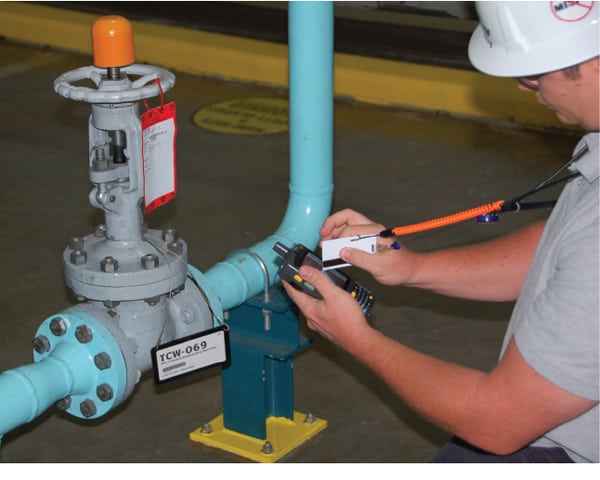 |
| 5. Operator using handheld technology for component identification. Courtesy: INL |
Two additional pilot projects are under discussion with interested nuclear utilities. One involves the integration of digital technologies within a conventional nuclear plant control room. It also includes the replacement of traditional alarm systems with an advanced alarm management system. The other involves the development of computer-based procedures for both operators and maintenance/support personnel. This project is intended to improve human performance, increase work efficiency, and better manage nuclear risk associated with work activities.
— Ken D. Thomas (kenneth.thomas@inl.gov) is a senior consultant in the Nuclear Safety & Regulatory Research group at Idaho National Laboratory. He was formerly manager, fleet technical support for Duke Energy, Nuclear Generation. Work supported by the DOE Office of Nuclear Energy under DOE Idaho Operations Contract DE-AC07-051D14517.