Asset management means different things to different people. But it boils down to converting raw data and observations about equipment and components into information and knowledge that is then used, propagated, and shared by workers and digital components to manage performance. Nuclear plants have special asset management needs, given the level of their safety, reliability, and regulatory requirements.
Due to the demanding nature of nuclear power plants’ operations, their asset management strategies are inherently complicated. For example, a person at a nuclear plant who is responsible for the performance of a pump might refer to the online condition-monitoring system, together with the operator rounds of data collected regularly, periodically, or intermittently, as asset management. Indeed, asset management, as described in basic engineering technical specifications for a new nuclear plant, may only cover the plant-level definition (Table 1). Yet it is so much more than that.
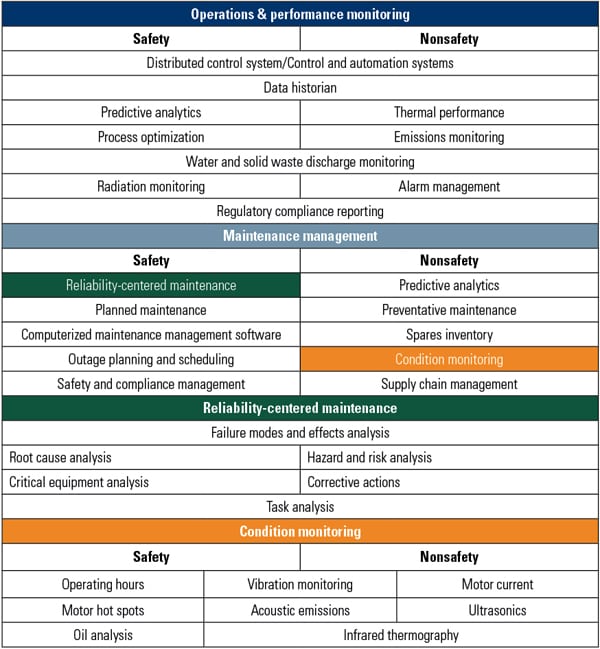 |
| Table 1. Not so simple. Asset management at the plant level might be synonymous with a condition-monitoring system and analogous to other plant functions, such as operations and performance monitoring, maintenance management, and reliability-centered maintenance. Source: Pearl Street Inc. |
At the owner/operator executive level, the asset management system is probably thought of more in terms of the business management systems (such as those supplied by SAP, IBM, and Oracle), which specifically link to the power plant data and digital systems. The distinction often made here is between the corporate information technology (IT) system and the operations technology system. But it is not just that either.
In between the plant workers and the executive suite are several other critical elements of “asset management,” including the off-line or periodic condition-testing data, other monitored process and supervisory variables, and predictive analytics software, all of which can be combined with work processes and procedures to form the reliability centered maintenance (RCM) system.
Any or all of the elements just described have logical interfaces with the computerized maintenance management system, stores and inventory management systems, central or corporate engineering department, centralized or multi-asset portfolio performance-monitoring facility, outage planning and scheduling processes, and so on.
Asset Management Starts at the Design Phase
One of the greatest challenges today in new plant design, engineering, and construction is to ensure that the asset management “system” is compatible with the owner/operator’s existing business and plant-level systems. For the most part, the asset management system is fragmented among different pieces of software, often found in various functional silos such as operations; maintenance; environmental, health, and safety; instrumentation and control; and regulatory. To make things more complicated, a variety of programs are available for RCM and enterprise management systems that include asset management components.
The software and hardware elements of asset management (Table 2) are often at the bleeding edge of technology and therefore are constantly being updated and improved. The design of an asset management system must include how to accommodate the evolving digital technology that will support it. Rather than simply buying software loaded onto computers and servers that will come with the plant from the automation supplier, there should be an intelligent design and rationalization of all the software and digital elements with an ongoing life-cycle perspective.
 |
| Table 2. Elements of a comprehensive asset management system. In addition to typical operator rounds and operators collecting data from handheld devices, data is collected by instrumentation and other software applications. Source: Pearl Street Inc. |
Because the components of asset management software supplied by various vendors overlap to a great extent, it should be the responsibility of the owner/operator to rationalize supply. You don’t want to buy what you don’t need or won’t use. Potentially millions of dollars can be saved in software licensing fees. A well-thought-out asset management strategy can help rationalize redundancy, spares, and excess capacity against the most advanced means of monitoring and managing operational risks. One example: a variety of “soft sensor” technologies could replace traditional hard-wired sensing.
Identify Critical Systems
An early step in all asset management programs is to identify and classify all plant equipment based on how critical it is to the continued and/or safe operation of the plant. This exercise is similar to determining the level of monitoring and protection given to any particular component and is based on such factors as effect on production, expense, complexity of repairs, environmental health and safety risk, operator presence, and location. For nuclear plants, the critical vs. noncritical determination is complicated by the safety vs. nonsafety system designation that affects everything nuclear with respect to regulatory compliance.
Some of the criteria that will determine the importance of individual equipment in a nuclear plant include: safe shutdown, safety-related equipment, components essential to power operation, events that trigger maintenance-rule functional failures, environmental qualification, station blackout, fire protection, anticipated transient without SCRAM, and pressurized thermal shock.
Propagating Data
One monitored data point from a plant component will be distributed, propagated, and used by multiple human experts as well as by various software systems. Some monitored points may be critical from the standpoint of asset management and therefore the quality of the sensor purchased, redundancy, and other issues may need to be reassessed. Remember: The automation system vendor is specifying and purchasing sensors and control elements to meet the control strategy, typically not the asset management strategy.
Some software systems, especially in the thermal performance and predictive analytics and condition-monitoring areas, will have their performance and usefulness optimized only if the data input requirements to the software are properly thought through. In other words, there are key measurements in the plant that can optimize the asset management suite, and some of these measurements/monitored points may not be the same as the ones for the automation system. Powerful predictive analytics programs can often avoid the need for certain sensors and monitored points.
Objectives of the asset management system design and specification might include the following:
- Failure analysis of critical components shall be integrated electronically/digitally into computerized maintenance system.
- Asset performance data for critical equipment shall be collected automatically in real time.
- The system shall support continuous improvement teams for condition-based and reliability-centered maintenance activities.
- Monitored data from the actual equipment—as opposed to generic equipment models—shall be used to build models that automate work functions such as workflows, parts ordering, and inventory.
Regulatory Requirements
Title 10 of the Code of Federal Regulations (CFR) Part 52 requires “reliability assurance programs” (RAP) for nuclear safety–related equipment. Additionally, the U.S. Nuclear Regulatory Commission (NRC) distinguishes between the design basis RAP (D-RAP) and the operations basis RAP (O-RAP). The reliability achieved must also support the probabilistic risk assessment (PRA) of specific components. In other words, specific safety-related equipment must achieve a reliability factor sufficient to support the PRA, which is part of the certified reactor designs. No consensus exists, however, regarding what, exactly is required to directly fulfill the RAP intent.
The RAP is, in effect, a scheduled maintenance plan. Scheduled maintenance has to be integrated into the RCM program to maximize safety and minimize cost. Licensing new designs includes certifying a complete RAP. A prospective licensee’s inspections, tests, and analyses acceptance criteria (ITAACs) verify final conformance to specifications that ensure safe operations. Completing the ITAACs allows the finished certified, licensed plant to operate. One ITAAC addresses a key part of design: the RAP. Although various NRC requirements and industry practices address reliability issues of specific parts of the plant piecemeal, there is no integrated program that addresses plant reliability holistically and comprehensively.
Today, the nuclear plant vendor provides the master equipment list to meet combined operating license requirements for the RAP. However, this should only be considered the bare minimum. Even something like the maintenance rule 10 CFR 50.65, which is triggered when the D-RAP transitions into the O-RAP, should not be considered an adequate RAP.
The RAP should answer the question, “What activities make this piece of equipment reliable?” We could extend this by saying the RAP should include everything working together and integrated that makes a piece of equipment reliable, including:
- Online sensors and monitoring devices with which the component is equipped.
- Periodic and regular condition-based data taken on that equipment, such as operator rounds and handheld instrument data.
- Predictive analytics and monitoring methods and software governing the equipment.
- The availability of spares and consumables required by that equipment.
- The visibility of the data and information about that equipment to decision-makers through the maintenance management software or 3-D virtualization software.
- Automation of work orders and tasks required by the equipment.
- The ease with which data and information about the equipment is accessed by the appropriate people and organized and presented to make it most useful.
- The critical nature of that equipment with respect to the availability and safety of the plant.
- Similarity, familiarity, and uniformity of the processes and procedures with other nuclear plant assets under the responsibility of the owner/operator.
Therefore, even if a comprehensive system governing the knowledge around the asset isn’t a practical goal during the design phase, then a comprehensive RAP should be.
The asset management “system” also may need to comply with, or at least consider, various existing or pending industry standards, including the Institute of Nuclear Power Operations (INPO) AP913; the Nuclear Energy Institute’s (NEI’s) Standard Nuclear Performance Model, PAS 55; probabilistic safety assessment (PSA) models; the Electric Power Research Institute’s (EPRI) planned maintenance (PM) templates; the Communities of Practice guidelines, the Department of Energy/EPRI aging management programs; and/or the International Atomic Energy Agency Technical Document 1305 or some version of a RAP as described previously (Table 3).
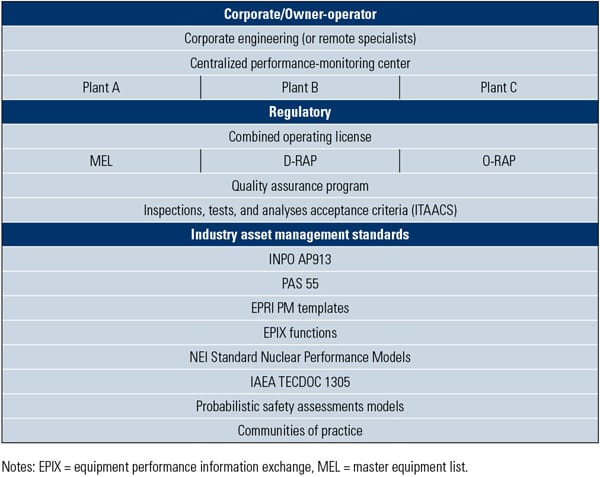 |
| Table 3. Levels of compliance for a nuclear asset management system. Source: Pearl Street Inc. |
Nuclear plants could also draw on the experience of fossil-fueled plants, where staff engineers often receive performance and operations and maintenance–related data and information on their smart phones or handheld devices. One power plant today may have several thousand process and sensor points. A fleet of large coal-fired supercritical units may have as part of its asset management system more than 300,000 “tags,” process data points that represent monitored data points, calculations, or information points. These process sensors and data points become the raw material of the owner/operators’ asset management program.
Oil and gas facilities also are beginning to deploy advanced technologies, including 3-D visualization technology, so that all the asset management data and information is organized around actual 3-D representations (developed by laser scanning the actual plant) of the as-built (and ever-changing) plant.
Relevant Industry Models
Because the next generation of U.S. nuclear unit projects are only now moving forward into the design and project management stage (from generic design and NRC approval stages), the concept of designing a suitable asset management system is only now being considered. Here are some important industry standards that staff should factor into the asset management strategy.
INPO AP 913, Equipment Reliability Standard. This standard is undoubtedly familiar to U.S. nuclear owner/operators. Although it certainly could be considered the foundation for a nuclear asset management program, today it is likely only a piece of a more sophisticated approach. Of critical note, though, is AP913, Appendix G, “Considerations for Building Equipment Reliability.” At a minimum, the design of the asset management system—the hardware, software, and digital elements—should be shaped to meet these requirements, to automate those aspects that are repetitive (such as acceptance checks), and to include new technologies for condition monitoring and other functions.
Standard Nuclear Performance Model. The Standard Nuclear Performance Model latest revision 2007 (developed by the INPO, NEI, and EUCG), identifies core processes, such as plant operation, work management, supply chain, equipment reliability, and configuration management, and then enabling processes, information technology, information management, human resources, business services/asset management, training, loss prevention, and support services.
PAS 55 Asset Management Standard. This relatively recent standard has been developed and promoted by UK companies (with compliance by utility companies mandatory). It appears to be gaining some traction in Europe, but there’s less awareness of it in the U.S. Asset management is defined in this standard as “systematic and coordinated activities and practices through which an organization optimally manages its assets and its asset systems, their associated performance, risks and expenditures over their life cycles, for the purposes of achieving its organizational strategic plan.” Interestingly, this standard recommends creating a chief asset officer in the company executive suite (see sidebar).
IAEA-TECDOC-1305, Life Cycle Management. Though this document addresses many of the issues embodied by asset management systems, it appears to be too general and too old (issued in 2002, although there may be revisions) to be of use for today’s nuclear plants.
Putting It All Together
Although at the plant level, a condition-monitoring system might be considered “asset management,” a comprehensive strategy has to go further and deeper. An asset management strategy should also go beyond the plant boundaries. Owner/operators with large fleets of power plant assets have moved to a centralized fleet monitoring facility, where engineering and technical expertise is shared among many assets. The asset management strategy needs to consider which functions will be distributed at the plants and which will be handled centrally.
This article is based on a technical paper presented at the 2011 ISA Power Industry Symposium and is available at the POWID website.
—Jason Makansi (jmakansi@pearlstreetinc.com) is president of Pearl Street Inc. Timothy Hurst (timh@hursttech.com) is president of Hurst Technologies Inc.