Combined-cycle plant operators have always recorded how long and often their gas and steam turbines have run and used that data to schedule overhauls and maintenance. Whether the metric used is equivalent operating hours (EOH) or equivalent starts/hour, tracking turbine use to monitor the cumulative effects of wear and corrosion has become the established method for scheduling major maintenance. It only makes sense to extend this strategy to the combined-cycle plant’s third key system—the heat- recovery steam generator (HRSG).
Scheduling upkeep according to key operating parameters such as turbine operating hours or starts, HRSG drum pH, or total fuel flow since the last overhaul enhances both maintenance and system reliability. A plant that is started up hundreds of times annually will have different preventive maintenance (PM) intervals for its pumps, valves, and turbine and HRSG components than a plant that runs continuously. If PM service intervals don’t reflect this reality, an equipment failure will always be a surprise—a very unpleasant surprise if it brings down a plant and prevents it from making a big profit on a peak demand day when spot market prices skyrocket. The PM approach may be operator-friendly, but addressing plant reliability by waiting for a failure to occur and then repairing its cause is not an economically viable strategy.
Who should apply?
Tracking the EOH of systems to correlate cumulative wear and corrosion with accumulated run time began in the aerospace industry. Most turbine and HRSG manufacturers now use the process to predict how long their systems will perform reliably with timely maintenance, and how quickly they will fail without it. A combined-cycle plant that would benefit from implementing an EOH tracking program is one that:
- Is routinely cycled or experiences large load changes.
- Uses lots of supplemental firing to handle large steam load swings.
- Switches the fuel of its gas turbines or duct burners.
- Duct-fires its HRSG(s) with low-quality fuels.
- Is often laid up for extended periods of time.
Tracking system EOH allows PM activities to remain consistent with plant operation. PM intervals are shortened when the plant is run harder, and extended when duty is less demanding. Even developing an EOH program is beneficial: The process identifies areas where maintenance can be improved, and those areas can then be emphasized by other management planning programs. However, the results of developing an EOH program are most important because they specify a consistent set of data collection processes suitable for plantwide use.
Beyond EOH
As mentioned, gas turbine vendors have long based their maintenance recommendations on formulas that relate cumulative component wear and tear to proxies such as EOH, starts, trips, and fuel switches. Indeed, most suppliers now include these formulas in their maintenance and service support agreements to help their power plant customers plan inspection and overhaul outages.
The earliest of these calculations produced results in terms of EOH only. Using a particular formula, an end user could equate the negative impact on reliability of a turbine start or trip to that of running the unit for a specific number of hours. Today, however, many gas turbine suppliers use formulas that produce more than just EOH numbers. Newer formulas also state the impact in terms such as equivalent starts (ES) and equivalent hours (EH), and some even calculate maintenance intervals. The first limit reached determines when maintenance will first be needed.
Rolling your own program
Unlike turbines, most other combined-cycle plant systems—including HRSGs—lack manufacturer-supplied EOH formulas or detailed PM recommendations for reliable service. If any maintenance guidelines are provided, they are rough, such as “overhaul every five years.” This lack of guidance requires the plant’s maintenance staff to determine HRSG PM intervals based on their personal experience or the experience of peer plants.
Tetra Engineering Group recommends taking the following steps to incorporate more complex EOH-type scheduling into a plant’s overall maintenance program:
- Identify the systems and components to be included in EOH calculations.
- Identify major service-related failure modes by component using Failure Mode and Effects Analysis (FMEA).
- Relate operational parameters such as starts, trips, high/low load, shutdown time, high/low temperatures, etc. to each failure mode.
- Match PM requirements to the failure modes.
- Determine the relationship of a system’s operational parameters to its longevity based on experience, analysis, or guidance from the supplier.
- Integrate manufacturer-supplied EOH values for the gas turbine, steam turbine, and HRSG(s) to produce a comprehensive and consistent EOH-based maintenance and inspection program for the entire plant.
- Implement EOH tracking either using an on-line system such as OSI PI data historian (www.osisoft.com), a link to the plant’s maintenance management system, or another maintenance scheduling tool.
The weakest links
With the exception of turbines, the HRSG is perhaps the combined-cycle plant system that can benefit the most from a well-designed EOH-tracking program. Although HRSG suppliers typically provide limited recommendations for scheduled maintenance, HRSG users must have a formal and detailed program of inspection and cleaning in place to avoid serious O&M problems. Such problems can be caused by daily cycling, overfiring duct burners, large steam load swings, tube leaks, water chemistry upsets, short- and long-term layups, or fouling of a selective catalytic reduction system’s (SCR’s) catalyst (Figures 1 and 2).
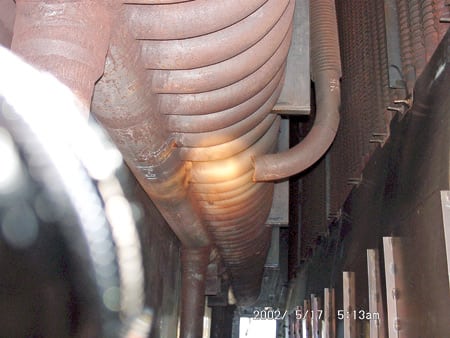
1. Extreme service. This boiler tube was ruptured by cyclic fatigue. Many HRSGs designed for baseload service experience problems like this when pressed into cycling service. Courtesy: Tetra Engineering Group Inc.
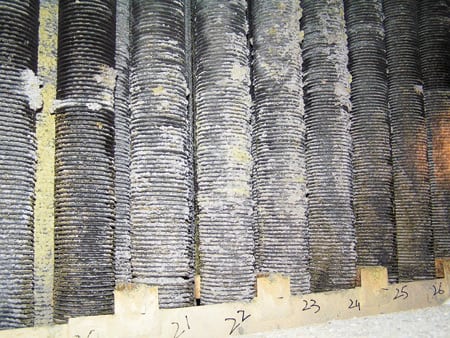
2. Deposit account. These finned superheater tubes are covered by heavy deposits as a result of burning low-Btu gas with higher-than-normal H2S content. Courtesy: Tetra Engineering Group Inc.
EOH formulas for an HRSG should be developed from a review of its design and operating history and based on a straightforward assessment of the lifetimes of major components. The assessment must include not just the HRSG’s pressure parts (Figure 3) but also all of its ancillary systems: main stream valves and sprays, reheaters, duct burners and supporting components, and its casing and stack. Remember to include the post-combustion emissions catalysts and controls for the SCR and CO systems.

3. Beat the drum. This HP HRSG drum had to be removed to repair damage caused by a gas explosion inside it. Courtesy: Tetra Engineering Group Inc.
An effective EOH program should also scrutinize other major systems and components of the typical combined-cycle plant, as explained below.
Valves. Large valves (bypass, stop and check, and feedwater control valves) are high-maintenance devices that must be installed correctly and are very sensitive to plant operating conditions (see “Desuperheating valves take the heat”). EOH formulations are best developed from direct experience at the plant and from the experience of similar installations at peer plants. A systematic review of maintenance and repair records usually provides invaluable insight into the effectiveness and thoroughness of previous maintenance programs.
Condensers. Steam condensers (air-cooled condensers in particular) are susceptible to corrosion, erosion, and mechanical damage at rates that depend on the plant’s operating profile and location. Fuel switches, bypass steam dump operation, and changes in steam and water chemistry all take their toll on long-term reliability. Both experience and analysis are required to set EOH parameters for condensers, and that’s also the case for deaerators and feedwater heaters.
Pipes. Power plant piping (main steam, reheat, and feedwater lines) is not immune to changes in unit operation. Thermal transients can fatigue and damage pipe supports, start-ups can produce water hammer, and load changes can increase flow-accelerated corrosion. Pipe stress and flexibility reports can provide basic data about thermal fatigue that EOH calculations can turn into actionable information. Separately, operations reviews and analyses can provide a wealth of data on corrosion and other damage mechanisms.
Pumps. Boiler feedpumps, condensate pumps, and circulating water and other large pumps also are affected by cycling. Here, experience and vendor guidance are the best foundations on which to develop EOH factors.
Electrical systems. Large transformers and switchgear usually come with guidance on overhaul intervals based on time, the effect of switching on load current, or other measures. These recommendations can be incorporated directly into EOH formulas.
Put it all together
Tetra Engineering Group has developed EOH programs for many combined-cycle plants. They range from programs that cover only the HRSG to those that cover a complete plant, including its gas and steam turbines. In our experience, the best ways to reap the full benefit of these programs are to:
- Keep EOH formulas simple but realistic. Develop a system that can capture significant plant upsets without too much effort. Avoid excessive detail, because it can result in an unworkable system.
- Expect minimal guidance from vendors. Be prepared to develop your own maintenance bases.
- Automate service tracking via your distributed control, performance indicator, or similar system. Make sure the system you use has basic data validation and replacement functions. The last thing you need is a tracking system that crashes due to the failure of an instrument.
- Consider renewal factors. Does overhauling a system or component make it as good as new again, or something less?
- Focus on the big-ticket items if your budget is tight.
Leveraging the effort
A good EOH program can also help justify the replacement of substandard components or the upgrade of an existing system (such as for water chemistry). In addition, it can justify taking action to address water chemistry or fuel problems reflected by higher EOH values. Finally, the actual operating and cost data developed by a strong EOH program are very helpful when developing dispatch cost and variable O&M cost studies (Figure 4) for plants that must routinely bid into competitive markets for operating hours.

4. Pay the freight. This chart shows a typical distribution of variable O&M costs, in $/MWh, for a combined-cycle plant. A plantwide EOH program can make managing these costs more precise. Source: Tetra Engineering Group Inc.
—Peter S. Jackson, PE (pjackson@tetra-eng.com) is director of field services, and David S. Moelling, PE (dave.moelling@tetra-eng.com) is chief engineer at Tetra Engineering Group Inc.