Optimizing combustion in pulverized coal (PC)-fired boilers today is more important today than ever. It is well known that the average American PC plant is over 30 years old and that over its lifetime NOx and SO2 emissions limits have been steadily ratcheted down (see box). Today, operators no longer wonder whether permissible levels will continue to fall but, rather, when and by how much.
The newest fork in coal-fired generation’s path forward is determining how to capture plant emissions of carbon dioxide (CO2) when—not if—the gas is regulated as a pollutant. Some advocate widespread installations of unproven integrated gasification combined cycle (IGCC) technology ASAP, to prepare it as a long-term solution. Others say building fleets of super-efficient supercritical and ultrasupercritical-pressure and -temperature plants would be a timelier, more prudent, and more cost-effective alternative. But while regulators, Congress, and the courts wrestle with the question of what to do about greenhouse gases, one thing remains clear: CO2 emissions could be lowered considerably by raising the efficiency of the existing U.S. fleet of 1,100+ coal plants.
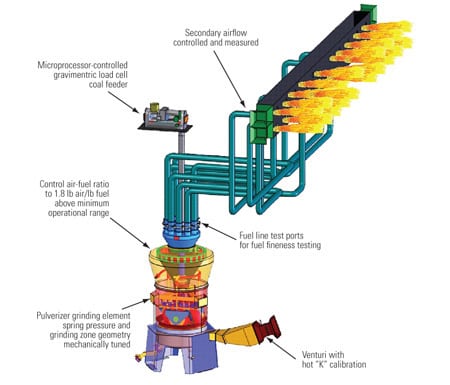
Today’s average U.S. PC-fired plant operates at a heat rate of about 10,500 Btu/kWh. Yet a subcritical (2,400 psi/1,000F/1,000F) unit is capable of operating at least 10% more efficiently, at a heat rate of 9,500 Btu/kWh (Figure 1). There are many proven ways to improve a boiler’s performance by continuously optimizing its controllable variables (see box). This article explores opportunities for raising a unit’s efficiency by improving the performance of its pulverizers.
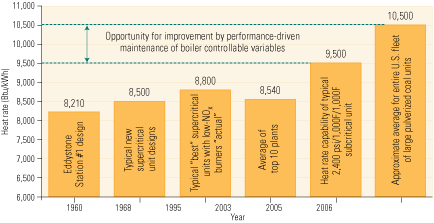
1. Room for improvement. The heat rate of most older coal-fired steam plants could be lowered by improving their combustion air and fuel systems. Source: Storm Technologies
Storm Technology’s experience has demonstrated that, of the 20 key O&M controllable variables with the greatest impact on unit heat rate (see box), most involve the furnace’s "burner belt." Essentially (and most often), in a plant operating at its lowest possible heat rate, the combustion airflows, pulverizers, fuel line balancing, burners, and air heaters will all be optimized.
Despite all the changes in regulations, equipment, fuels, and combustion controls over the past few decades, one thing has not changed in evaluating pulverizer performance: You need to get the inputs right! Table 1 breaks down the potential heat rate improvements achievable from giving your pulverizer and related systems a good tune-up.
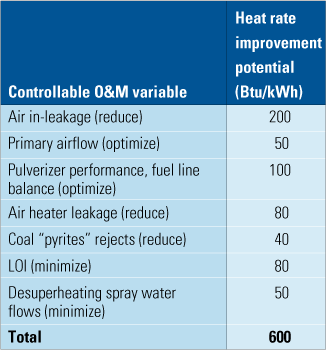
Table 1. Pulverizer improvements are significant and easy to accomplish. Source: Storm Technologies
Reversal of fortune
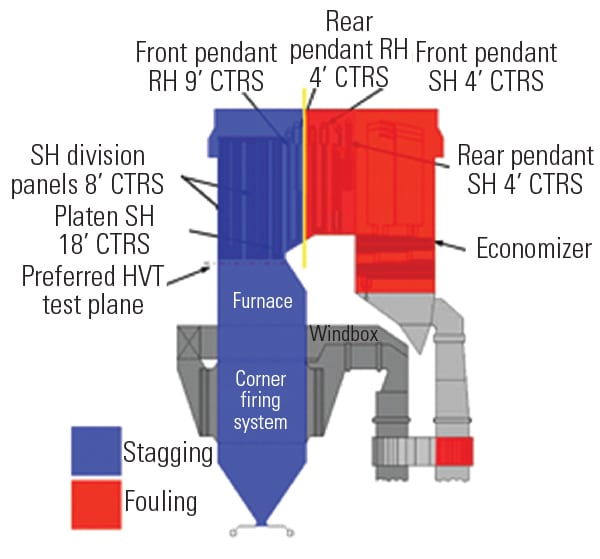
Before moving on to some prescriptions for pulverizer optimization, consider the internal configuration of a typical, 1970s-vintage 600-MW PC-fired boiler (Figure 2). The top of the burner belt is about 55 feet below the nose arch, or furnace exit. For optimal production and environmental performance, combustion must be 99% complete by the time its products are passing over the superheater and reheater surfaces. The flue gases are moving swiftly; the residence time in the furnace of the primary air/coal mixture that entered the furnace at the top burner level is less than 2 seconds. Usually, residence time from the top burners to the nose arch is more like 1 second. Remembering the shortness of this interval is important when it is essential to minimize NOx emissions and when firing fuels with high levels of iron and sodium in their ash.
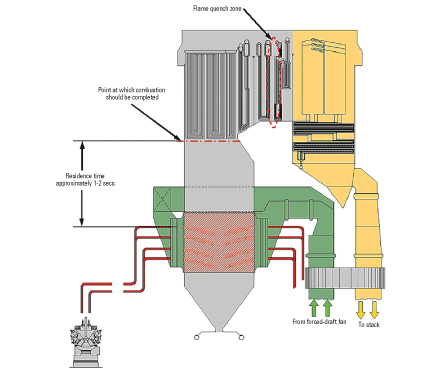
2. Burned to a crisp. In a typical "thirty-something" pulverized coal-fired boiler, 99+% of combustion should be complete by the time the products of the process reach the convection surfaces. Source: Storm Technologies
Common in-furnace NOx-reduction solutions include using low-NOx burners and overfire air (OFA) systems to intentionally stage or slow down combustion. Realizing that delayed combustion is fundamental to the design of all low-NOx burners and OFA systems helps in understanding why it is so important to optimize pulverizer performance. For example, the ash-softening temperature of a bituminous coal whose ash is high in iron content may be as much as 300 degrees F lower in a reducing (0% oxygen) atmosphere than in an oxidizing environment.
Storm Technologies has found that when coal with high sulfur and high iron content is fired with non-optimized inputs, excessive slagging occurs in the furnace due to the combination of coal chemistry and secondary combustion. The key point to be made here is that the effect of chemistry kicks in when the ash becomes "sticky" or molten, and that happens at a lower temperature with fuel ash high in iron content.
Low-NOx combustion deliberately consumes some of the furnace residence time for staging combustion and, as a result, contributes to more zones in the upper furnace being in an oxygen-deficient state. Consequently, more slagging occurs and more sootblowing is needed to remove the slag, which reduces heat transfer. Because increased sootblowing increases tube erosion and shortens tube life, suboptimal combustion contributes to reduced plant reliability and availability.
Double down
Suboptimal combustion also takes its toll on unit heat rate:
- Each extra sootblowing cycle imposes an overhead cost on steam cycle efficiency.
- The carryover of cinders into the air heater increases draft losses and fan auxiliary power consumption. The increased air heater differential will then increase air in-leakage due to the fouling.
- In units retrofitted with low-NOx burners or an OFA system, combustion may be actively occurring higher in the furnace, creating secondary combustion. This elevated center of combustion will decrease waterwall heat absorption, elevating the peak furnace exit gas temperature (FEGT). High FEGTs lower combustion efficiency and raise unit heat rate.
Given the extremely short furnace residence times and the staging or slowing of combustion to reduce NOx formation at the source, it is clear that combustion efficiency must be maximized in the burner belt. Unnecessarily high FEGTs can overheat superheater and reheater metals and cause higher-than-optimal desuperheating spray water flows (imposing a sizable heat rate penalty). Optimizing burner belt performance requires more precise measurement of key boiler performance variables and tighter control of the fuel:air ratio.
Focus on firing
By now, you’re probably asking,"What does low–heat rate, low-NOx boiler performance have to do with pulverizer operation?" Plenty, as it turns out. Several significant factors involved in optimizing combustion with low-NOx burners are equally applicable to corner-fired and wall-fired boilers.
Let’s first consider corner-fired boilers, which are considered inherently forgiving of less-than-optimal combustion tuning. This tolerance seems to derive from the fact that in corner-fired boilers (Figure 3), the entire furnace volume can be considered a single burner into which fuel and air are injected from the corners, creating a burning mass in the center. The burning mass serves to reduce peak temperatures. Meanwhile, tangential injections from the corners impart "swirl" to the fuel and combustion air at all burners; that creates a more homogeneous mix of the products of combustion for fuel-rich and fuel-lean burners. The tangential admission of the fuel and air also slightly increases the residence time of a coal particle, from its introduction into the furnace until its conversion to a burning carbon char particle that is quenched to below 1,400F in the convection pass.
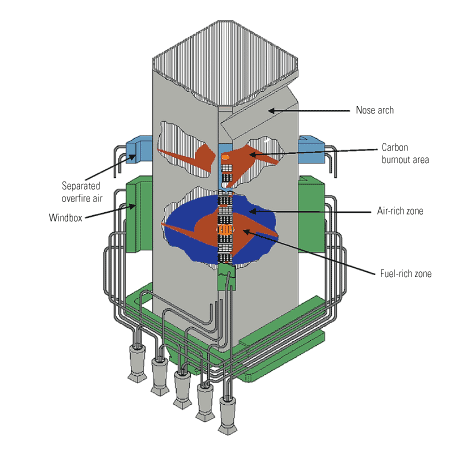
3. Stand in the corner. Corner-fired boilers utilize more of the total furnace for combustion and tend to have lower NOx emissions. Source: Storm Technologies
The "burning mass" principle also reduces the intensity of combustion in the burner belt, lowering "natural" NOx levels in the process. Before low-NOx burner technology was perfected, corner-fired boilers inherently produced less NOx than wall-fired boilers. Modern, low-NOx designs stage combustion not only vertically, but horizontally as well.
Learn from experience
Another proven way to reduce NOx emissions without imposing a heat rate penalty is to apply high-momentum OFA through opposed nozzles in the upper furnace. Figure 4 shows the configuration of such a system, as installed both at AES Corp.’s 126-MW Westover Plant in Johnson City, N.Y. (see POWER, October 2006) and Savannah Electric’s McIntosh Plant.
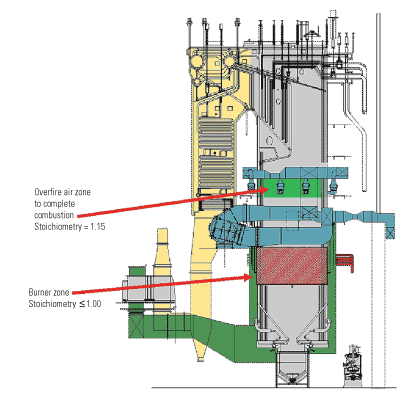
4. Over and above. NOx emissions can be reduced by applying high-momentum overfire air through opposed nozzles in the upper furnace. Source: Storm Technologies
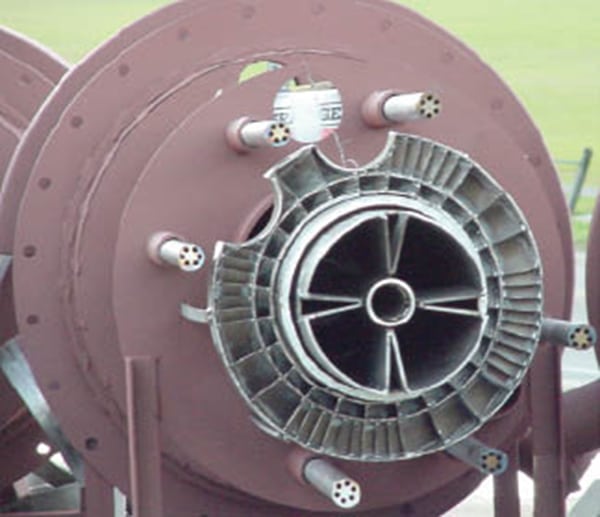
In Storm Technologies’ experience, wall-fired boilers require fine-tuning of the fuel and air inputs to the burner belt to optimize plant performance, response, and heat rate. A good example is McIntosh Unit 1, a 1975-vintage, 175-MW unit with 16 front wall-mounted burners (Figure 5, left). The furnace division panel separated the eight burners on the right side of the boiler from the eight burners on the left. The 16 burners are arranged in four levels of four across. A fan-boosted OFA system was retrofitted to the unit (Figure 5, right) with excellent results (Table 2). For McIntosh Unit 1, the overall project included optimization of its pulverizers, burners, combustion airflow paths (primary, secondary, and OFA), and improvements to the management and control functions of the systems.
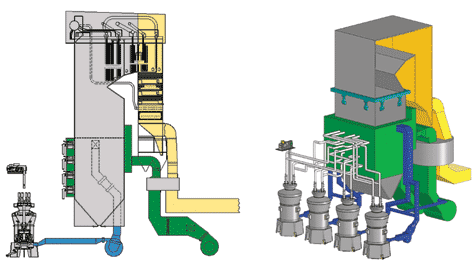
5. You’re fired. McIntosh Plant Unit 1 before (L) and after (R) retrofit of a fan-boosted overfire air system. Source: Storm Technologies
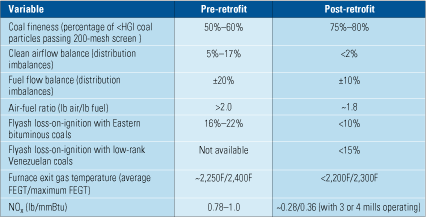
Table 2. Results of retrofitting a fan-boosted overfire air system to Unit 1 of Savannah Electric’s McIntosh Plant. Source: Storm Technologies
This wall-fired unit—which has an unforgiving furnace arrangement (furnace division panels and wall-mounted burners) and a relatively short residence time (1 second from the top burners to the nose arch)—validates the potential of using the tenets of combustion optimization found in Table 1. It has test-burned a wide range of coals from South America, Central Appalachia, and the Powder River Basin with good results.
Those results include improved reliability, which must be quantified and factored into the savings equation. Optimized combustion has reduced slagging and fouling. Improved fuel fineness, fuel distribution, and combustion air distribution also have contributed to greater unit availability.
One less well-documented advantage of greater fuel fineness (75% of coal particles pass a 200-mesh screen, and none pass one of 50 mesh) is reduced waterwall wastage. This type of corrosion becomes more severe on boilers operating at supercritical pressure and firing fuels with high sulfur and iron content. Even boilers running at 1,600 to 1,800 psi can have their useful life shortened considerably if their waterwalls are exposed to highly aggressive fireside corrodents of sulfur and iron in a reducing environment.
Future shock
In fact, the industry can expect fireside wastage to become more prevalent as more 30+-year-old plants install SO2 scrubbers and then are converted to be capable of firing higher-sulfur coals. Why? The reason is because most low-sulfur compliance coals also have low iron content in their ash. These coals are "forgiving" from the perspective of contributing to aggressive fireside corrosion of water walls and slagging. Once a plant owner has spent the money on a scrubber, he will be tempted to buy a higher-sulfur fuel (with higher iron content in its ash) for economic reasons—primarily escalating Western coal rail costs and improved Eastern coal cost-competitiveness. This "reverse fuel switch" trend is likely to foster more slagging, fouling, and aggressive furnace tube corrosion.
Fortunately, there are options available to prevent increases in slagging and fouling that result from a reverse fuel switch. One for minimizing fireside wastage is to optimize pulverizer performance to fuel fineness that’s acceptable in all fuel lines at all times. Storm Technologies’ standard minimum recommended fineness is greater than 75% of particles passing through a 200-mesh screen and none through a 50-mesh screen. Lowering superheater and reheater metal temperatures, to reduce slagging and fouling in the convection passes, is another step than can be taken to improve unit reliability and burner belt combustion.
Finally, operating a unit at its maximum efficiency and capacity should be an overriding economic objective. Optimizing pulverizer performance and burner belt inputs can help reach that goal. So can diagnostic performance testing of fuel lines, combustion airflows, and key upper furnace combustion parameters. When fuel line fineness declines, and reducing environments are found in the furnace, corrective action should be taken immediately.
Cleaner coal-burner
To sum up, there are three significant ways in which optimizing pulverizer performance can contribute to a reduction in a coal-fired boiler’s NOx emissions.
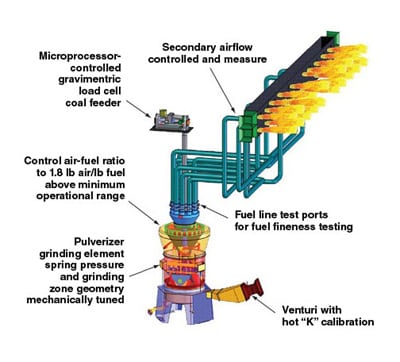
One. Release of fuel-bound nitrogen in the burner’s devolatilization zone is enhanced by making coal particles smaller, in effect increasing the overall fuel surface area. Low-NOx burners are most effective when they’re fed coal that has been finely ground. Poor fineness traps fuel-bound nitrogen within the carbon char particles, beyond the reach of even the best low-NOx burners.
Two. Fuel balance usually improves with better fuel fineness. A powdery mixture of fine coal particles passing through a pulverizer, classifier, and coal riffles (if the unit is so equipped) will flow more uniformly when it is more finely ground. Such fuels actually flow more like a gas when entrained at the proper ratio in the primary air stream. Fine coal particles mixed in the transport air become more uniformly distributed than coarsely ground coal particles at a similar air/fuel ratio.
Three. A more homogeneous mixture of coal and air entering the burners will naturally reduce required excess air levels. By reducing the total airflow and reducing the excess air, thermal NOx production is reduced. The better the mixing of the combustion products in the available residence time, the less "extra air" that has to be added to create oxidizing zones in portions of the furnace that are fuel-rich (Figure 6). When these "peaks and valleys" of free oxygen and high temperatures are made more uniform, then it becomes possible to reduce the total excess air that has to be added to make up for imprecise fuel and air inputs into the burner belt.
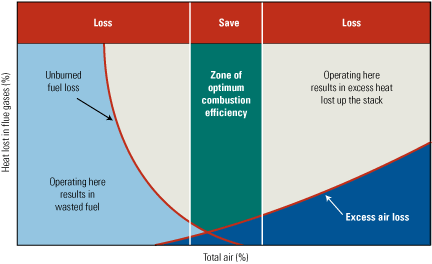
6. Walk the line. Economic plant operation requires operation in the narrow zone of optimum combustion efficiency. Source: Storm Technologies
—Dick Storm is president of Storm Technologies (www.stormeng.com); he can be reached at (704) 983-2040 or rfstormsea@aol.com. Stephen K. Storm is a vice president of the company and its manager of technical field services; he can be reached at 704-983-2040 or skstorm1@aol.com.