Electricity grids are slowly getting smarter. Simultaneously, the use of distributed generation is increasing. Though smart grid advocates tout the ability of a smarter grid to enable greater deployment of distributed resources, the benefits could flow in both directions.
In decades past, distributed generation (DG) consisted of a smattering of off-grid generation sources, industrial and commercial grid-connected generation—including backup supply and combined heat and power (CHP), and strategically located utility-placed generation for grid reliability. DG was fairly predictable.
Today we are seeing an expansion of the types of technologies that fall under the DG umbrella (see the sidebar “Distributed Generation Is Up—Way Up”). In addition to the familiar diesel- and gas-fired engines and microturbines, wind power and rooftop solar generators are proliferating across not just North America and Europe but on every continent. (Yes, even Antarctica’s research stations use solar and wind power.) Electric vehicles are starting to both take from and give back to the grid. Small and micro-size nuclear power generation promises to become a DG power source in the foreseeable future. And pole-mounted solar generation starts to blur the very line between distributed generation and distribution lines.
Some of these new DG technologies are being developed in anticipation of a more widespread, smarter grid. But others are proliferating for other reasons, and the grid—whether “smart” or “dumb”—will have to deal with them. Accommodating increased DG, especially sources that are not under full-time, direct utility control, would be easier with a smarter grid. More energy storage options would help, too (see p. 30, “Energy Storage Enables Just-in-Time Generation”).
Though many of the distributed resources discussed below likely would have materialized without the prospect of a smarter grid, a smarter grid promises to maximize their value to both their owners and the greater grid. But the grid stands to benefit from increased DG as well. From peak load management to voltage support, smart grid operators are likely to welcome the ability to interact with small generation sources located in or near load centers.
Old and New Types of Distributed Generation
Wind and solar power have become common enough to count as “old-style” DG, even though solar photovoltaics (PV) have not been around as long as reciprocating engines. And although new wind turbine designs are proliferating (see p. 38, “Changing Winds: The Evolving Wind Turbine”), the basic principles and constraints (such as variable generation) are familiar.
System operators may not always have the most precise tools to predict and control such resources’ contribution to supply, but all of the major North American regional transmission organizations are already using central wind power forecasting programs, and tools to predict output from solar generation are being developed. For example, researchers at the University of California, San Diego and Merced are working on solar forecasting techniques that would help any large or small grid operator predict and plan for variable solar generation.
For the purposes of this article, “distributed renewables” are those that do not require new transmission and that are connected to the existing distribution grid, when they are grid-tied. That includes an increasing number of residential installations that may or may not be utility-owned. An overview of less-familiar DG options follows.
Microgrids
Sitting between microgeneration and utility-scale “central station” generation are microgrids. They typically consist of multiple small generation sources situated in the midst of, and serving, a dense load center. Some microgrids get developed for economic reasons, some to enhance supply surety, some to ensure local control over electricity supply, and some to cover all three bases.
Research for a Pike Research report on microgrids released in the fourth quarter of 2010 found that “there are more than 140 microgrid projects totaling over 1.1 gigawatts (GW) of capacity worldwide. The current mix of microgrids is heterogeneous in nature, utilizing a wide variety of renewable and fossil fuel–based power sources in addition to a full range of application segments, including commercial and industrial sites, university campuses, remote off-grid communities, and military microgrids.”
Though microgrids are most common on industrial and university campuses (see “Smart Power Generation at UCSD” in our Nov. 2010 issue), their advocates (including the Galvin Institute—see “In Search of Perfect Power,” Apr. 2009) argue that more microgrids would mean enhanced grid reliability and security. Microgrids have been around for awhile, but the overlay of smart grid technologies promises to make it easier to interconnect them to, and island them from, a main grid. That capability would be mutually beneficial for DG and the grid. And that’s where the interplay gets interesting.
Microgrids and the smart grid have several shared goals. However, as Smart Grid News editor Jesse Berst noted in Oct. 2009, “The Smart Grid is largely being deployed by utilities, while the microgrid model has been, until recently, primarily the terrain of non-utility developers. Instead of upgrading the entire utility grid to the same ‘smartness,’ microgrid advocates argue that power quality and reliability (PQR) could be improved incrementally at the local level, offering services specifically tailored to the needs of customers.”
What’s more, Berst continued, “Utility engineers have historically opposed the concept of microgrid ‘islanding’ on the basis of safety.” Their fears may be less justified with a smarter grid and new inverter technologies that enable faster and safer disconnection/connection to the larger grid, and Berst cites evidence that “a few utilities are beginning to embrace microgrids rather than viewing them as a threat.” In fact, those that are willing to consider something other than business as usual are recognizing the potential value of microgrids to provide grid stabilization—provided smart grid control technologies are part of the system.
Virtual Power Plants
In contrast with microgrids, “virtual power plants” are a newer concept. Essentially, a virtual power plant consists of aggregated DG resources that are treated as a single entity. Typically, the individual resources would be small, but when pooled together, they would be of a size to provide reactive power or support peak power demand. Given their multiple locations (and, possibly, different generation technologies), it’s easy to see how controlling a group of small, dispersed generation sources would be facilitated by information- and communication-technology-assisted grid control.
Here’s how Siemens describes a virtual power plant: “The virtual power plant concept complements the big utility companies with their large, central power plants by creating new suppliers with small, distributed power systems linked to form virtual pools that can be operated from a central control station. Such a pool can unite wind power, cogeneration, photovoltaic, small hydroelectric, and biogas systems as well as large power consumers such as aluminum smelters and large process water pumps to function as a single supplier.”
Movable Generation: EVs and More
Movable, or portable, DG has been used for some time in niche applications, such as powering irrigation or electrifying portable fences. Such sources typically are not grid-tied. However, with a smarter grid, they need not be excluded. With the addition of a microchip and communications technology to determine who owns and gets credit for the movable power generation, the owners of a portable solar-powered fence, for example, could earn revenue from it on days when it’s not being used to corral weed-eating goats (Figure 1). Conceptually, all they would need to do is set the module in the sun and plug it into virtually any power outlet. Theoretically, any portable solar-powered device with a plug could become a movable generation source.
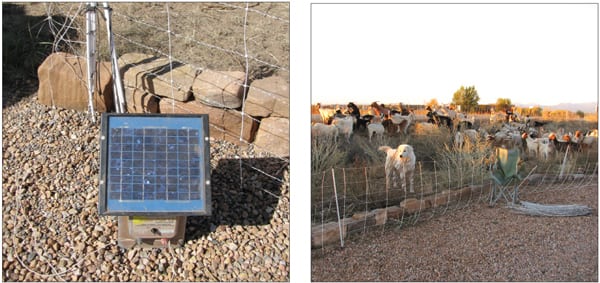 |
| 1. Portable power. A small PV module powers a portable fence that corrals weed-eating goats. When the module isn’t needed to power the fence, it could be used to feed power to the grid if it were equipped with the appropriate communication module and plugged into a smarter grid. Source: POWER |
Until the necessary electronics are incorporated into all renewable-power devices, the most common type of portable power is likely to be electric vehicles (EVs). Although EVs can only store, not generate, power, when they discharge to the grid, their electrons contribute to supply in the same way as a pumped hydro system or a coal-fired power plant. And those EVs—which will be showing up in more-noticeable numbers this year (mainly in China, the U.S., Europe, and Australia)—are the most distributed, and redistributable, power source currently imaginable (Figure 2).
 |
| 2. EV testing. A plug-in hybrid electric vehicle prototype is prepared for testing. Source: Argonne National Laboratory |
The long-term net benefit of EVs to a distribution grid are as-yet unknown, but even an EV advocacy group, the California Plug-in Electric Vehicle (PEV) Collaborative, notes in its strategic plan that, given the existing grid, “Over the next decade, electricity demand from PEV charging is unlikely to require new power plant or transmission line capacity. But even in small numbers, PEVs could stress local electricity distribution networks. Under certain circumstances, a cluster of PEVs in a particular neighborhood could overload or shorten the life of a local transformer and require equipment upgrades.”
However, with a smarter grid, both PEVs and the grid could benefit. According to the PEV Collaborative, “If appropriate technology and communication protocols develop, intelligent charging stations may allow PEVs to adjust their charging rate to provide additional services that contribute to increasingly efficient operation of the electricity grid.”
Summaries of two Electric Power Research Institute (EPRI) research programs nicely illustrate the potential pros and cons of EVs as well as the hopes and fears of utility distribution system operators.
One EPRI report looking at the impact of PEVs included evaluation of “the impact of the smart grid on load shifting and economic benefits in terms of deferred capacity investment.” It found that there is a net benefit for the grid and utilities.
Another one noted that “Both vehicle owners and utility companies would benefit if PEVs could draw power during off peak periods, but implementing a demand response program will require grid-to-PEV bidirectional communications to allow the utility system to influence the timing and amount of energy the PEV draws from the grid.” (Emphasis added to the part that many customers, especially in the U.S., fear. Note to utilities: Customers are going to demand the ability to override utility charging curtailment, aka demand response, programs. This is America, where automobiles were invented, and after paying a premium for PEVs, drivers are going to expect that they can drive, and charge, when they want to.)
Pole-Mounted PV: Literally Grid-Integrated Solar
Petra Solar describes itself as “a clean energy technology company that provides solar and smart grid solutions for utility, commercial and residential applications.” Though it makes systems for rooftop installation, its notable twist is “an integrated utility grade solar, smart grid, and power management solution primarily designed for deployment on utility distribution and streetlight poles.” That’s right, small PV modules feed juice directly to the grid, from the grid.
The company says its SunWave UP Series systems “consist of a high efficiency PV module and integral line voltage inverter with comprehensive communications capability and the ability to improve power quality and grid reliability through the injection of VARs and non linear power. Remote monitoring and control is achieved through an integrated communications network that creates an IP-based Smart Grid backbone when deployed in large scale.” The systems are said to be “compatible with existing grid infrastructure” as well as emerging smart grid technology and can be “remotely upgraded to leverage future applications and standards as they emerge.”
Petra Solar says the SunWave system’s price is “comparable to traditional PV technology” but offers “a measurably better return when installed behind the fence.” President and CEO Dr. Shihab Kuran, PhD has said that the technology is equally suited to rural areas with lots of poles and urban areas, where space for siting traditional renewables is scarce.
In Sept. 2009 the company landed a contract worth roughly $200 million with New Jersey’s Public Service Electric and Gas Co. to make units for 200,000 utility and street light poles in the state’s six largest cities and 300 rural and suburban communities in the utility’s service territory. The company said the project represented “the largest pole-attached solar installation in the world.”
The company has also received a DOE Energy Innovator Award and in Sept. 2010 was awarded $2.7 million in the DOE’s Stage III Solar Energy Grid Integration Systems awards (one of four companies to win an award).
The Pros and Cons of More DG
Distributed generation resources, of whatever technology type, sit mostly at the distribution level, rather than the generation or transmission levels, though the whole notion of “levels” would be moot with a fully realized smart grid (see “Generation and Distribution: No Longer Separate Spheres”), and some industry watchers predict that the percentage of demand supplied by distributed resources is likely to grow faster than central station generation, for a number of reasons beyond the scope of this article. Whatever percentage it supplies, DG is likely to proliferate in large part because its benefits typically outweigh the challenges it introduces, especially in times of economic and regulatory uncertainty.
The benefits of adding more DG resources—whether renewable or not—to a smarter grid anywhere in the world include these:
- Incremental supply can be added closer to where it’s needed, whether by using rooftop solar installations, quick-start engines, or other sources, thereby deferring the larger expense and regulatory trouble of building utility-scale/central station generation.
- DG can be sited where distribution lines already exist. That’s a significant advantage that small-scale renewables have over “utility-scale” renewable projects, which often require new transmission lines.
- DG improves efficiency by lowering transmission line losses because the power travels a shorter distance to its users.
- DG can alleviate grid congestion (see “DOE Program Fosters Integration of Smart Grid and Renewable DG”).
- DG often can provide reactive power.
- Reliability (particularly for customers that are part of a microgrid or who own small-scale generation that can be islanded) can be improved by adding DG.
- DG, particularly building-mounted PV, typically requires less water and land than similar capacity totals provided by central station plants.
The “cons” of adding more DG to a grid system fall largely into the categories of asset control and grid control:
- Asset control. DG resources will not always be owned by a utility, and decisions about adding distributed resources will not always require utility approval. From the point of view of a traditional utility looking only at “lost revenue opportunities” (rather than at systemwide efficiency and stability and avoided plant-siting headaches) that might be a negative. From a customer standpoint, that could be a positive feature, as the owner could choose the type of DG to install.
- Grid control. The proliferation of generation sources that are small in scale but potentially significant in the aggregate, and whose operation may not be directly under utility or grid operator control, could add challenges to grid operation. Or, as the North American Electric Reliability Corp. put it (in the one paragraph devoted to DG in its 137-page December 2010 report on “Reliability Considerations from the Integration of Smart Grid”): “Distributed resources have the ability to supply isolated parts of the system during disturbances and to supplement generation requirements during large generator failures. At higher penetration levels, distributed resources can affect reliability, unless operators have visibility and the ability to send dispatch signals to them. Otherwise, balancing and regulation would be challenging, and overall bulk power system control, hampered.”
That second concern brings us to the next big question.
How Much DG Can The Grid Take?
How much DG any particular grid system can integrate depends on how advanced it is and on how you define DG.
A Jan. 2010 California Public Utility Commission (CPUC) report notes that “Perhaps the most useful definition of distributed generation is one that focuses on connection and location rather than generation capacity. Based on comparisons of different characteristics and impacts of electric generating systems, researchers from the Swedish Royal Institute of Technology’s Department of Electric Power Engineering defined distributed generation as ‘an electric power source connected directly to the distribution network or on the customer side of the meter.’” That definition includes generation from all sources. However, different countries, governmental and regulatory bodies, and reports define DG in different ways, so straightforward answers to the “how much” question are hard to come by.
How Much DG Do We Have?
One 2009 study found that Denmark produces more than 45% of its power with DG. Keep in mind, though, that in Europe, DG often also includes demand response and renewable power projects of any size.
According to one European source (Improgres—Improvement of the Social Optimal Outcome of Market Integration of Distributed Generation and renewable energy resources in European Electricity Markets), power generation from distributed sources/renewable energy will rise from 490 TWh/year in 2005 to about 1,280 TWh/year in 2030. DG’s proportionate share of generation will also increase—from about 15% to about 26% in the same timeframe.
Determining precisely how much DG the U.S. has is difficult, particularly if one wishes to include non-grid-connected and all backup generation sources. The most convenient data source is the Energy Information Administration’s Form EIA-861, which collects data from utilities about generation sources under 1 MW.
For 2009, total U.S. small-scale “dispersed” generation was 3,615 MW and total “distributed” generation was 1,132 MW. Note that this EIA data source only collects information about small industrial and commercial generation, not residential installations, which would be even smaller. “Distributed generators” are those that are grid connected/synchronized; “dispersed generators” are not grid connected/synchronized. Total U.S. grid-connected capacity is roughly 1,000 GW, which means that the current percentage of grid-connected DG is extremely low.
California’s DG Experience
Integrating DG is likely to pose slightly different challenges depending on a grid operator’s resource types and load characteristics. With that caveat, as with many energy trends, California has some of the most extensive experience and documentation of DG use and may provide a useful example.
As of 2010, one source claimed that 2.5% of California’s peak demand was met by DG, which in California is defined as “typically in the range of 3 to 10,000 kW.” That’s a very small percentage, especially when you consider how much demand fluctuates and the percentage of supply that can be lost to a grid system due to a major weather event. Nevertheless, dealing with multiple small generation sources is harder for the current grid than working with fewer, larger sources.
A Jan. 2010 CPUC report on DG in California found that “Compared to the rest of the United States, California has a significant amount of DG installed on the grid, particularly solar. We will illustrate that as yet there are no noticeable impacts on the distribution and transmission infrastructure, based on performed studies. However, with the continued expected growth of DG, we identify in the following Chapters opportunities to develop consistent interconnection policies and the need for continued evaluation of penetration of DG on distribution feeders and DG’s contributions to reducing peak demand through existing technology and technologies still being developed.”
The 2010 report notes that “For the purposes of this report, [distributed energy resources] is limited to distributed generation and energy storage; referred to herein as DG resources.” Later, it explains that “One reason for not limiting our definition of DG resources in this report is the perception of what constitutes a DG resource has evolved over time.” Fair enough. Defining “distributed generation” is likely to get even more complicated, as the quick review of emerging options above demonstrates.
Unfortunately, this report also explains that “There is no readily available information on all DG interconnections within California.” Data accounting for certain types of DG are available through individual state programs: “the CPUC’s [Self-Generation Incentive Program (SGIP)], the Net Energy Metered (NEM)-biogas tariff pilot program, and various solar programs, including the [California Solar Initiative (CSI)]. Based on this information, there have been over 50,000 small DG facilities interconnected in California.”
In capacity terms, as of 2009, the report lists 400 MW from the SGIP, 509 MW from “customer-generators,” 3,475 from NEM biogas facilities, and 8,846 MW purchased by investor-owned utilities (IOUs) from “qualifying small power producers and cogeneration facilities.” These totals are just from IOU service territories.
Here’s another piece of the DG puzzle. California’s 2009 Integrated Energy Policy Report notes that “The Climate Change Scoping Plan has a target of adding 4,000 megawatts of combined heat and power capacity to displace 30,000 gigawatt hours of demand, thus reducing greenhouse gas emissions by 6.7 million metric tons of carbon by 2020.” The state has “almost 1,200 sites representing nearly 9,000 MW of installed CHP capacity.” It’s unclear how much of this capacity would be defined as “distributed” or as “dispersed.”
California has several policies that encourage DG, including net metering. “As of October 2009, the CPUC reports that more than 90 percent of the 509 MW of grid-connected solar in IOU territories are net metered.”
California has also looked hard at DG integration issues. Here are some observations from its 2009 Integrated Energy Policy Report.
The state’s 2007 Strategic Transmission Investment Plan noted that “it is imperative that California reach its 33 percent RPS goals and expand distributed generation applications, particularly rooftop solar PV and CHP.”
How easy will it be to integrate that DG? According to the 2009 report, “Studies by the CPUC and the Energy Commission have included scenarios of high penetration of distributed resources. The CPUC Energy Division Preliminary 33 Percent Implementation Analysis included a scenario with about 14 gigawatt (GW) of PV systems under 20 MW and also included about 250 MW of distributed biogas capacity.”
It continues: “Simulations and system analysis have shown that a significant amount of wholesale distributed renewable energy could be integrated into the California distribution grid. A recent analysis by E3 for the CPUC Energy Division found that approximately 69 percent of the California IOU substations can interconnect projects of 10 MW or smaller. Another study by General Electric on the effect of distributed renewable energy on feeder lines found that limits could range from 15 percent to 50 percent of feeder capacity depending on location and distribution. In addition, preliminary staff analysis suggests that about 10 GW to 11 GW of wholesale distributed renewable energy could be connected at the distribution level, at substations, or on distribution feeders.”
However, it notes that “Currently, the state’s electric distribution systems are not designed to easily accommodate large quantities of randomly installed distributed generation resources at customer sites. Accomplishing this objective efficiently and cost-effectively will require the development of a new transparent distribution planning framework that allows for the active participation of all stakeholders.”
In short, California needs distributed generation, and adding more distributed generation requires a smarter grid.
— Gail Reitenbach, PhD is POWER’s managing editor.