The University of California, San Diego has been accumulating awards for its savvy use of a constellation of power generation and energy-saving technologies. The campus already controls a fully functioning microgrid—including a cogeneration plant—and, as befits a research institution, is constantly looking for new ways to make its energy system smarter. This “living laboratory,” as campus leaders like to call it, demonstrates what it takes to build a smarter grid and why the effort is worth it.
Electric utilities have historically been conservative entities. In contrast, research universities—while preserving the wisdom of the ages—are always pushing the boundaries of theoretical and applied knowledge. That may be one reason that some of the most comprehensive advances in deploying technologies associated with the concept of a “smart grid” are happening on university campuses.
The University of California, San Diego (UCSD), for example, has collected multiple accolades and grants for a variety of initiatives related to its combined heat and power (CHP) plant, energy efficiency, and campus sustainability efforts. In 2002 the CHP plant received a VIP (Very Important Planet) Clean Air Award from San Diego Earthworks. This year, it was one of three 2010 Energy Star CHP winners (the other two were CHP plants at Fairfield University and the University of Missouri).
When considering energy systems more broadly, the campus has garnered additional kudos. The entire University of California system won a California Environmental Leadership Award from Global Green USA for its 32 LEED-certified buildings (those recognized by the U.S. Green Building Council’s Leadership in Energy and Environmental Design system)—more than any other university in the country—and for its leadership in research and education related to climate change, clean energy, and other sustainability issues. And the June issue of Fast Company named Director of Strategic Energy Initiatives Byron Washom one of “The 100 Most Creative People in Business 2010.”
Although many other campuses enjoy the benefits of CHP and may have energy management systems, UCSD’s comprehensive plan makes it an exemplar not just for educational institutions but also for other campus-like settings and “local power” initiatives. UCSD also demonstrates that successfully building a smarter grid requires multiple steps and initiatives, a clear view of the big picture, and a solid business plan. (For more information on CHP plants across the U.S. and Department of Energy [DOE] goals for CHP, see the online supplement “Combined Heat and Power Across the U.S.”)
Financially Viable Even in Tough Times
John Dilliott, PE, LEED AP is UCSD’s manager of energy and utility services. When POWER visited the campus in July, Dilliott said that, since the mid-1990s, UCSD has invested $60 million in energy-related projects, including the cogeneration plant. The San Diego campus also has “a new program that’s [budgeted] $73 million for energy efficiency, and it’s all based upon a payback analysis,” Dilliott explained. The campus uses an 85% debt ratio for all proposed projects: “For every $1 that a project saves, no more than 85 cents can go toward paying off the loan. That’s actually a pretty huge ratio.” Projects include replacing older office equipment with Energy Star–rated equipment.
Energy savings have more than covered the debt for the cogen plant, and that investment has had a positive cash flow. The CHP plant had an impressive five-year capital cost payback, based on avoided power purchase costs, which average $670,000 per month.
Dilliott made a point of noting that if a state-funded campus that’s having its budget cut (remember, this is California during the worst recession in a generation) can make self-generation and a microgrid economically viable, then it should be possible elsewhere—though not everywhere.
More than Heat and Power
The centerpiece of the UCSD energy system is its award-winning cogeneration plant (see the table for details), which operates at a net efficiency (LHV) of 66%. Cogeneration plants are also often called “combined heat and power” plants, but they can do more. Although many cogen plants do not use steam to drive chilled water, doing so makes a lot of sense for UCSD, Dilliott noted (see sidebar). Chilled water—cooled overnight when electrical demand is low—is stored in a 3.8 million gallon storage tower. During the day, chilled water goes out to all the campus buildings for air conditioning. The heat removed from the buildings is absorbed by the refrigerant, transferred to the cooling water in the chiller, and rejected to the atmosphere by the cooling towers.
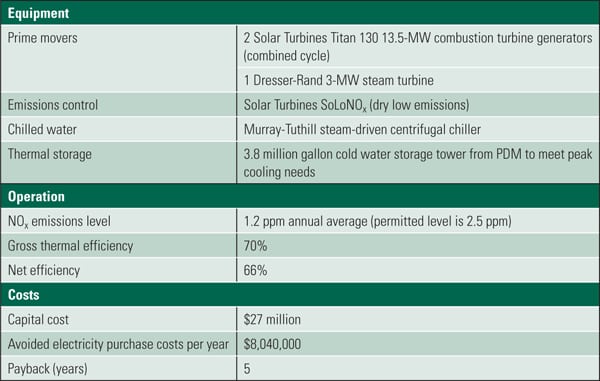 |
| UCSD’s cogeneration plant at a glance. Source: UCSD |
The San Diego campus was founded in 1960, and the Central Utilities Building (Figure 1) was the first structure built. Thanks to forward-thinking planners, steam was produced on campus from the beginning, and supply lines for heating and cooling were built out as the campus grew. Having all the steam-using equipment in place made adding cogeneration a lot easier, Dilliott acknowledged.
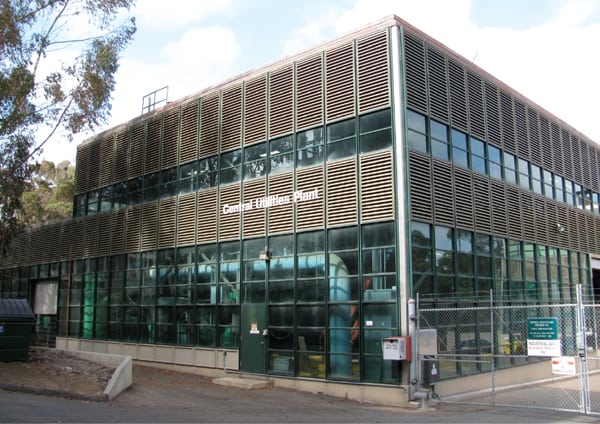 |
| 1. Central planning. When the University of California, San Diego campus was founded in 1960, the Central Utilities Building was the first structure built. Thanks to forward-thinking planners, steam was produced on campus from the beginning, and supply lines for heating and cooling were built out as the campus grew. Fifty thousand people come onto campus each day, giving the campus’s electrical and cooling load a steep bell curve. Source: POWER |
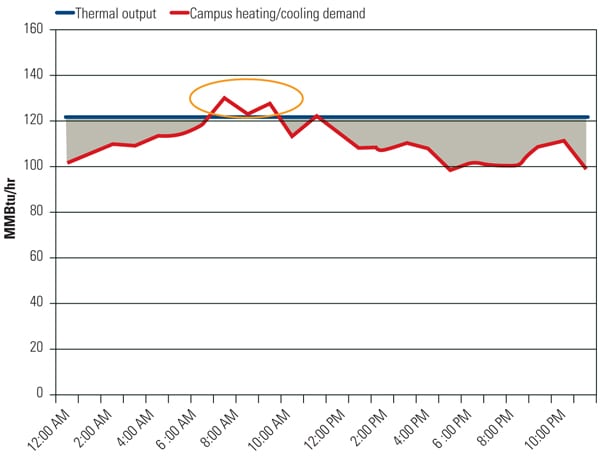
Annually, the cogen plant, which operates in electrical load-following mode with thermal override, supplies 85% of campus electricity needs, 95% of its heating, and 95% of its cooling. (See the online supplement “Matching Load and Generation at UCSD” for seasonal electrical and thermal load profiles.)
Thanks to Solar Turbines’ SoLoNOx dry low-emissions system, the UCSD plant’s emissions of NOx are typically below 1 ppm, which, Dilliott explained, is why the plant does not require tall stacks (Figure 2). In fact, Dilliott noted that when area wildfires have burned, the ambient air held more NOx than the plant was emitting.
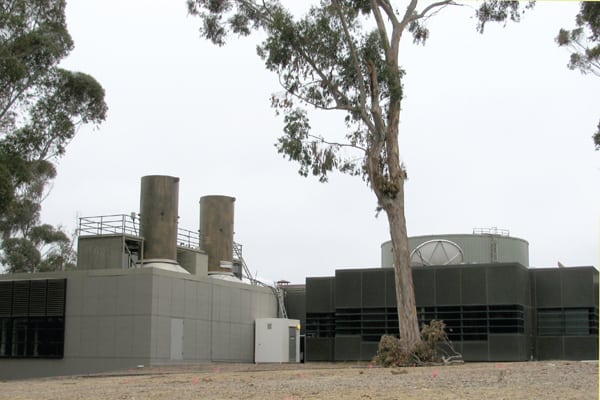 |
| 2. Short stack. From most points on campus, the power plant’s stacks cannot be seen. A dry low-NOx emission system avoided the necessity of taller stacks. The top of the chilled water tower is visible on the right, behind the eucalyptus tree and the Central Utilities Building. Source: POWER |
Economics, Pure and Simple
When asked about the original impetus for constructing a cogen plant, Dilliott explained that it was purely economics. Prior to deregulation in California, utilities’ “departing load charges” served as a disincentive to distributed generation (DG), as did various utility incentives not to cogenerate. When utilities went out of the generation business and those potential charges were no longer a factor, the economics improved.
Before cogeneration, the campus imported all of its electricity and purchased natural gas to operate boilers that made steam for heating and cooling the campus. Though the campus still purchases gas for the plant’s turbines, it does so through the California Department of General Services at an attractive rate. (The local utility, San Diego Gas & Electric [SDG&E], only provides transmission and distribution for commodity power and gas.) That option, Dilliott pointed out, was open during deregulation not just to state entities but also to any energy user of any size.
Other factors that improved the economics for UCSD included having an existing campus steam distribution system and the ability to use steam to drive chilled water for facility cooling, as well as for hot water and heating. Though plant operators recover “waste” heat from the Solar Turbines gas turbines to generate extra power when heating and cooling demand is less than the plant can provide, the priority is maximizing the value of heating and cooling with the cogen plant rather than firing up three auxiliary gas-fired boilers (which were on site prior to the cogen plant) to provide steam for those purposes.
The thermodynamic efficiency increase that the campus enjoys as a result of cogeneration is reflected in its bills. “We pay about $8 million less to the utilities than we did before,” Dilliott said.
Though power quality and reliability for the vast campus medical and laboratory facilities was not a primary reason for building the campus microgrid, it is a valuable side benefit.
A Suite of Technologies
In addition to maximizing the value of its cogen infrastructure, the campus serves as a test bed for several renewable and low-carbon energy technologies. When asked about the impetus for all of the following “green” and advanced energy systems, Dilliott answered, “Leadership at the highest level” wanted to create a “living laboratory.” Another factor was the campus’s close relationship with the Scripps Institute of Oceanography and “the fact that they are the pioneers of the science behind climate change.” Given those institutions’ joint role in alerting the world to the challenges of climate change, “It’s up to us to provide some solutions,” Dilliott said.
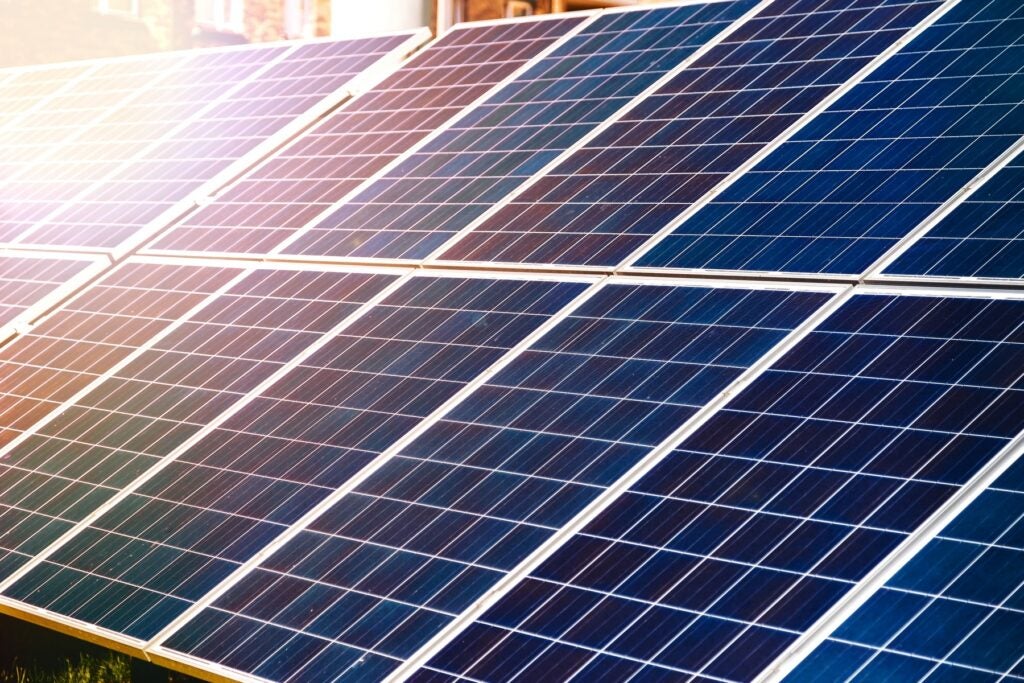
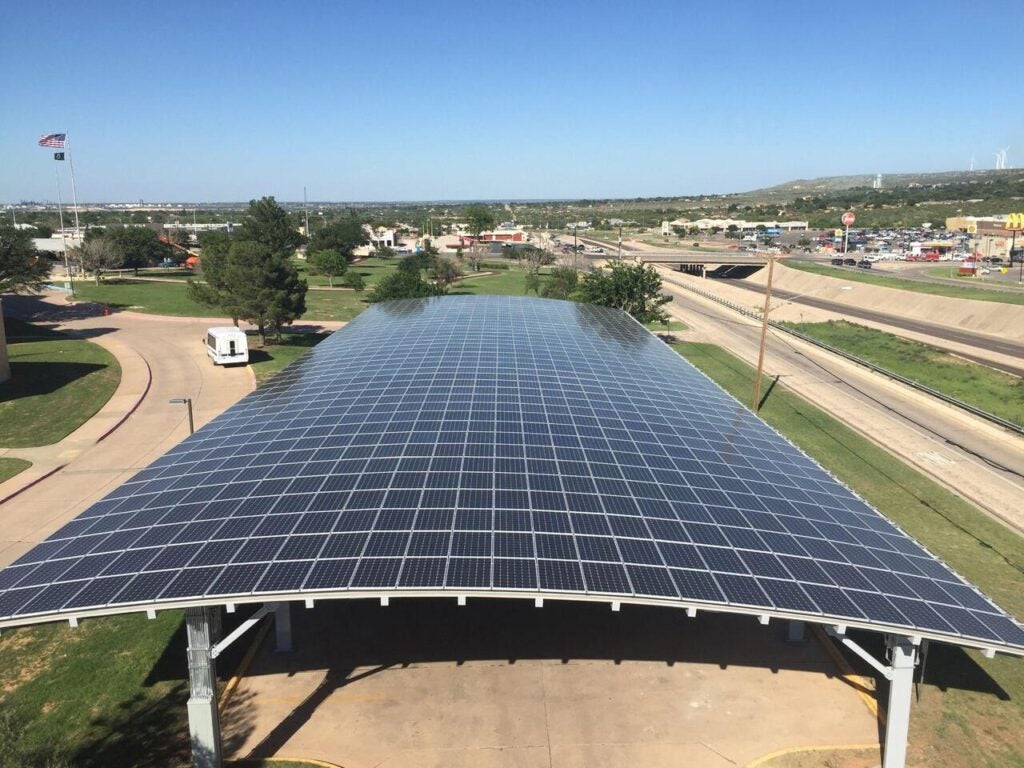
Solar. The San Diego campus has 1.2 MW of photovoltaic (PV) modules installed (Figure 3), mostly under a power purchase agreement (PPA) with Solar Power Partners. Campus PV modules, installed from fall 2006 through summer 2009, supply about 1% of the annual electricity demand. Two small systems—on the Powell Structures Lab (12.8 kW) and the Rady School of Management (18 kW)—are campus-owned. The $103,000 Powell system received a $35,000 rebate from the California Energy Commission’s (CEC’s) Emerging Renewables Program. Though there were no incentives for installing the Rady system, Kyocera donated the panels (valued at approximately $105,000). The campus got the cost of PV electricity to grid parity via rebates, which were capped at 1 MW.
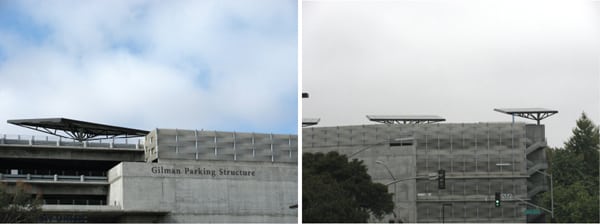 |
| 3. In sun and shadow. The Gilman Parking Structure holds 195 kW of solar panels. As with all solar generation technologies, their output varies, depending on whether the day or hour is partly sunny (left) or overcast (right). Campus researchers are working on solar forecasting techniques that would help any large or small grid operator predict and plan for variable solar generation. Source: POWER |
Dilliott estimates operations and maintenance (O&M) costs for the campus-owned solar systems at about $200 per year. O&M for the PPA installations is the responsibility of Solar Power Partners.
Planning for variable renewable generation is a challenge that promises to intensify for grid operators large and small. To help address that issue, Washom, the director of strategic energy initiatives, is working with UCSD researchers on solar forecasting, and the campus work in this area is supported by grants from the DOE and cofunding from the CEC. The California Independent System Operator (CAISO) is also investing in the system, Dilliott said, because it wants to know about solar ramp-up and ramp-down. The CAISO partnership is one example of how a small system like UCSD’s can be a valuable proving ground for much larger systems.
Fuel Cell. A 3-MW molten carbonate fuel cell that will run on waste methane is under contract with Fuel Cell Energy. California’s self-generation incentive program funds are going toward the fuel cell’s development, and the campus will also take advantage of 30% federal investment tax credits. Those incentives get the fuel cell to grid parity, Dilliott said.
Energy Storage. The latest component of the UCSD energy system is a plan to develop an energy storage system. Half of the capital cost will come from the California self-generation incentive program. Support has also been committed by the CEC and the DOE, which made a $2 million grant to UCSD and San Diego–based General Atomics in July.
The DOE describes the joint project as “a novel flow battery technology that pumps chemicals through the battery cell when electricity is needed. The proposed flow battery revolutionizes a century-old lead-acid battery technology to achieve low cost, high efficiency and reliability needed for use on the electric power grid. This high-risk technology development program will use novel materials that greatly increase power while resisting the corrosion that limits the cycle life of conventional lead acid batteries. The goal of these innovations is a battery that can be scaled for grid-scale energy storage but which costs less and performs far longer than today’s technologies.”
A Cool New System. UCSD is even evaluating the possibility of tapping the deep, cold seawater in La Jolla Cove to displace about 10% of the campus energy use by replacing mechanical cooling with ocean cooling. The Sea Water Air Conditioning system would obtain cold seawater from about 1 mile offshore at a depth of 750 feet. Cold seawater would be pumped through a 36-inch-diameter pipe to large titanium plate heat exchangers by shore-mounted electric seawater pumps.
Because of environmental concerns regarding the discharge, two options are being investigated: using a closed-loop system with the heat exchanger located at the deep water end of the pipe (at 750 feet) and incorporating desalination into the process using an innovative process called DEMWAX. The trademarked DEMWAX process is unique, Dilliott told POWER, in that it uses the pressure of the deep ocean to drive the reverse-osmosis desalination process and it provides an almost 1:1 ratio of water intake to desalinated water, thereby eliminating most if not all of the discharge.
Once onshore, the cold freshwater would be distributed around Scripps Institute via two 10-inch freshwater loops and through a main 40-inch loop routed uphill to the UCSD Central Utilities Plant.
Installing a Cutting-Edge Microgrid Controller
UCSD owns what’s typically called a microgrid—localized power generation, whose distribution is controlled onsite, in this case by a DynaElectric control system that is integrated with the campus energy management system and SCADA systems (Figure 4). (Most of the facilities’ energy management tasks have been automated, via Johnson Controls equipment.) That microgrid is connected to the utility grid but can disconnect and operate in islanded mode if conditions (such as a cascading blackout) warrant.
 |
| 4. Smarter control. Manager of Energy and Utility Services John Dilliott, shown here in the cogeneration plant’s control room, is overseeing an upgrade to a smarter, more automated control system. The sum of the new system’s parts is expected to be a world first. Source: POWER |
UCSD has only one connection to the SDG&E grid at the transmission level, and it owns the high-voltage substation, which, Dilliott says, gives the campus greater reliability. (That single point of connection feature is shared by the other UC campuses, he noted.) Having a substation also gives you a “huge break on your rates, so we invested… $15 million to own this high-voltage substation.” The campus also owns and maintains all of its distribution wires and meters.
The next step is more tightly integrating generation and end use through automatically controlling buildings to help manage load. Through a CEC-funded projected called RESCO (Renewable Energy Secure Communities), UCSD is in the process of installing what is being dubbed a world’s first: a microgrid with a master controller that reoptimizes and reschedules generation, storage, and load based upon dynamic market price signals either from the ISO or the local utility. The campus is unlikely to sell or wheel power, though, Dilliott explained, because periods when utilities would want to purchase power coincide with campus peak loads, when the system would have little or no power to spare. The project is being funded by a $1 million grant from the CEC and $1 million in matching funds from the university’s ongoing energy efficiency program, which is a collaboration between the California Public Utilities Commission, SDG&E, and UCSD.
The project will use EDSA’s Paladin SmartGrid master controller and Viridity Energy’s VPower optimization software. Dilliott noted that the EDSA master controller has its origins in the “mission critical industry, and it currently has over $100 billion in assets operating with its software and systems.” This new controller is expected to be fully operational next summer.
What has all of this to do with a smart grid? Dilliott explained that the “UCSD test bed for model evaluation will be an intensely metered microgrid representative of much of the urban coastal areas where (a) a dynamic system model using the EDSA Paladin master controller, (b) a network of 16 densely spaced microclimate monitoring systems (>1 per 100 acres), a hemispherical sky imager, and ceilometers [devices that use lasers or some other light source to determine the height of a cloud base] will (c) produce 1-hour-ahead output forecasts for 1 MW of dispersed PV that will (d) be utilized by Viridity’s microgrid scheduler/optimizer to make possible supply, storage, and load adjustments on a microgrid (e) based on dynamic market price signals. Each one of these five elements in and of themselves represents the leading edge of the current state of the art, but the assemblage of all five is globally unique.”
Additionally, he noted, “UCSD satisfies at least five of the eight Qualifying Investments criteria per [the Energy Independence and Security Act of 2007], Section 1306 (b), specifically subsections (2), (4), (5), (7) and (8). UCSD’s microgrid has operations and capabilities involving digital information utilization with devices and technologies; digital utilization with computers and other devices; digital measuring and monitoring of electricity; automatic protective responses; subtasks involving cyber security; programmable and automatic smart appliances and machines; automation of electro-mechanical/manual functions; and digital controls enabling distributed resources, congestion management, voltage control, operating reserves, and frequency regulation.”
A Living Laboratory
UCSD uses the campus energy system as a teaching tool, and energy managers use campus researchers and students to test out new technologies. For example, since the 1990s, thermodynamics classes have taken tours of the power plant. On the research side, the DEMROES system microclimate weather stations that measure wind speed, solar insolation, and temperature began as a mechanical engineering professor’s project to examine differences in energy in the air as a way to determine the best places to site new buildings and solar panels. Those sensing stations are tied into the Johnson Controls building control system that is networked throughout the campus.
It may seem as if UCSD has been so successful largely because it has been able to leverage OPM (other people’s money), as UCSD’s Washom is fond of encouraging. However, Dilliott points out that government funds and grants are available to anyone, and wastewater treatment plants in particular are good candidates for all of the technologies deployed at UCSD. That’s especially true of the fuel cell—particularly if carbon costs raise “business as usual” costs, making low-carbon generation more attractive. Nevertheless, if you’re a huge utility-scale generator in the Southeast, like the Tennessee Valley Authority, with 5 cent/kWh power, he notes, “it’s going to be very, very hard to justify the investment.”
When asked to characterize the value of distributed generation in general, Dilliott responded, “I place a really high value on it—especially for emergency situations.” He then gave the example of a hurricane taking out one transmission line in Houston, which resulted in thousands of people being without power for days. “With both DG and an interlinked system—plus a smart grid—reliability is enhanced.”
Dilliott said that the campus’s goal is “to supply and use the energy as efficiently as possible, with as much intelligence and as much reliability and safety” as possible. “Then, we want to show that it’s easy to do, and it’s cost-effective,” and share that knowledge with others. “That’s why it’s so exciting to work here.”
— Gail Reitenbach, PhD is POWER’s managing editor.