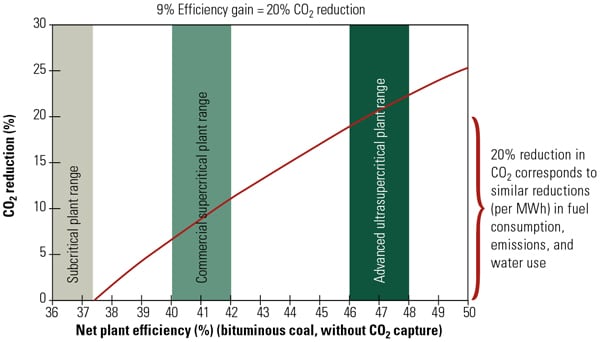
Carbon emissions produced by the combustion of coal may be collected and stored in the future, but a better approach (in the near term at least) is to reduce the carbon produced through efficient combustion technologies. Increasing the efficiency of new plants using ultrasupercritical technology will net less carbon released per megawatt-hour using the world’s abundant coal reserves while producing electricity at the lowest possible cost.
Pushing the technology envelope to simultaneously minimize pollutants and fuel consumption through improved plant efficiency is the goal of every utility with an environmental conscience. One approach to achieving these goals is selecting coal-fired steam generation equipment operating at ultrasupercritical (USC) steam conditions. At these extremely high pressures and temperatures, a coal-fired power plant can operate with a net plant thermal efficiency over 44% based on the higher heating value of coal. Future development efforts target net plant efficiencies at or above 48% within the next decade.
In this article, we show the effects of increasing the steam turbine operating conditions for a new USC project in the U.S. and quantify the potential CO2 reductions this advanced design makes possible.
Coal Conundrum
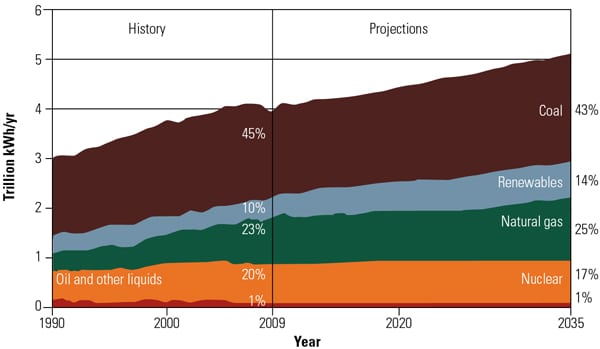
Coal is a very attractive resource in the U.S. for power generation due both to its availability and the estimated 250 years of reserves still in the ground. As utilities strive to keep up with rising demand for electricity, coal-fired generation remains exceedingly economical and the preferred fuel source for 50% of the U.S. electricity consumed.
The bad news is that coal-fired power plants are under heavy scrutiny, and there is strong political pressure to further limit pollutant emissions and begin regulating greenhouse gasses. Currently, 30% of worldwide CO 2 emissions come from power plants, and most U.S. plants average more than 30 years of age. Alstom estimates that if all existing plants in the world were replaced by the latest, most-efficient plants, two gigatons of CO 2 emissions would be avoided every year. If all coal-fired units in the U.S. were replaced by state-of-the-art coal combustion technology, the coal power sector’s CO 2 emissions could drop by 25%, or almost 500 million metric tons annually.
First U.S. Ultrasupercritical Project
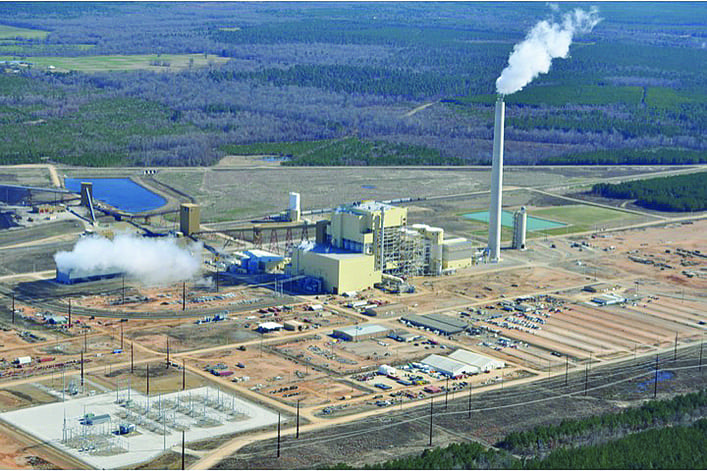
American Electric Power (AEP), one of the largest electric utility power producers and distributors in the U.S., recognizes the need to continue to develop new coal-fired generation to meet projected load growth in its service territories, including west Arkansas and east Texas. To that end, construction on the John W. Turk, Jr. Power Plant (TPP), a 600-MW net coal-fired project that will introduce USC technology into the U.S., began in November 2008 (Figure 1). Integrated gasification combined-cycle (IGCC) was also explored as an alternative, although the supplier guarantees were stronger from the vendor supplying the USC plant. Table 1 illustrates the slight difference in CO 2 emissions from IGCC, subcritical, and USC plant designs considered by AEP.

1. One of a kind. AEP’s John W. Turk, Jr. Power Plant will be the only ultrasupercritical power plant in the U.S. when the $1.5 billion project enters commercial service in 2012. Shown is an artist’s concept of the project at completion. Courtesy: AEP

Table 1. CO2 from various technology options. AEP’s evaluation of John W. Turk, Jr. Power Plant emissions for different combustion technologies. The fuel used in the evaluation is subbituminous coal. Source: AEP
Another key metric that persuaded AEP to adopt USC technology is its efficiency. A USC plant operates with steam conditions above 3,500 psia and 1,100F (593C). For comparison, a conventional supercritical unit operates at steam temperatures of 1,000F to1,050F (538C to 566C) and pressure typically up to 3,500 psia, levels that require careful equipment configuration decisions.
The design for TPP’s steam turbine efficiently optimizes steam cycle and operating parameters, uses the best advanced materials to operate reliably under these pressures and temperatures, uses a welded rotor design to match materials with the extreme operating environment, and includes new high-pressure (HP) and intermediate-pressure (IP) turbine design. Also, an Alstom Gigatop generator with direct hydrogen-cooled rotor and stator core and water-cooled stator windings, rated at 840 MVA, was selected.
Compact and Reliable Configuration
The resulting USC steam turbine configuration for TPP is a condensing tandem compound single-reheat, 3,600-rpm steam turbine generator set. The proven Alstom STF60 design includes a four-casing steam turbine with a single-flow HP turbine, a double-flow IP turbine, and two double-flow downward exhaust low-pressure (LP) turbines. The IP turbine is connected to the LP turbines through crossover pipes. The complete turbine configuration is illustrated in Figure 2.

2. Compact and reliable arrangement. The TPP steam turbine is a condensing tandem compound single-reheat design. It includes a four-casing steam turbine with a single-flow high-pressure turbine, a double-flow intermediate-pressure turbine, and two double-flow downward exhaust low-pressure turbines. The turbine operates at 3,600 rpm. Courtesy: Alstom
HP and IP turbine casings are separate in Alstom’s standard design. This compact design is not prone to self-excited vibration, which may occur in some combined HP/IP turbines. Unbalanced axial thrust forces experienced in some combined HP/IP designs cannot occur because the axial thrust of each cylinder is balanced under all operating conditions, including load rejection and bypass operation. Furthermore, the long-term efficiency of the separate HP and IP casing design is superior because steam cannot leak through the seal between the HP and IP sections.
The compact casings, together with the single-bearing design, lead to a short overall shaft length and thus a shorter turbine. All turbine and generator bearings are independent of the casing structure and are directly supported on the foundation. This principle makes shaft alignment easy, shortens overall unit erection time, and ensures long-term, stable running behavior of the steam turbine generator set. Inlet valves are directly flanged to the HP and IP casings in the design used at TPP. This eliminates turbine inlet loop or connection piping and yields higher efficiency, better accessibility, and ease of maintenance.
Optimized Steam Cycle
There are rules of thumb we use to quickly determine the benefits of USC operating conditions versus subcritical steam turbine conditions that we would like to share:
-
Raising the main pressure by 100 psia improves the plant net efficiency by about 0.16%.
-
Increasing the main steam temperature by 10F improves plant efficiency by 0.16%.
-
Increasing reheat steam temperature by 10F improves plant efficiency by approximately 0.13%.
-
A 10F increase of the final feedwater temperature improves plant net efficiency by about 0.1%.
These rules do have application limitations. For example, increasing steam conditions to improve efficiency is limited by available metallurgy and cost. Nevertheless, the key to improved cycle efficiency is to raise steam temperatures as high as possible. The final optimized steam conditions selected for TPP are shown in Table 2.

Table 2. Steam conditions for AEP’s John W. Turk, Jr. Power Plant. Source: Alstom
TPP was designed with eight heaters to raise the final feedwater temperature to improve efficiency as compared with a traditional subcritical unit utilizing six to seven heaters (Figure 3). Also, a heater above the reheat pressure (HARP cycle) is used. Downstream, four stages of low-pressure condensate heaters, one deaerator, and three stages of high-pressure feedwater heaters are used. An extraction from the HP turbine steam path feeds the top heater.

3. Eight is enough. The TPP steam cycle uses eight feedwater heaters in a HARP configuration. The optimized steam cycle is shown with data taken from the average conditions for the heat rate guarantee. Source: Alstom
The HARP cycle has one big advantage: Its design allows optimization of the final feedwater temperature independent of the reheater pressure while reducing moisture at the LP exhaust. At TPP, a final feedwater temperature of 570F was chosen to optimize performance while maintaining boiler operating constraints.
TPP’s optimized steam cycle heat rate guarantee is based on 20% summer, 20% winter, and 60% annual average operating conditions. The condenser pressure on the cycle diagram (Figure 2) represents the average condition for the heat rate guarantee. In addition, the TPP cycle uses a 100% single-flow boiler feed pump turbine that is fully integrated into the main steam turbine systems. The entire steam turbine system is controlled by an Alstom digital control system.
Due to the elevated steam parameters and increased final feedwater temperature, the 672-MW gross TPP plant will be about 6.2% higher in efficiency than a new-build subcritical unit of comparable power rating. This increased efficiency equates to a reduction of more than 300,000 metric tons of CO 2 per year and about 10 million metric tons of CO 2 over a 30-year lifetime compared to a new-build subcritical steam turbine unit. A comparison of various cycle parameters based on Alstom cycle calculations is illustrated in Figure 4.
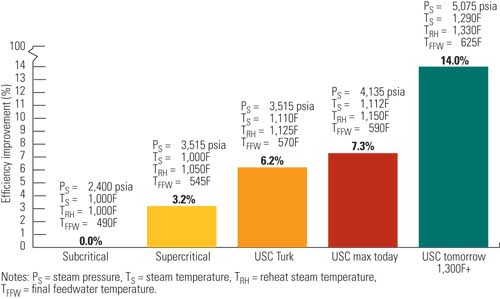
4. Reducing CO2 emissions. Ultrasupercritical steam conditions will increase the TPP plant’s efficiency by approximately 6.2% and reduce CO2 emissions by more than 300,000 metric tons per year over a conventional subcritical steam plant design. Source: Alstom
Alstom has been in the business of supplying supercritical steam turbines since 1957. Alstom’s supercritical fleet now numbers 66 units with a total capacity of 44 GW. Included in that total are AEP and Tennessee Valley Authority cross-compound units rated at 1,300 MW each. The two units in the Lippendorf power plant in Germany (930 MW each) are Alstom’s largest single-shaft units. They have been in operation since 1999. An 1,100-MW single-shaft unit is under construction today with main steam temperature of 1,112F and reheat up to 1,148F.
Major Material Advances
Realizing a robust steam turbine design operating at USC steam conditions is all about selecting the right materials of construction. Alstom and its partners completed extensive studies of forgings, castings, and piping on high creep rupture strength, resistance to embrittlement, metallurgical stability, low oxidation velocity, oxidation layer strength, and ease of manufacture. Inside the turbine, advanced materials in the HP and IP rotor, inner casings, valve casings, and inlet blading stages were selected. In particular 9% to12% Cr ferritic steels are used in order to maintain operational flexibility. Table 3 shows the specific materials used in the TPP steam turbine design. The CB2 materials for castings and the FB2 materials for forgings were developed in the COST 522 program.
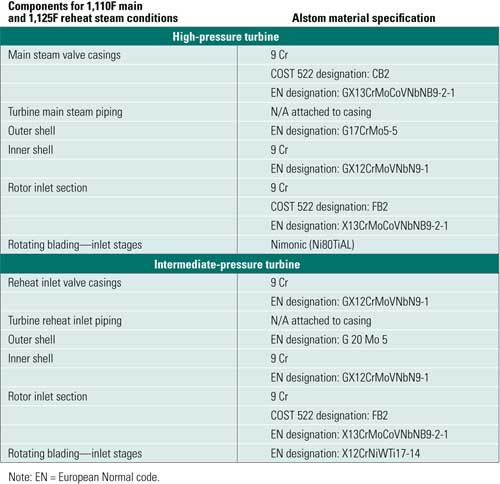
Table 3. Steam turbine material specifications for AEP’s John W. Turk, Jr. Power Plant. Source: Alstom
Figure 5 shows the progression of material selection from X20 steel used in a conventional subcritical design to the active European development program COST 536, which is developing suitable steam turbine materials for the next generation of USC steam turbines. Materials from the COST 501 program for applications up to 1,130F (610C) have been in operation for almost 10 years. New materials with higher creep strength and higher oxidation resistance are available from the COST 522 program for operation up to 1,165F (630C) and will be applied to many Alstom USC steam turbine projects under construction in Europe (up to 1,148F/620C for reheat) as well as the TPP steam turbine.

5. Steel history. The development history of steel alloys for steam turbine components. Source: Alstom
Turbine Design Features
Constructing rotors from several smaller forged disks allows the use of different materials for each section of the rotor, to match the optimum material for the exact operational conditions with a specific stage on a rotor. The high and intermediate inlet rotor selection for TPP is an FB2 material that has been developed for improved creep properties. Stress levels of welded rotors during thermal transients can be up to 40% lower compared to monoblock rotors operating under the same conditions. Alstom’s welded rotors, therefore, have an additional benefit of allowing faster start-ups and/or lowering the life consumption rate compared to monoblock rotors. Examples of forged disk materials and welding were photographed in the Alstom manufacturing plant (Figure 6).
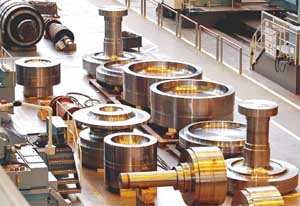

6. Forged steel. Rotor sections are queued for their next machining operation (top). First-step rotor welding begins (bottom) for the TPP steam turbine in the Alstom factory. Courtesy: Alstom
Radial symmetry is a big concern, in particular at higher temperatures. The HP turbine shrink ring design, utilized by Alstom successfully since the 1960s, eliminates inner casing bolt flanges and therefore maximizes radial symmetry. Lower inner casing stresses reduce creep and distortion, thus extending unit life and outage intervals. Because the inner casing is in symmetrical compression, ovalization, as known from flange designs, does not occur. The benefits of this design are long-term stable clearances and sustained efficiencies. In regard to USC applications, the benefits extend to long-term reliability and excellent operational flexibility. Figure 7 shows an HP inner casing with rotor before and after assembly into the lower outer casing.
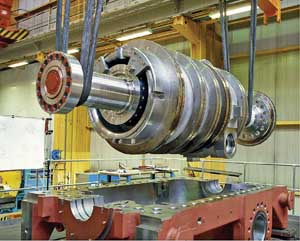

7. Close tolerances. A high-pressure inner casing with rotor before (top) and after (bottom) assembly into the lower outer casing. Courtesy: Alstom
The basic double-shell IP turbine design with horizontal split outer and inner casings is common but was adapted to higher-temperature USC conditions through judicious selection of materials. In addition, the IP turbine inner casing was modified with a more-harmonic mass distribution in the inner shell to minimize distortions at elevated temperatures in the inlet section. The benefit is long-term sustained clearances and efficiencies.
Many Efficiency Improvements
The Alstom principle of using separate cylinders for the HP and IP turbines gives the steam path designer full freedom to optimize the number of turbine stages given the long expansion line of an USC unit compared to a subcritical unit. The number of stages in the HP turbine, as well as in the IP turbine, were increased by about 25%, compared to a typical subcritical application.
Other design parameters were considered when maximizing performance of the TPP steam turbine design for USC steam conditions. Full arc inlet scrolls improve efficiency and minimize component thermal fatigue damage. In this design the control valves typically operate wide open with flow control through the boiler feed pump. Overpressure operation provides the turbine flow margin to produce additional electrical output when required.
The TPP steam turbine will also be equipped with Alstom’s latest steam path and sealing technology. Alstom has continuously improved the airfoil design and optimized the complete steam path by reducing gap and leakage flow interactions with the main flow. Brush seals and abrasive coating seals will be considered to further improve efficiency.
The exhaust area plays a critical role in steam cycle efficiency; therefore, optimizing the performance of the last stage blade is critical. The TPP exhaust area of 4 feet x 72.1 feet ideally covers the operating range at the various design ambient conditions.
—Heinrich Klotz (heinrich.klotz@power.alstom.com) is a product specialist for Alstom Turbomachines Group, Alstom Power Systems GmbH, Germany. Ken Davis (kedavis@aep.com) is manager for New Generation Design & Engineering for AEP. Michelle Nowak is sales manager and Eric Pickering (eric.pickering@alstom.power.com) is regional sales development manager for Alstom Power Inc., USA.