With the eighth-largest economy in the world, Brazil has a clear need for power, but balancing supply and demand has proven tricky in recent decades. Even in a country where over 80% of generation capacity comes from renewables, planning for future capacity additions isn’t straightforward or easy.
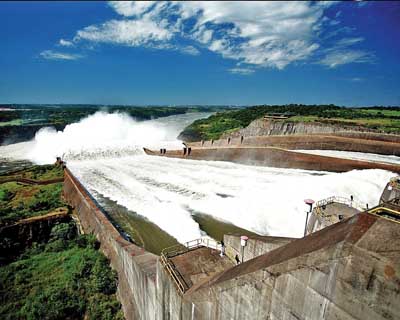
On the night of Nov. 10, 2009, 18 of Brazil’s 26 states were abruptly plunged into darkness. For more than two hours, the failure of three transmission lines that deliver power from Itaipú dam — a 14,000-MW hydroelectric power plant that straddles the border between Brazil and Paraguay (Figure 1) — created a domino effect. The outage took some 28,800 MW out of the system — nearly 50% of the power available on the grid at that time — blacking out the country’s largest cities, including São Paulo and Rio de Janeiro.
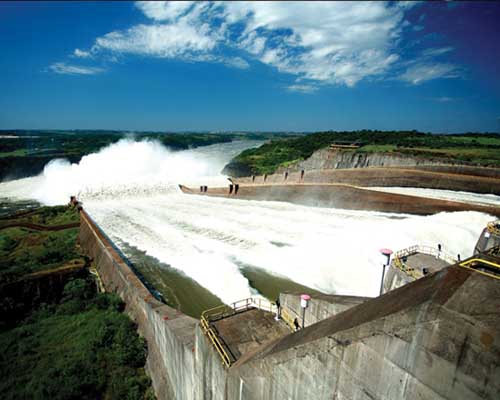
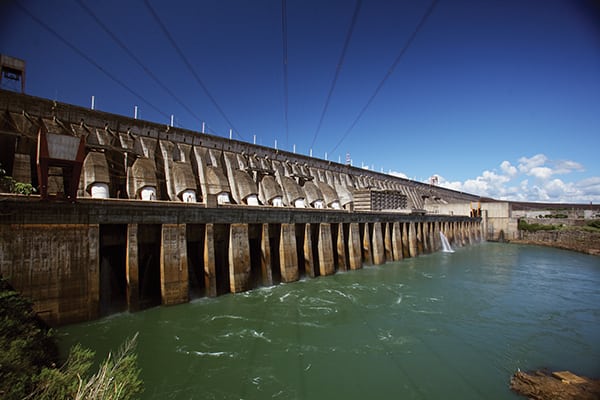
1. The day the giant fell. Brazil relies on the mammoth 14,000-MW Itaipú hydroelectric power plant on the Paraná River, bordering Paraguay, for 20% of its electricity. Built from 1975 to 1991 in a joint development venture with Paraguay, the 8,000-meter-long and 146-meterhigh dam features 14 segmented sluice gates with a total potential discharge rate of 62,000 cubic meters per second. No one could have anticipated total shutdown of the world’s biggest dam after China’s Three Gorges—but it happened, on Nov. 10, 2009, for the first time in its 25-year-history. Short circuits on surrounding high-voltage transmission lines, triggered by bad weather, have been blamed for the blackout. Courtesy: Itaipú Binacional
Tens of millions of people were affected — and not just in Brazil. All of Paraguay briefly lost power, as did parts of Argentina. People were trapped in elevators, stranded on commuter trains. Hospitals were forced to use emergency generators. Thousands swarmed roads, walking alongside chaotic traffic. Rather than be stuck in sweltering apartments, others took to bars to drink by the light of their cell phones. When power was restored just before dawn, as a BBC radio listener reported, cheers resounded from every window — it was almost as if Brazil had scored a soccer goal, he said.
The world watched warily as the event raised doubts about the reliability of the country’s energy infrastructure. Some analysts pointed to underinvestment; others claimed the grid had been compromised by hackers. It was implied that Latin America’s powerhouse, whose robust economy had weathered the global crisis, was unready to host two major global events: the World Cup in 2014 and the Olympics in 2016.
A Dark Age: The 2001 Power Crisis
For Brazilians, the Nov. 10 blackout brought flashbacks of an energy crisis that had almost crippled the nation’s development. On June 1, 2001, the government of then – Brazilian President Fernando Henrique Cardoso ordered a 20% electricity consumption cut to avoid an uncontrolled collapse of the national grid from a shortage of electricity. As the country reluctantly introduced rationing, the shock of the draconian measure shook the world.
Even at the beginning of the decade, as they published dire forecasts that the crisis could wipe out up to 20 or 30 years of economic growth in as little as a year, Brazil’s media were calling for the government to confront the crisis, beginning by admitting its cause. As one of Brazil’s largest weeklies, Istoé, observed just as the 2001 crisis began, "arriving at the blackout took a lot of time and obstinacy." Others said that the fateful crisis was the result of a deliberate policy — one that achieved an intended result; it had stemmed from two decades of the interwoven policies of privatization, environmentalism, and International Monetary Fund debt looting.
Case studies of the Brazilian crisis in subsequent years revealed that it had its roots in worsening mismatches between the expansion of electricity supply and demand throughout the 1990s. Despite market-oriented reforms implemented after 1996 that were aimed at boosting private investment, installed capacity expanded only 28% from 1990 to 1999, whereas electricity demand increased by 45%, says a 2005 study from the Organisation for Economic Cooperation and Development.
Recognizing the need to tackle the supply constraint — because an investment in new hydropower plants was unlikely to compensate for delays that took place in the late 1980s and early 1990s — the government launched the Programa Prioritário de Termoeletricidade (PPT) in 2000. This program was designed to encourage investment in gas-fired power plants and develop the market for natural gas. However, because of regulatory uncertainly and the high cost of gas — imported from Bolivia — the PPT failed to provide strong enough incentives for new investment. Of 49 planned power plants, only 15 were built, adding about 4 GW in new capacity. Most of these plants came online too late to avoid the power shortage in 2001.
In addition to the supply shortfall, the country, which today relies on hydropower for more than 80% of its generation, suffered an unusually long drought. As water volumes in Brazilian dams, after years of overuse, fell to their lowest in two decades, the already overstretched power system collapsed.
Among the government’s first actions to manage the crisis was appointing a special commission, Câmara de Gestão da Crise de Energia Elétrica. That group recommended and helped implement a price-based rationing program — rejecting the more common solution of rolling blackouts. Referred to as the quota system, the program was based on historical and target consumption levels. It had high penalties for excess consumption, bonuses for energy savings, and some freedom for large users to trade their quotas in a secondary market.
Owing largely to the semi-voluntary quota system — coupled with a television information campaign and US$200 million in government bonuses to residential, industrial, and commercial customers — electricity consumption dropped by 20%.
At the same time, however, the Brazilian government engaged in drastic interventions on the supply side, implementing an emergency program for power generation and creating additional incentives for investment in short-term power supply projects. The government also created a special company, Companhia de Geração Térmica de Energia Eléctrica (CGTEE), for buying electricity on an emergency basis. These measures produced proposals for 117 new generating units with a total capacity of 4 GW. The company eventually purchased 2.1 GW of capacity, mainly from small-scale diesel-powered generators and small power plants firing sugar cane residuals (known as bagasse). The average contract price for some of these power sources has been cited at US$100/MWh — nearly three times the price commanded by the quotas trading in auctions at that time.
Rationing was finally lifted at the end of February 2002, but even by 2003, consumption did not rebound. This persistent reduction in demand, along with the increase in installed capacity after 2001, created excess supply, which adversely affected generators and some distribution companies. The situation was eventually amended with government-approved tariff increases — some as high as 140%, between 1995 and 2002.
The Aftermath
The legacy of the 2001 power crisis persists, according to a 2007 World Bank study. On the supply side, it has caused distributors to become wary of energy efficiency efforts, which could further reduce revenues. On the demand side, the crisis provided incentives for all groups to engage in conservation and efficiency. Those incentives include high electricity prices, which continue to pay for the financial hangover from the crisis.
Another important change that occurred following the crisis involved reforms introduced to the sector by the new administration of President Luiz Inácio Lula da Silva ("Lula"). It opted for a model that was designed to attract long-term private investment to the sector and relied on competition — as opposed to the prior administration’s fully regulated model. A defining element of the new model was the introduction of energy auctions for distribution companies to acquire energy for their captive customers. Under this system, auctions of capacity from new generation projects will be held three to five years in advance of delivery dates to ensure that the nation’s future expansion needs are met and plants are only built once they have won bids and are guaranteed long-term power purchase agreements.
A New Dilemma
Since the power crisis, owing to an increase in average monthly incomes and low unemployment, electricity consumption has been on the rise, growing at 5.6% in 2007 and 3.5% in the first six months of 2008. Yet, experts suggest that the nation may be poised to suffer another energy debacle, saying that another generating gap is imminent due to the nation’s inability to expand its electricity supply as planned. As was highlighted by the Nov. 10 blackout, foremost among these concerns is Brazil’s reliance on hydropower. As significant is the country’s vulnerability to drought, like the one in late 2007 and early 2008, which bumped the risk of rationing to 22% — four times higher than normal.
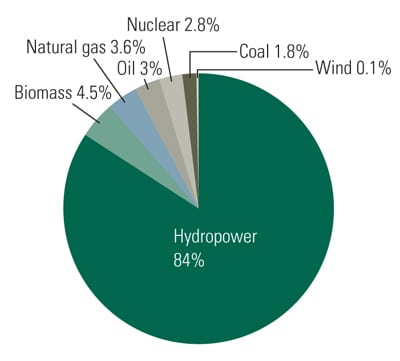
2. Brazil’s generation profile (2008). Renewable hydro resources provide the vast majority of Brazil’s power, but those resources are also vulnerable to drought. Courtesy: EPE
Another concern is that the nation’s population is expected to expand from 192 million people to 204 million by 2013, with GDP per capita and electricity consumption forecast to increase significantly — as much as 40% and 10% respectively. Added to this, estimates from Business Monitor International say that the country will by 2013 account for 41% of Latin America’s regional power generation, which in itself will see a 17.6% increase from 2008.
Finally, the Brazilian Ministry of Mines and Energy (MME) recently announced it would expand its electrification program, Luz Para Todos (Light for All), to reach a million more families by the end of 2010. The program, which began in 2003, has to date provided electricity to 2.4 million homes.
A Long-Term Plan for Power Expansion
In 2006, the MME’s Energy Research Office, Empresa de Pesquisa Energética (EPE) — created in 2004 to study the country’s energy industry and support the government’s policies — released a blueprint for the expansion of the power sector through 2030. In it, the government essentially proposes huge increases in supply, arguing that its scenarios forecast a tripling of current consumption by 2030. The projection assumes that Brazil’s population will increase 53 million by 2030 (more than the entire population of Spain), that the economy will have an annual growth rate of 4.1%, and energy demand will grow at an annual average rate of 3.5%.
The agency predicted that only 10% of this new demand would be met through energy efficiency measures and another 10% through off-grid generation. To meet the rest of projected demand by 2030, the plan calls for doubling nuclear power capacity by adding five 1,000-MW power plants; adding about 88 GW of new hydroelectric capacity; increasing production of power from small hydroelectric plants tenfold, to 7,800 MW; increasing waste-to-energy project capacity from nil in 2005 to 1,300 MW; and a comparable expansion in natural gas generation. It also calls for a major expansion in biodiesel and bagasse power generation and steady growth in wind energy, from 29 MW in 2005 to about 4,700 MW in 2030.
The country’s more recent — and more detailed — 10-year energy expansion plan (2008 – 2017) expects that consumption will grow between 45% and 50%, taking into account government ambitions for the Luz Para Todo program as well as reduced demand following the global economic slowdown. The plan projects that 181 billion reais (about US$103 billion), or 23.6% of the 767 billion total earmarked to secure the country’s future energy supplies, will be needed to expand the electricity sector, including power generation and transmission. The government is expected to supply 70% of this investment through its Program for Growth Acceleration.
Hydropower
In 2008, Brazil’s hydropower resources (excluding small hyrdo) made up 77.7 GW, or 77.3% of its total installed capacity of 100.5 GW. Yet according to the Energy Research Office, much of the country’s massive hydro potential has barely been exploited (Figure 3). In the MME’s "10 Year Energy Expansion Plan," hydropower generation capacity is expected to grow 41% to 109,058 MW between 2007 and 2016. Almost 90% of this capacity is expected to come from new large hydroelectric plants in the Amazon. Hydroelectric generation capacity in the Southeast and at Itaipú — the massive hydropower plant in Paraguay, from which Brazil imports almost 20% of its power — will remain flat until 2016. There will be slight capacity increases in the South and Northeast, however — a shift from Brazil’s traditional concentration of hydroelectric capacity in the Southeast.
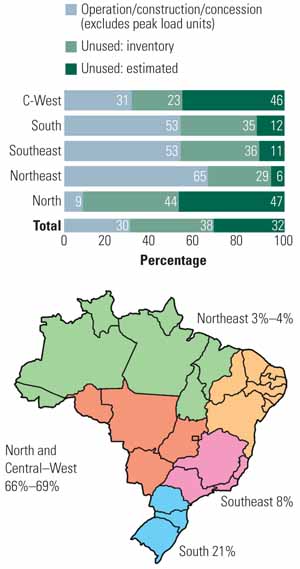
3. Brazil’s hydropower potential. The EPE (Empresa de Pesquisa Energética), Brazil’s Energy Research Office, estimated in 2008 that the nation had two-thirds as much unused hydropower potential as what it was already using. Source: EPE
Among the three largest projects are the 3,300-MW Jirau, the 3,150-MW Santo Antônio — both on the Madeira River, in the Amazonian state of Rondônia — and the massive 11,000-MW Belo Monte Dam in the state of Pará, on the Xingu River. The Santo Antônio, a project estimated to cost US$5.94 billion, is expected to be completed by 2012, while the US$3.9 billion Jirau project is expected to be completed by 2013. The long-anticipated Belo Monte is in the pipeline, but it has been delayed by massive national and international protests. Critics say it will flood 400 square kilometers of agricultural land and forest and will directly impact the Paquiçamba reserve of the Juruna indigenous people.
In addition to these projects, Brazil is considering the construction of six bilateral hydroelectric stations with Argentina, Bolivia, and Peru. These projects are thought capable of providing between 10 GW and 12 GW of power to the region. Brazil remains wary of depending on its neighbors for imported power, however, owing to the recent disruption in gas supplies due to a political crisis in Bolivia as well as long-standing tensions with Paraguay regarding the price of power from the Itaipú dam. That controversy was seemingly resolved after the July 2009 renegotiation of the Itaipú agreement: In a surprising move, Brazil agreed to a more equitable payment to Paraguay for electricity from the project. It also allowed Paraguay to sell power directly to Brazilian companies instead of solely through the Brazilian electricity monopoly.
Brazil’s commitment to the expansion of hydropower has been met with cynicism from power industry experts who caution against reliance on a single source — even though hydro is much cheaper than thermoelectric generation and contributes minimally to global warming (see the sidebar "Of Hydropower and Combustion"). There are also concerns that large dams are expensive and time-consuming to build, and new projects have experienced delays, especially in obtaining environmental licenses. Then there are concerns about uncertain rainfall and the fact that large dams are likely to be located far from centers of demand, which requires large investments in transmission.
An emphasis on small hydro — projects between 1 MW and 30 MW — is therefore emerging. Some 2,235 MW of small hydro capacity had been installed in Brazil as of 2007, but estimates suggest that Brazil has the potential to build more than 1,600 small hydroelectric plants, which could add almost 15,000 MW of generating capacity to the grid. The government, too, is making it easier: Developers are exempt from bidding to obtain grants and need only obtain a permit from electricity regulator ANEEL. In 2008, for example, Brazilian oil company Petrobras announced it would bring 13 small hydropower projects totaling 288 MW online at an investment of almost US$680 million.
Thermoelectric Generation
Brazil’s massive hydropower reserves have always taken precedence over its low- calorific-value coal reserves. For that reason, compared with other developing nations, including India and China, coal only produces 1.81% of the nation’s power, through eight power plants with a combined capacity of 1,455 MW. According to the U.S. Commercial Service, that is bound to change. Since 2002, local coal production has increased 40%, and in the next four years, it will increase another 40% — specifically because of new power projects under way.
The federal Energy Research Office has planned for an expansion of coal power to 6,000 MW by 2015, bringing coal’s share to 5% of the total. Several interesting projects are in the pipeline. These include state-owned company Electrobras subsidiary CGTEE’s plans to expand its two 126-MW and 320-MW Candiota coal power plants — the largest ones operating in Brazil. The company is also building a 350-MW plant, readying it for completion in January 2010 (Figure 4), and has indicated it will likely build another. Meanwhile, Tractebel Energia started building a 340-MW plant in 2009 for start-up in 2012, near the Candiota coal plants complex. The projects are all located near larger coal mines in the south of the country.
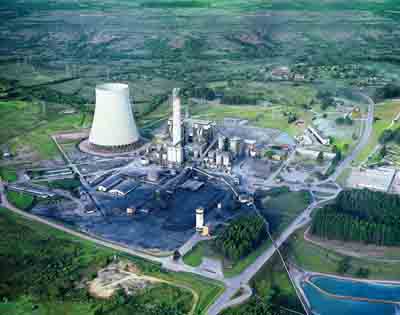
4. Playing with fire. The 350-MW Brazil Candiota coal-fired power plant in Candiota City, Rio Grande de Su in southern Brazil was due for completion in December 2009. The US$428 million project took 36.5 months to construct and will be the largest coal-fired power plant in Brazil. The project is also a much-publicized collaboration between the Chinese and Brazilian governments. About 80% of the plant’s equipment was supplied by the Chinese company Citic International Contracting, and the project is being financed by the Chinese Development Bank. Courtesy: CITIC International Contracting
Natural gas has a slight lead on coal, with a 3.6% share of the country’s power portfolio. In 2000 the government launched a program to make natural gas a viable alternative for generating power alongside hydro plants, and this led to an increase in supply, both from within Brazil and imported from Bolivia. The government had foreseen supply issues, however, and only brought 73% of 49 selected projects online by 2006.
The country remains under a contractual obligation to buy a minimum of 20 million cubic meters of gas per day from Bolivia, even though natural gas plants have been shuttered owing to high water levels this past winter. Imports from Bolivia have fallen steadily, however, from a high of 31.5 million cubic meters per day at the end of 2008 to 21 million cubic meters per day at the beginning of August 2009.
In the meantime, new cogeneration gas plants continue to be built to power energy-intensive industries. An example is the 490-MW combined-cycle plant Alstom is building for a steel mill owned by Companhia Siderurgica do Atlântico. The plant uses blast furnace gas and heat scavenged from the iron-smelting and coke-making process to produce power for consumption and delivery to the local power grid.
Nuclear Power
Brazil’s two nuclear units — Angra-1, a 626-MW Westinghouse pressurized water reactor (PWR) built in 1986, and Angra-2, a 1,270-MW PWR completed in 2002 — generate about 2.8% of the country’s power. A third unit, Angra-3 (Figure 5), was designed to be a twin of Angra 2. But, though 70% of the equipment was on site — its storage costing the Brazilian government US$20 million annually — its construction was delayed first by environmental concerns and then by a search for a partner with US$1.8 billion to complete it. In December 2008, state-owned Electronuclear signed an industrial cooperation agreement with French state-owned nuclear giant AREVA that included the plant’s completion. Construction — a 66-month process — is now slated to be completed in 2014.
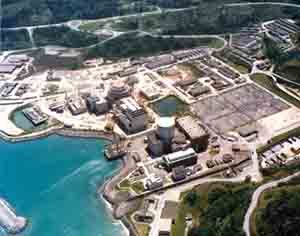
5. A nuclear new age? Construction resumed on the 1,345-MW Angra-3 reactor in 2009 after being suspended in 1986. Although Brazil has vast uranium resources and the capability to enrich its own fuel, critics say new nuclear power is not cost-effective. A recent study from the University of São Paolo shows, for example, that Angra-3’s energy costs soar to US$113/ MWh—much higher than that of the planned 6,450-MW hydropower complex on the Madeira River (US$46/MWh). New nuclear power would seem costly even compared with other sources such as natural gas (a 500-MW plant would cost US$79/MWh), coal (a 350-MW plant, US$134/ MWh), and bagasse (a 12-MW plant, US$74/MWh). Courtesy: FURNAS Centrals Eléctricas
The government’s plans go much further than Angra-3, however. In November 2006, the MME announced it would build four 1,000-MW nuclear power plants from 2015 onward, two in the Southeast and two in the Northeast. Then, in October 2008, Brazilian Minister of Mines and Energy Edison Lobão claimed that the country had set as a priority a resumption of its nuclear program — and that it was considering calling for the construction of 50 to 60 nuclear plants over the next 50 years.
The minister was then reacting to a Bolivian political crisis, which had stalled natural gas imports and threatened power production. But, experts say, the idea that Brazil — like several developing countries, including China and India — would increase its nuclear power capacity to that extent is plausible. Brazil has the resources. As exploration in the 1970s and 1980s showed, it holds nearly 5% of the world’s uranium. Today, only one mine is operational: Industriás Nucleares do Brasil (INB) Lagoa Real/Caetite Unit, with 340 tU/yr capacity. All mined uranium is used domestically, after conversion and enrichment at Cameco in Canada.
But even that is slated to change, since a decision by the INB in January 2009 to allow the Brazilian Nuclear Energy Commission to start enriching uranium on an industrial scale at the Resende plant. Production of enriched uranium began in February, with some 12 metric tons of enriched uranium expected by January 2010.
The Resende plant uses ultracentrifugation enrichment technology, which was developed domestically by the Naval Technology Center São Paulo and the Institute of Energy and Nuclear Research. It plans to expand its two cascades of centrifuges to eight by 2012 — by which time the INB is expected to produce all the enriched uranium used in the Angra I reactor and 20% of that used in Angra 2.
Officials said that the domestic production of enriched uranium will save the country some $25 million a year, but the perks are certainly much higher: Brazil is one of only four countries — the U.S., Canada, and Russia are the others — that has both large deposits of uranium and the technology to process and enrich it.
Climate Change and Alternative Energy Sources
In November 2009, Brazil voluntarily agreed to cut its greenhouse gas emissions to a stunning 40% by 2020 when compared to the country’s projected business-as-usual emission levels. Most of that percentage will be achieved by reductions of up to 80% in deforestation. The move was touted as a "political gesture" to shame developed countries into making similar pledges at Copenhagen in December.
But Brazil, a country that harbors 60% of Amazonia, hasn’t always been as committed to the environment. The country has effected laws regarding forests, water, and wildlife since the 1930s, though their implementation and enforcement have not always been ideal. In fact, until 2007, Brazil’s position in international climate change talks had been in the vein of China’s and India’s, which is that Northern Hemisphere industrial countries should shoulder the burden of reducing greenhouse gas emissions. And the country had for years outright resisted plans to create market mechanisms to provide payments for reductions in deforestation and carbon emissions.
This seemingly sudden burst of "green" awareness is being driven by politics — but it is rooted in public alarm about how climate change could wreak havoc on the country’s economy, analysts say. Concerns ride on severe droughts in the past decade, which killed crops, kindled forest fires, caused disease, and threatened power supplies. Environmental issues have also been propelled onto the political agenda due in large part to the recent emergence of presidential candidate Marina Silva. The former environmental minister — and a rubber tapper who had been virtually illiterate until her teens in her home state Acre, deep in Brazil’s western Amazonian jungle — has been on the frontlines of Brazil’s battle against deforestation.
Alternative energy’s potential has always been apparent in Brazil, however. In 2002, reeling from crippling power shortages, the government passed a pioneering program (Programa de Incentivo às Fontes Alternativas de Energia, or PROINFA) to increase power supplies with alternative energy. With about $6.22 billion in grants, including financing for a variety of research and development projects in biomass energy technologies and a series of fiscal incentives, within five years the country rapidly increased its capacity of biomass- and wind-powered projects.
Production of electricity from bagasse is particularly being encouraged by the government not only because it is cheap (US$15/metric ton), but also because sugarcane harvest season extends over an eight-month period, from April to November. This coincides with the period of low rains — and possible drought — in the Brazilian Southeast. That means that bagasse power plants can operate at a cost of US$74/MWh with a capacity factor of 60%, in synergy with hydroelectric power plants, the government says. Other advantages include a synergy with ethanol production — a major Brazilian industry. Sugarcane production in the country in 2007 was about 500 million metric tons, and it is estimated to reach about 1,075 million metric tons in 2017. The potential for power is so vast that the government proposes the sugarcane industry could produce up to 10,000 MW of power by 2012 if sugarcane bagasse and leaves were used in cogeneration projects.
Currently, Brazil has 393 bagasse power plants, a majority of them in the south-central region. Spurred by PROINFA auctions, 91 more are under implementation and 23 are being studied.
The PROINFA program hasn’t worked as well to foster wind power development, though the country harbors tremendous wind potential, particularly in the Northeast, Southeast, and South. But, with government incentives, including PROINFA auctions specifically for wind, massive growth is expected for the industry, says the Brazilian Wind Energy Association. The organization and government expect that 10 GW of wind energy could be installed by 2020, up from the 605 MW installed as of November 2009, mostly in the state of Ceará, in the Northeast. The industry hopes that a wind energy auction planned for December 2009 will pave the way for 1,000 MW in new generating capacity and kick-start Brazil’s wind energy sector, which already accounts for 70% of the total in Latin America. More than 4,500 MW of projects are qualified for that auction.
In 2008, four major wind turbine manufacturers — Enercon, Suzlon, Vestas, and IMPSA — entered the market, and the number of qualified developers and operators increased considerably. Investment also picked up as Brazilian groups and new international players from Portugal, Spain, Italy, France, Norway, Germany, and other European countries showed interest in the industry.
Transmission
The November 2009 blackout was not caused by a supply issue, the government said. It was caused by a weather-related "short circuit" of three transmission lines carrying power generated by the Itaipú dam. Two of the fallen lines were 765-kV lines located between the towns of Ivaipora (Parana) and Itabera (São Paolo); the third one collapsed between Tijuco and Itabera Petro (São Paolo). The government said in a statement that the three line outages combined to cause cascading outages on the National Interconnected System.
The event highlighted a number of vulnerabilities in the country’s unique energy infrastructure. Unlike the U.S., which has three main regional power grids, almost all of Brazil’s electricity runs through an interconnected network. In the mid-1960s, the existing electricity systems had functioned independently, working in an integrated fashion through regional coordinating groups. In 1998, however, the government, led by Fernando Henrique Cardoso, established the National Operating System, a body responsible for operation of the National Interconnected System. The country then inaugurated the first north-south transmission line, allowing for the exchange of power between the North and Northeast and the rest of the country. In the past decade, the grid expanded more than 35% — reaching a total 86,395 km in 2008 — and now includes all but 3.4% of Brazil’s power capacity.
Today, Brazil has one of the largest interconnected electric grids in the world, which is "fantastic because it facilitates electricity transmission between regions, but the domino effect that happens when we have a problem is a major inconvenience," Mauricio Tolmasquim, president of the federal Energy Research Agency, told Bloomberg in November.
But some analysts disagreed that the November incident was isolated and said that it could happen anywhere, pointing out that the event wasn’t the first time the country had suffered such a large-scale grid-related outage. Three similar incidents occurred involving transmission lines from Itaipú since 1985, the worst of those in 1999, after a lightening bolt struck a power substation in São Paolo state and plunged 97 million Brazilians into darkness for up to five hours.
Many pointed to government neglect of the system — sparking concern all over the world about whether the economic powerhouse’s aging infrastructure could shoulder the enlarged energy burden of hosting the 2014 World Cup and the 2016 Olympics. Brazil’s President Lula defended the grid as "solid," saying that investments in transmission lines over the past seven years amounted to about 30% of what had been spent over the preceding 120 years. Energy Minister Edison Lobão, meanwhile, compared the strength of Brazil’s system with systems in the U.S. and Canada, countries that, he pointed out, had taken days to fully restore power after a blackout turned out the lights for some 50 million in August 2003.
However, the system is not entirely foolproof, government officials conceded in their response to the more ominous allegation made by a CBS "60 Minutes" broadcast just two days before the blackout that the Brazilian grid was vulnerable to hackers. The 2007 two-day blackout in the Atlantic state of Espírito Santo — which the newsmagazine claimed, citing unnamed sources, was triggered by hackers targeting a utility’s control systems — was actually the result of the utility’s negligent maintenance of high-voltage insulators on two transmission lines, they told newspaper Folha de S. Paulo. It was, as the utility initially claimed, dust, and soot from burning fields that had caused the trip. And there was no evidence of hacker attacks in the smaller 2005 blackout north of Rio de Janeiro either, as Raphael Mandarino Jr., director of the Homeland Security Information and Communication Directorate told the newspaper. The official added that Brazil’s electric control systems were not directly connected to the Internet, and that the findings had resulted from yearlong investigations ordered by regulators.
If there is one thing that the night of Nov. 10 proves, it is that there has been a failure in management, according to Ildo Sauer, a professor of energy at the University of São Paulo. "There is not a lack of generation capacity, there is not a lack of transmission capacity, there has not been a lack of investments," Sauer told The New York Times following the blackouts. "What is lacking is management, command, and control of the operations." It was just enough to show that reforms made in 2003 and 2004 "were not sufficient," and that Latin America’s beacon is not shining as brightly as it could.
—Sonal Patel is POWER’s senior writer.