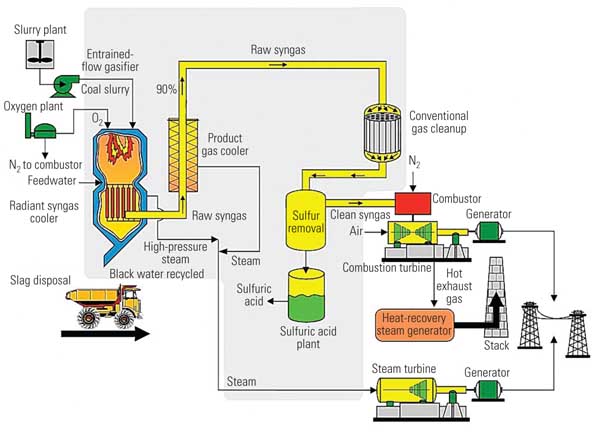
In recent years, U.S. utilities have shown increasing interest in deploying new coal-fired power plants based on advanced technologies such as integrated gasification combined-cycle (IGCC), ultrasupercritical pulverized coal (USC PC) combustion, and supercritical fluidized bed combustion (SC FBC). The appeal of innovative and more-efficient coal plants continues to be driven by volatile natural gas prices, the need for new baseload generating capacity, ever-lower limits on plants’ air pollution, and likely future restrictions on carbon dioxide (CO2) emissions.
Yet deployers of advanced coal plants face considerable obstacles. Unlike natural gas–fired plants of the 1990s, which were inexpensive and could be built and permitted relatively quickly, advanced coal plants are challenged by high capital and construction costs, reliability shortfalls, long project schedules, and lengthy environmental permitting processes.
On a timeline of technology development (Figure 1), advanced coal-fired facilities are now nearing the crest of the curve, where commercial units must overcome high initial costs to reach technological maturity and the lowest achievable cost. If advanced coal plants are to succeed, the industry must get beyond the current penalties in cost and schedule that dog first-of-a-kind plants to achieve the shared economies of “Nth-of-a-kind” plants.
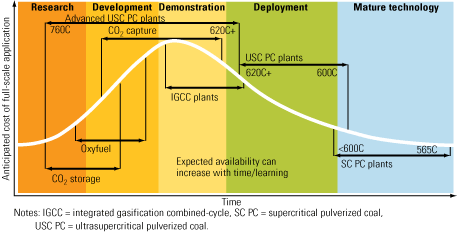
1. Ride the wave. Advanced coal plants, like any new technology, must overcome the crest of the technology development cost curve if they are to become economically viable. Source: EPRI
A major contributor to this challenge has been a lack of experience with the new technology. For example, although more than 130 coal gasification plants are currently operating worldwide, only 16 can be considered IGCC plants, whose primary role is to produce electricity. Only four of those 16 plants are in the U.S.
A shortage of operating experience has not been the only hurdle on advanced coal plants’ road to technological maturation and lower costs. Another is the fact that all of the advanced plants in commercial service today were conceived, designed, and built as custom projects. Standard design specifications are needed to lower initial capital costs, support repeatable and reliable performance, and reduce development time and cost for potential plant owners.
CoalFleet for Tomorrow
An EPRI-sponsored collaborative effort—called the CoalFleet for Tomorrow program—seeks to lower the hurdle of technology development by deploying the first group of full-scale advanced coal plants as quickly as possible. Launched in 2004, the program brings together a broad cross section of generating companies, turbine and boiler suppliers, engineering/procurement/construction (EPC) firms, and research partners from around the world. Today, more than 60 companies from five continents are active participants in the effort.
One of CoalFleet’s key initiatives is a unique, circular, learn-by-doing process in which expert information is provided to utilities developing plant designs, and the utilities’ experience is fed back into growing databases of information on advanced coal technologies.
The process works as follows. EPRI provides expert consultation to an “early deployment project” (EDP) utility that has committed to design and build a new IGCC, USC PC, or SC FBC plant. For this consultation, EPRI enlists a large team of independent world-class experts to work with its own knowledgeable staff to advise the EDP utility on how to optimize the plant’s design. In return for the expert advice, the utility shares nonproprietary information from its site-specific feasibility studies and front-end engineering designs (FEEDs) with the broader CoalFleet membership.
The expert consultations and the feedback from EDPs are creating a family of design guidelines and permitting data and guidance that are continually updated to reflect new information and lessons learned. It is estimated that participating in this process could cut the costs of feasibility and preliminary engineering studies by 30% to 50%, shorten a project’s development cycle by up to two years, and reduce an advanced coal plant’s capital costs by $100/kW to $200/kW or more.
It takes a village
To date, the process has produced four types of documents and databases that are used both progressively and for feeding back lessons learned into their predecessor documents (Figure 2).
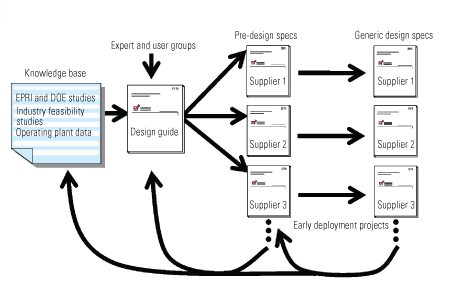
2. Design for success. The CoalFleet for Tomorrow program produces a series of design guides and specifications that are progressively more detailed. Early experience with the specifications is fed back and captured in later editions of the documents. Source: EPRI
The first resource at the start of the process is the Advanced Coal Technology Knowledge Base, a web-based repository of information on trends in advanced coal technology design, cost, and performance. The core of the knowledge base is more than 50 design cases from eight state-of-the-art studies conducted by EPRI, the DOE, utilities, consultants, and teams of technology suppliers. Each case study details vital characteristics in up to 450 defined fields. CoalFleet adds data as they become available from new feasibility studies by members and from design decisions made by companies undertaking early deployment projects. The Knowledge Base also includes papers from key conferences and lessons learned from demonstration units.
A second resource is a series of plant design guides that were developed out of the knowledge base. The first of these guides, developed for IGCC plants, is the CoalFleet User Design Basis Specification for Coal-Based Integrated Gasification Combined Cycle, or UDBS for short. The UDBS is intended to foster the benefits of standardization in design specifications.
The 800-page IGCC UDBS defines the major specifications needed to contract for IGCC “reference plants”—generic, 600-MW and 900-MW (nominal) plants that use gasification processes and combustion turbines from several manufacturers that commercially guarantee their equipment. For bituminous coal plants, the UDBS includes plant designs using commercial entrained-flow gasifiers from GE Energy, ConocoPhillips, and Shell—both with and without CO2 separation. For low-sulfur Powder River Basin (subbituminous) coal, the UDBS includes plant designs from ConocoPhillips, Shell, and KBR—again, both with and without CO2 separation.
A reference plant replicates both the design and execution from project to project in order to reduce costs, shorten project schedules, and improve the project’s certainty of outcome. However, while defining the reference plants, the UDBS also allows for different coal types and other basic options to match the needs of different power companies.
The UDBS provides a comprehensive picture of what is involved in planning, building, and operating an IGCC plant—including, crucially, the tradeoffs an owner must make when making design and operational decisions. For example, the specification lays out the risks and rewards of various strategies for incorporating CO2 capture into a prospective plant design.
The UDBS has two novel aspects. First, it was written by more than 25 experts from around the world with experience and expertise in IGCC technology—and with the cooperation of equipment suppliers, plant designers, and EPC firms. Second, the document has been designed so users can substitute site- and system-specific data for nominal data, producing information that can become part of a site-specific specification. The UDBS provides a choice of configurations, reference site information, target performance, RAM (reliability, availability, and maintainability), and operability goals, along with matching data based on an EPRI reference site. The designs also provide for making a swap-out choice of environmental cleanup systems tailored to two levels of licensing constraint.
Pre-design and generic design specs
Two types of documents derive from the UDBS: pre-design specifications and generic design specifications for IGCC plants. A pre-design specification is a nonproprietary description of the design of a specific IGCC plant whose feasibility study has been completed and is ready to begin a FEED study. Essentially, it is a generic version of the feasibility study. As part of several EDPs, four pre-design specifications have been developed for different IGCC suppliers and coal types based on feasibility studies conducted by Duke Energy, Excelsior Energy, Nuon, and Southern Company.
By contrast, a generic design specification is a nonproprietary description of the design of an IGCC plant created after its developer has completed a FEED study. It corresponds to about the first half of the FEED study. CoalFleet intends to publish its first generic design specification early this year; it will be based on the FEED study completed by Southern Company and Orlando Utilities Commission for the recently cancelled IGCC project at the latter’s Stanton Energy Center.
Permitting histories and guidelines
The owner of a proposed power plant must obtain permits to build and operate the plant during its planning and construction phases. Obtaining an environmental permit for a new IGCC plant is a critical-path item before construction can begin. Given the limited regulatory experience base, permitting could cause significant delays in a project’s schedule.
Accordingly, there is a need for readily accessible information on past permits for use in system design and regulatory negotiations. To meet this need, the CoalFleet for Tomorrow program has compiled an IGCC permitting database in Microsoft Access format. The database includes narrative summaries of 18 existing or proposed IGCC plants, including descriptions of the facilities and the permitted discharge sources. The database also details permit conditions for plant operations (heat rate and hours of operation, for example), limits on air and water emissions, and the test methods required for compliance with the permit conditions.
CoalFleet also has developed a series of regularly updated IGCC permitting guidelines that summarize federal requirements for obtaining air, water, and solid waste permits for a generic IGCC facility, as described in the CoalFleet UDBS. These guidelines will improve the dialogues that owners of planned facilities have with regulators regarding IGCC plants’ technology, typical emissions, and appropriate monitoring and compliance approaches. By establishing a common basis for all IGCC permit applications, owners could also reduce the time needed to obtain permits.
Other advanced coal plants
The CoalFleet for Tomorrow program is using a similar process to develop design and permitting guidelines for USC PC and SC FBC power plants. Last year, EPRI published the first of these guides—Versions 1 and 2 of the CoalFleet Guideline for Advanced Pulverized Coal Power Plants, which are intended to help power companies define the technical requirements for a site-specific USC PC plant.
Sharing pays off
As mentioned, Duke Energy is one of the EDP utilities that has participated in the CoalFleet program. Duke plans to build a 630-MW IGCC power plant at the site of its existing coal- and oil-fired power plant in Edwardsport, Ind. (Figure 3). As part of the project development process, the company has already completed a FEED study. The utility is seeking to ensure that the design incorporates the best available information while accelerating the design process and reducing its cost.

3. Next-generation coal. An artist’s rendering of the 630-MW IGCC plant that Duke Energy plans to build in Edwardsport, Ind. Source: Duke Energy
As a sponsor of a CoalFleet EDP, Duke Energy has been able to use the UDBS and the permitting guidelines to gain insight into several areas of plant design and permitting. They include the possible application of selective catalytic reduction (SCR) for additional NOx control, and engineering assessments of future options that include various levels of CO2 capture. These documents have helped Duke develop a design that will achieve very low emission levels and support the air permit application process. Duke also has gained an understanding of the technical requirements for the sulfur market that were incorporated into the design of the plant’s sulfur recovery system.
The utility also worked with CoalFleet IGCC experts to understand the issues involved in potentially retrofitting CO2 capture into the plant design at a later date. For example, Duke identified several options for various levels of CO2 capture that could be implemented at lower cost, compared to other IGCC and PC designs.
Finally, information from permitting guidelines and CoalFleet meetings was used by Duke in its discussions with the permitting agency on technical issues affecting IGCC design and emissions. Among the subjects discussed were the feasibility of applying SCR technology to IGCC, start-up and shutdown emissions levels, and the applicability of EPA guidelines and regulations to coal-fired IGCC plant operations, as opposed to those of natural gas–fired combined-cycle plants.
In return for those tangible and intangible benefits, Duke provided valuable support to the CoalFleet program. Duke representatives maintained an open dialogue with EPRI’s IGCC experts and other members of the IGCC Design Guidelines working group and provided significant input to the UDBS. Finally, as a designated EDP, Duke will help develop a CoalFleet pre-design specification that will contain a nonproprietary description of the Edwardsport design that other CoalFleet members can use as a reference when deciding which “standard IGCC” they would like to adopt for their own project.
—Jack Parkes (jparkes@epri.com) is the senior manager of EPRI’s Advanced Coal Generation program. Neville Holt (nholt@epri.com) is a technical fellow with the program, and Jeffrey Phillips (jphillip@epri.com) is one of its managers.