Smart Grid, GridWise, IntelliGrid, AMI (advanced metering interface), Modern Grid, Smart Modern Grid, Grid Modernization. All of these terms float around today’s discourse on the future shape of electricity transmission and distribution (T&D) in the U.S.
But could all of them be bogus? Alternatively, I propose "Lucy in the Sky with Diamonds" as the catchphrase for tomorrow’s electricity delivery infrastructure. After all, there’s a decidedly psychedelic tone to the whole discussion of the future of U.S. T&D, which is driven by words such as "smart," "intelligent," and "modern" that have no common meaning (Figure 1).
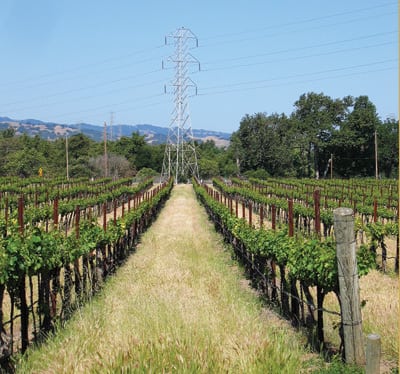
1. Wired vines and lines. These transmission lines near Livermore, Calif., run through a Wente vineyard whose vines are supported by wire. In keeping with the fanciful way the grid of the future is being described, that would make these "cultivated" transmission lines—maybe even connoisseur lines. Courtesy: Gail Reitenbach
As you read this and ponder what’s going on with the grid, I urge you to focus on the difference between transmission and distribution: the movement of high-voltage current across state lines versus the delivery of lower-voltage supply to homes and businesses. Is it a distinction without a difference? What does the difference mean, and who will be responsible for accommodating it?
Those questions have bedeviled discussions on electricity T&D for decades. The "smart grid" buzz doesn’t resolve long-standing jurisdictional and political issues. Beyond that, there are daunting technical and legal issues involved in using existing and future lines to do more than just deliver power where it is needed.
More talk, less action
Grid gurus assembled in Washington in late April for a confab billed as GridWeek by its sponsor, the U.S. Department of Energy (DOE), and attended by a lot of big-time private-sector players. The focus was almost entirely on the vision of an intelligent grid. Participants began by trying to wrap their too-short intellectual arms around the large question of where the "grid of the future" is headed and the route it will take.
I was there, and, in my opinion, the conference wasn’t entirely a success. Not a failure, but not a success. Nice try, but incomplete. More to come next year, the organizers promise.
While much of the industry is still divining the implications of the August 2003 collapse of the northeastern transmission system, the movers and shakers of electricity policy are trying to anticipate a T&D future they don’t really understand and can’t quite conceptualize. At this point, the best they can do is to call it by a generic term, such as "smart grid."
In the meantime, the grid of today, not the grid of the future, isn’t getting built. The results are higher electric prices (or costs not passed on to consumers) in congested areas and more risk of grid failure. While the industry ponders the wonders of a smart grid, consumers face the immediate problems of not enough grid.
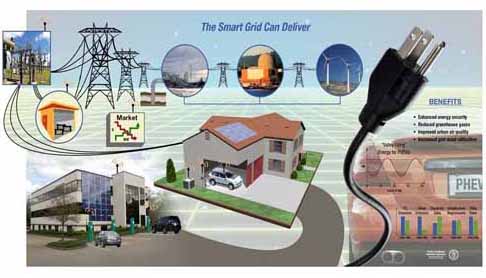
Several years ago, EPRI broached the notion of a smart grid that would use modern telecommunications technology, implanted on the grid from busbar to toaster, to balance supply and demand. That would lead to a world of optimum outcomes for consumers and providers of electricity. Peaks would be shaved, dumped power would vanish, and all would be right in the world.
The smart grid would enable time-sensitive rates, empower consumers with demand response, and make real fantasies such as automatic peak shaving, plug-in hybrid cars, and toasters that won’t toast when demand is high. Remember the "smart houses" of the 1980s? Welcome to the smart grid, which is even smarter than your 1980s smart house.That’s why I like "Lucy in the Sky with Diamonds" as a catchphrase for the smart grid. It sounds groovy. But how the grid would work, and who would pay for it, are major questions that remain unanswered by the many players in the business. Those problems were the back story at the GridWeek celebration of new grid technologies. There wasn’t a lot of talk about the obstacles, but they definitely served as the undertone of the meeting.
Who will rule: Washington or the states?
Dozens of vendors and consultants have flocked to the T&D niche, offering a multitude of solutions to what they perceive as problems and opportunities of interoperability, internal and external communications, grid intelligence, and other crucial issues. The smell of money, stronger than blood, is in the water. That’s the way the market works, imperfectly but implacably.
Can the smart grid become a reality? It’s not clear, from either a technical or a political perspective. The lasting impression that I took away from the GridWeek extravaganza was that of a Tower of Babel. Multiple sellers were talking to multiple buyers, but it didn’t appear that anyone was speaking the same language. It wasn’t just a matter of jargon passing in the night—hypertext markup language (HTML) versus extensible markup language (XML), for example—but fundamental issues about who buys, who sells, for what purposes, and under what conditions.
Where are the boundaries between state and federal regulation of allegedly smart grid technologies? Are these transmission-originated costs, or distribution costs? It’s not an easy question, but the answer will determine the outcome of the debate: Who will pay—ratepayers or federal taxpayers?
The elusive "bright line" between federal and state authority consumed the Federal Energy Regulatory Commission (FERC) and state regulators during the 1990s debate over retail competition. That was another big issue with no easy answer. Ultimately, FERC said the subject was too big to decide, so it punted.
This continuing conundrum puzzled several regulators at GridWeek, including Sam J. Ervin IV from North Carolina and FERC’s Jon Wellinghof, a former Nevada consumer advocate. They couldn’t come up with even the beginning of an answer to the question of where to draw the line between federal and state authority. But both honestly acknowledged the issue, saying that it must be resolved somehow.
"Real soon now" is the computer industry’s mantra about irresolvable questions, and that has now become the utility industry’s response. But failing to agree on its boundaries and jurisdiction could doom the smart grid. It would not know to whom it could talk, and under what circumstances.
Here are some of the easiest questions that present themselves:
- Can a "smart" grid make distinctions between a federal wholesale transmission system and a state retail distribution system?
- Does "smart" end when the retail distribution system begins, beyond which "stupid" prevails?
- How can regulators at the federal and state level allocate the costs of smart and stupid grids?
These are mind-bending questions, with no answers in the offing.
If the smart grid can’t connect to every node seamlessly, regardless of political jurisdiction, it has questionable value. The big upside of a smart grid, of course, is its ability to enable demand response by electricity consumers. But if the smart grid, constrained by jurisdictional issues stemming from "states rights," can’t control consumption, it won’t yield the benefits that its advocates are touting. The as-yet impenetrable barrier between state and federal jurisdiction—the wholesale versus retail issue—makes seamless communication nearly impossible.
The boundaries of federal and state authority have been at issue since the U.S. Constitution was implemented in 1789. They continue to bedevil us today, as numerous Supreme Court cases demonstrate every year. The Energy Policy Act of 2005, several commentators at the meeting noted, ducked the jurisdictional issue.
The GridWeek meeting didn’t really address the nasty issues. There was a lack of focus throughout, and an unwillingness to surface show-stoppers, in favor of happy talk. "Grid is good" was the theme, and a smart grid is better; all else will follow. It was full of hype but short of skepticism. That’s a prescription for failure.
With apologies to Shakespeare
Following are synopses of the discussions from four diverse groups and interests that held separate meetings at GridWeek. Their names present a fabulous confabulation of clichés and buzzwords that constitute, as Macbeth might say, "A tale full of sound and fury, signifying nothing." Or, as Juliet might say, "What’s in a name?"
Intelligrid. This is the EPRI-created consortium, which describes itself in self-reverential terms as a "public/private partnership that unites visionary thinkers to create a win-win situation; integrates and optimizes global research efforts; funds high-impact R&D on enabling technologies and on the integration of technologies to achieve the vision of the power delivery system of the future." I defy anyone to parse that sentence in a way that makes sense.
NETL’s Modern Grid Initiative. Again, the language defies understanding. The initiative by the DOE’s National Energy Technology Laboratory "seeks to create a national vision for a fully modernized electric power system." A vision? What we need is a grid.
The GridWise Architecture Council. This group "assembles a focused team of experts to articulate the guiding principles that constitute the architecture of a future, intelligent, transactive energy system and see that GridWise evolutionary directions remain true to these principles." Don’t stop scratching your head, because there’s more. "GridWise Architecture must take into account the entire horizontal and vertical range of business sectors concerned with the future energy system including, but not limited to, those in the utility industry, telecommunications, information technology, appliance and industry (manufacturing), buildings and construction, finance and trading, regulators, and other standards bodies and consortia." Who gets left out of that, Starbucks and 7-Eleven?
The GridWise Alliance. This group describes itself as "a consortium of public and private stakeholders who have joined together in a collaborative effort to provide real-world technology solutions to support the U.S. Department of Energy’s vision of a transformed national electric system; an electric system that will employ new distributed ‘plug-and-play’ technologies using advanced telecommunications, information and control approaches to create a society of devices that functions as an integrated transactive system." There is, in that paragraph, no useful meaning for people who speak and write English. What is "real world?" What is "a transformed national electric system?" Beats the heck out of me. By the way, I’d like to put a stake through the heart of the term "stakeholder." Who isn’t one?
Deconstructing the smart grid
As far as I can tell, the smart grid will control everything in your house hooked up to it, from your computer to your phone to your air conditioner to your electric toothbrush. I’d advise a switch to a blade razor, lest the grid control your shave. The high-voltage grid will talk to your home through your low-voltage distribution system. The distribution network and the supply grid will talk to each other in aggregate, communicating seamlessly (as if by magic) about the order of dispatch of baseload and peaking plants and other issues that may include pollution emission rates and CO2 and SO2 allowances.
The smart grid enthusiasts didn’t say how the system will accumulate these so-called demand-side signals and combine them into an intelligible message sent to the supply side in real time. According to the buzz, the scheme might involve broadband-over-power-line technology, but that’s likewise something the industry can’t address yet. There’s a lot of passive voice in all of the posturing, where actors are not specifically identified nor their actions fully described. That’s a characteristic of institutional language, and it’s a red flag that the speakers don’t fully know what they’re talking about.
But if you don’t want Big Brother telling your toothbrush in which direction to revolve, hitching a ride on the smart grid will be optional. So says Duke Energy’s CEO, Jim Rogers, who doesn’t want to make you feel coerced, although coercion will be the default mode. Unlike the 1980s, he says, the new technology will be bundled into your rates from the start, so the utility can earn a return on its demand response investment. Unless, of course, you opt out. That will be up to you, not your utility.
For example, your utility won’t ask you in advance to take part in demand response, Rogers told the Washington meeting. That’s why demand-side management programs failed in the 1990s. Rather, the utility will require that you take part unless you affirmatively ask to opt out. As Rogers acknowledged, that’s not likely to win an easy thumbs-up from consumer advocates. But he feels it is essential to a successful demand-response regime.
Rogers spoke at the second day of GridWeek, which was billed as a "national town meeting on demand response." But I found it to be nothing of the sort. Rather, I considered the conference an assembly of industry and government leaders emphasizing the importance of demand response to civilization as we know it today. The essence of a town meeting—regular folks having a conversation with their elected officials—was absent.
Grid smart, money smarter
Demand response and the smart grid, however defined, are inextricably entwined. What is the purpose of the smart grid if not to change consumers’ electricity consumption habits to suit utility interests, such as minimizing their costs, maximizing their costs, and—oh, I almost forgot—avoiding blackouts? The smart grid means less spending of big bucks on dumb grids increase reliability. In most industries, the way to test consumers’ willingness to pay for product is simple. It’s price.
But, for good and bad reasons, the electric utility industry is unwilling to embrace the capitalist tenet that price is where supply and demand meet.
The good reasons? As Duke’s Rogers said at the GridWeek meeting and later to reporters in a press conference, electricity bills are a "back-of-the-mind" matter. Folks simply don’t pay much attention to their electric bills, particularly because, in real (adjusted for inflation) terms, electric bills have declined significantly for many years. Maybe reducing CO2 emissions is socially useful, but most folks won’t play along if it bloats their electric bills.
So, notes Rogers, adding a demand-side management (DSM) component to utility bills that requires consumers to opt in makes no sense. Nobody will pay attention. Nor should they. Consumer education in the 1990s to support DSM programs didn’t work. Rogers argues for flipping the paradigm: Don’t ask consumers to opt in; make them opt out.
The bad reasons that utilities don’t like market capitalism? Many utilities, investor-owned or public, don’t want to face market forces in their business. Horrified, they call these forces "price volatility."
The utilities would rather earn a small but dependable return on investment (guaranteed by regulators, whom they often control) than face the profit vagaries inherent in free markets, regardless of whether their customers are willing to pay prices that reflect supply and demand. There’s often a political backlash to price spikes, and oil companies find a way to deal with it every time.
Tech issues unresolved, too
Those are the political issues behind the smart grid. But there are also some technical questions, as the GridWeek meeting revealed. We are going to have to indulge in a bit of computer "geek-speak" to deal with them.
The smart grid must be able to communicate in multiple directions. It will need to speak, and listen simultaneously to generators, substations, transmission lines, distribution networks, and your toaster. Who will develop and own the smart grid’s lingua franca? That’s a big deal, and it involves multiple vendors and multiple approaches.
A key issue is whether the grid’s communication protocols will be open or proprietary. A case can be made for each. Let’s start by assuming that any system will be encrypted, which raises the issue of who will control the encryption.
Encrypted communication in an open system—for example, the Internet with "pretty good" encryption controlled by the consumer—protects customers in dealings with the utility. Privacy demands encryption and identity protection.
But given the multiple points of contact of a smart grid, encryption becomes a problem. It’s not one-to-one communication, so encryption keys will have to be available to many of the parties, not just the sender and receiver. If the smart grid makes it easier for someone to mess with a consumer’s account because the encryption key is too available, then "smart" will translate to intrusive, or dangerous, or both.
Yet a communication system with absolution encryption, controlled by the consumer, could be much more difficult to break into by miscreants bent on wreaking the kind of havoc that viruses or Trojan horses are notorious for. On the other hand, absolute encryption would make it equally difficult for a trusted party to intervene to correct an imbalance or redirect a transaction.
The smart grid will face many of the same, and difficult, issues that FERC faced when it began to implement its Oasis requirements for wholesale transmission access. But they will be more complex and difficult.
Jury still out
Is the smart grid a smart idea? It is certainly useful to think about both the beneficial possibilities of embedding intelligence in the grid and the difficulties that that might entail or create. But the road to the smart grid will be long and arduous for utilities, industry, and regulators to travel, and it’s uncertain whether they will ever arrive.
In the meantime, there is still a need for the old-fashioned dumb grid (see box)—and much more of it.
Bodman and the stupid grid
While the GridWeek gurus were pondering the coming of the smart grid, Energy Secretary Samuel Bodman came to the meeting to make some news about the old-fashioned stupid grid.
Bodman, in a "state-of-the-grid" speech on the final day of GridWeek, announced that his agency has proposed two draft designations of "national interest electric transmission corridors," as mandated by the Energy Policy Act of 2005 (EPAct). These designations would allow the Federal Energy Regulatory Commission, after what are sure to be long and contentious proceedings, to override state and local objections to the siting of new interstate, high-voltage power lines.
"These draft designations," said Bodman in a written statement, "set us on the path to modernize our constrained and congested electric power infrastructure." Bodman said that the U.S. grid is "aging and stressed. Simply put, it is no longer adequate the meet the needs of the 21st century."
The corridors that the DOE proposes (Figure 2) are no surprise to anyone who followed the debates following the August 2003 great Northeast blackout and the western electricity market meltdown in 2000–2001. They represent the DOE’s first proposed designations. There could be more.

2. Draft Mid-Atlantic Area and Southwest Area national interest electric transmission corridors. Source: U.S. DOE
One corridor is in the East; the other in the Southwest. The proposed "Mid-Atlantic Area National Corridor" includes all of New Jersey, Delaware, and the District of Columbia, and counties in Ohio, West Virginia, Pennsylvania, New York, Maryland, and Virginia. The "Southwest Area National Corridor" includes counties in California, Arizona, and Nevada.
The Mid-Atlantic corridor is designed to facilitate movement of power from Ohio and West Virginia to the PJM Interconnection, which serves markets in the Northeast. American Electric Power and Allegheny Energy, which had competing transmission proposals for the region, recently combined their efforts, and the DOE plan would push that proposal.
Lesson learned and applied
Ironically, it was the failure of a plan in the late 1980s and early 1990s to move power from West Virginia (which has a surplus of generation) to New Jersey (which was short of capacity) across Pennsylvania (which essentially derived no benefits from the project) that highlighted the problems of interstate electric transmission. Pennsylvania essentially killed the project.
The Southwest corridor would help move power from Arizona and Nevada to Southern California, which faces numerous points of congestion.
The corridor designations are likely to be controversial, particularly in the Mid-Atlantic region. Opponents in Virginia have already derailed a plan by Dominion Virginia Power for a high-voltage power line across some pristine and history-rich territory.
The DOE announcement backs into an acknowledgement of the politics of the issue: "The department recognizes the broad public interest in this process and therefore, though not required by statute, is issuing draft designations in order to allow additional opportunities for review and comment by affected states, regional entities, and the general public." The agency could have simply designated the corridors but realized that a unilateral action would set off a political firestorm.
Given Democratic control of Congress, it is a good bet that there will be hearings on the corridor designations. According to the DOE announcement, there will be a 60-day comment period once the proposals show up in the Federal Register. The DOE also said it will hold public meetings in the D.C. area and in San Diego and New York City.
Plan has some fans
The DOE’s decision to propose corridors and provide an opportunity for comment drew praise from some state regulators. North Carolina’s Sam J. Ervin IV, a Democrat and one of the savviest of state commissioners, said, "Making preliminary designations and providing further opportunity for comment by States and others balances the need for the Energy Department to carry out its statutory responsibility with an acknowledgement of the inherent complexities and sensitivities that this process involves."
The political nature of the process became immediately apparent. Rep. Maurice Hinchey (D-N.Y.), who represents the Catskills and Hudson Valley area, told the Associated Press, "The federal government is continuing to try to usurp state authority and override the Constitution." Hinchey is fighting a proposed high-voltage transmission line intended to bring power from upstate through his district to transmission-constrained New York City.
Republican Reps. Frank Wolf and Tom Davis of Virginia, who represent the folks in the corridors in the original—and now abandoned—Dominion route, have introduced a bill that would roll back the authority given to the federal government by EPAct. They cite a violation of states’ rights in the 2005 law.