Thanks to recent technology developments, large U.S. electricity customers soon could be improving their power quality and lowering their cost of energy through the use of microgrids.
Industry analysts view microgrid development as a major transition in the way electricity is generated, delivered, and controlled. The deployment of microgrids could shift electricity supply away from today’s highly centralized universal service model toward a more dispersed system.
One element of a dispersed system, according to Chris Marnay of Ernest Orlando Lawrence Berkeley National Laboratory, is the clustering of power generation sources and loads into semiautonomous microgrids. This new delivery model will result in more electricity generation closer to end users, often involving combined heat and power (CHP) for building heating and cooling (see sidebar), increased local integration of renewables, direct control of end-use equipment, and the possible provision of heterogeneous qualities of electrical service to match the requirements of various end uses.
Free fuel powers water reclamation plant
In 2001 the Santa Margarita Water District and the South Coast Air Quality Management District (SCAQMD) funded the installation of two Capstone 30-kW microturbines and one Microgen hot water generator at the Chiquita Water Reclamation Plant in southern California. Two additional 30-kW microturbines were commissioned in 2003. The microturbines are fueled by anaerobic digester gas from the reclamation plant. Waste heat from the microturbines is used to heat the anaerobic digesters (Figure 1).
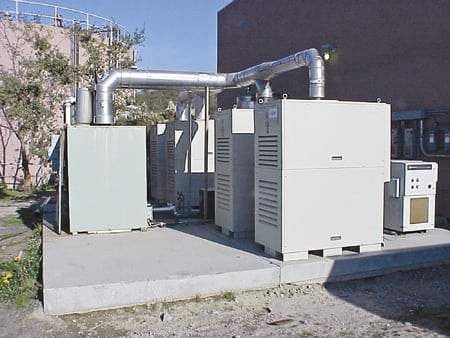
1. Firing digester gas. The Chiquita Water Reclamation Plant in Orange County, California, uses four 30-kW microturbines and one hot water generator fueled by anaerobic digester gas. The turbine exhaust heat is used to heat the digesters. Courtesy: Advanced Power and Energy Program at the University of California, Irvine
The systems are all baseloaded at full electrical power and typically deliver 26 to 30 kW each. Their electrical efficiency is around 20% to 22%. Waste heat from the first two microturbines was sufficient to allow shutting down the two boilers that originally fed hot water to the digesters. Additional heat from the two newer microturbines may be used to dry sludge in order to lower shipping costs and/or heat future anaerobic digesters.
Phase 1 installation costs were $114,020, plus SCAQMD support. Phase 2 installation costs were $160,582. Energy costs savings were estimated at approximately $60,000 per year, yielding an expected payback period of around two years for Phase 1 with the SCAQMD support. For more information about the pilot project, go to www.chpcenterpr.org.
How does a microgrid differ from what we now call distributed generation (DG)? A handful of randomly selected DG professionals who were asked this question at the ELECTRIC POWER Conference in Baltimore in early May couldn’t say—or hadn’t heard the term “microgrid.” That may be a sign of the term’s newness. But in an interview after his presentation in the DG track, Imre Gyuk, director of energy storage research at the Department of Energy, explained: “It’s a continuum.” Whereas a single generator probably shouldn’t be called a microgrid, Hawaii is “the ultimate microgrid.” It depends, he said, on the amount of internal generation supplied and the degree of self-sufficiency provided. And, as you’ll see, the sophistication of the system’s controls also plays a large role in enabling a microgrid to serve all the roles of the traditional grid (and sometimes more).
One key feature of a microgrid is its ability to separate and isolate itself (islanding) from the utility’s distribution system during a grid disturbance, as distributed generation systems typically can today. This is accomplished via intelligent power electronic interfaces and a single, high-speed switch. During a disturbance, the distributed energy resources (DER) and corresponding loads can be separated from the utility’s distribution system, isolating the microgrid’s load from the disturbance (and thereby maintaining high-level service) without harming the integrity of the utility’s system. Intentional islanding of DER and loads has the potential to provide a higher level of reliability to end users than that provided by the distribution system as a whole. Then, when the utility grid returns to normal, the microgrid automatically resynchronizes and reconnects itself to the grid, in an equally seamless fashion.
In the U.S., this new microgrid technology was first proposed by Robert Lasseter, a professor emeritus of electrical and computer engineering at the University of Wisconsin-Madison. Under the Consortium for Electric Reliability Technology Solutions (CERTS), funded by the Department of Energy and the California Energy Commission, Lasseter developed the electronics control technology that enables large businesses to switch back and forth from generating their own power to pulling power from the main grid (see sidebar).
CERTS microgrid R&D program
The CERTS Microgrid Test Bed is located at American Electric Power (AEP) Co.’s Walnut Test Facility in Groveport, Ohio, and is designed to demonstrate the CERTS microgrid concept, which is an advanced approach for enabling the integration of multiple distributed energy resources (DER) into an electric utility’s distribution system/power grid (Figure 5).
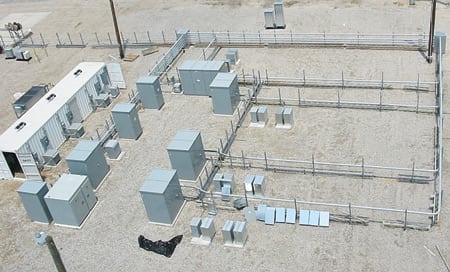
5. Testing different grid options. The Microgrid Test Bed at American Electric Power’s Ohio test site is used to develop advanced distributed generation technologies. Courtesy: Consortium for Electric Reliability Technology Solutions and American Electric Power
AEP shares a common vision with CERTS of the potential for advanced technologies within the electric power industry and, in particular, the increasing value of DER. The utility has developed a unique research and testing facility for generation, energy storage, and power quality devices.
The CERTS microgrid concept envisions enabling the integration of (in principle) an unlimited quantity of DER (including distributed generation and energy storage) into the electric utility grid. The original concept was driven by two fundamental principles:
- A systems perspective was necessary to enable customers, utilities, and society to capture the full benefits of integrating DER into an energy system.
- The business case for accelerating adoption of these advanced concepts will be driven, primarily, by lowering the first cost and enhancing the value of microgrids.
Each innovation was created specifically to lower the cost and improve the reliability of small-scale distributed generation (DG) systems (typically defined as installed systems with capacities ranging from less than 100 kW to 1,000 kW). The goal was to increase and accelerate realization of the many benefits offered by small-scale DG, such as the ability to supply waste heat where it’s needed or to provide a higher level of power quality to some, but not all, loads within a facility.
From a utility perspective, the microgrid concept is attractive because it recognizes the reality that the nation’s distribution system is extensive, aging, and will change over time.
CERTS says that potential applications of its microgrid include industrial parks, commercial and institutional campuses (locations that require uninterrupted power supplies and high power quality), combined heat and power systems, greenfield communities, and remote applications. In short, wherever economic and DG colocation considerations indicate the need for multiple DG units within a (or among) site, the CERTS microgrid offers the potential for a more reliable, flexible, and lower-cost solution compared to traditional engineering approaches for integrating DG.
For more information about the CERTS Microgrid Test Bed project, go to http://certs.aeptechlab.com.
“What is unique about the CERTS microgrid is that by incorporating peer-to-peer and plug-and-play concepts for each component within the microgrid, it can provide this technically challenging functionality without extensive and expensive custom engineering,” said Lasserter in a statement released by University of Wisconsin. “In addition, the design of the CERTS microgrid also provides the high system reliability and great flexibility in the placement of distributed generation within the microgrid” (Figure 2).

2. Connected, but independent. Thanks to such elements as a static switch and power flow controller, the CERTS microgrid concept should enable high penetration of distributed generation systems without requiring redesign or reengineering of the utility’s distribution system. Source: Lawrence Berkeley National Lab
Currently, research, development, demonstration, and deployment of microgrids are being conducted on at least three continents. For example, in the U.S., American Electric Power and CERTS signed a memorandum of understanding in 2006 to work cooperatively in promoting the microgrid concept. CERTS includes four DOE national labs (Lawrence Berkeley National Laboratory, Sandia National Laboratory, Oak Ridge National Laboratory, and Pacific Northwest National Laboratory); the Power Systems Engineering Research Center; and the Electric Power Group. Additionally, research is under way at several other U.S. institutions and at many others overseas, including the Advanced Power and Energy Program at the University of California- Irvine, GE Global Research, U.T.C., NEDO in Japan, and various groups funded by the European Commission. New programs are also starting up in Singapore and Korea.
Microgrids and supergrids: Competing visions
“Two somewhat contrived pictures that I use to contrast what are really only differences of emphasis among analysts of the future grid are the supergrids vision versus the microgrids vision,” Marnay told POWER in an interview in April. “On the one hand, some tend to emphasize improving all aspects of the traditional power system (or macrogrid) to establish supergrids as the route to improving delivered power quality and reliability (PQR). On the other hand, improvements could be achieved by controlling PQR more locally, and microgrids are one such approach.”
According to Marnay, the key difference between the two types of systems is the PQR that is actually delivered. The supergrids paradigm retains our familiar way of doing business: The power delivered to every customer and to most devices meets or nearly meets universal standards—it’s more or less homogeneous (Figure 3). In contrast, the microgrid paradigm seeks to deliver heterogeneous PQR tailored to end users’ requirements (something of particular value to industrial users, such as silicon chip manufacturers who require guaranteed, uninterruptible high power quality). Though there are many other reasons to believe that more dispersed energy conversion to electricity might deliver significant benefits, notably the opportunity to recover waste heat, the difference in the provision of PQR is the essence of the distinction between supergrids and microgrids (Figure 4).
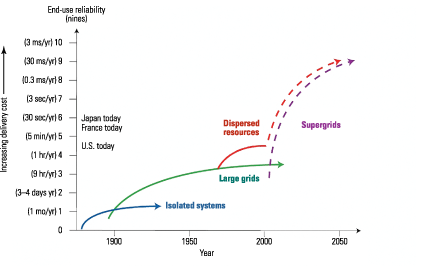
3. Is bigger better? The supergrid or macrogrid vision puts resources into improving the traditional power system to improve delivered power quality and reliability. Source: Lawrence Berkeley National Lab

4. Close to home. The dispersed or microgrid vision of the grid uses distributed control and provides heterogeneous service close to the load to improve power quality and reliability. Source: Lawrence Berkeley National Lab
Making microgrids part of the new smart grid
Better reliability and efficiency are what economists would call goods, and consumers definitely have a high demand for such goods. Many industry observers are pointing to the development of the smart grid as a means of improving reliability and efficiency in the transmission and distribution of electric power.
The general definition of a yet-to-be-implemented smart grid is an intelligent, autobalancing, self-monitoring power grid that takes a variety of fuel sources (conventional and renewable, centralized and dispersed) and transforms them into electricity with minimal human intervention. It also relies upon real-time, two-way communication between generation and loads plus load-connected energy controls and energy storage devices to optimize supply and demand. (See POWER, May 2008, p. 42 for more detail and a look at Xcel Energy’s particular brand of smart grid, to be tested in Boulder, Colo.)
“If new technologies can improve performance and/or lower costs, this clearly is a good thing,” said Marnay. “Where this discussion goes astray is that the cost side of the economists’ calculation typically gets overlooked. Sadly, as with so many things, better grid performance may be wonderful, but we can only afford so much of it. New technologies that can improve the PQR of power delivered to customers are only worthwhile as long as the improvement justifies the cost. In fact, we really don’t have much of a picture of what the costs and benefits of investments in the grid actually are. We focus on the economic damage to our existing system relative to unattainable perfection but rarely balance the potential gains of improvement against the probable costs.”
According to Marnay, we also have other societal goals that tend to run counter to improving PQR, such as developing active wholesale markets or expanding the role of intermittent renewables in the supply mix. Not to mention that our record of sustaining investment in electricity delivery infrastructure has been inadequate relative to our growing energy and PQR requirements.
Marnay emphasized that the costs are multifaceted. The cost of new equipment represents one element; the cost of better training and operating practices is another. But the cost of conservative operation—the foregone benefits from active transactions and running the grid close to its physical limits—may be the biggest. He also noted that the value of PQR varies enormously from customer to customer and among various end uses.
“The route to a truly efficient system is to provide PQR that matches the requirements of the task at hand, and microgrids offer a way to achieve this: gourmet power for loads that appreciate it, and gourmand [sic] power for those that don’t. Another way to say this might be that PQR should get increasingly heterogeneous close to the load,” said Marnay. “This, in turn, suggests that the big benefits from smart grids are likely to come from technologies that can improve the distribution network, which is where most PQR problems originate.”
Regulatory drivers for DG
“Regulatory efforts to encourage microgrids are not easily identified because they are so interwoven with or even coincidental to other goals, such as expanding renewables, encouraging efficiency and CHP, strengthening demand response, and alleviating congestion,” Marnay said. This is especially true at federal and state regulatory levels.
One industry-based regulation mechanism that does specifically address microgrids is the Institute of Electrical and Electronics Engineers (IEEE) P1547.4 standard development process. This standard, IEEE Draft Guide for Design, Operation, and Integration of Distributed Resource Island Systems with Electric Power Systems, specifically addresses the conditions under which local generation can island with colocated loads, which is one definition of a microgrid, according to Marnay.
This draft guide provides alternative approaches and good practices for the design, operation, and integration of DER island systems with electric power systems (EPS). It includes the ability to separate from and reconnect to part of the area EPS while providing power to the islanded local EPS. This guide addresses the distributed resources, interconnection systems, and participating electric power systems. The draft standard is intended to be used by EPS designers, operators, system integrators, and equipment manufacturers and is meant to be relevant to the design, operation, and integration of DER island systems. Implementation of the guide is intended to expand the benefits of using DER by targeting improved electric power system reliability and to build upon the interconnection requirements of IEEE 1547. For more information, visit http://grouper.ieee.org/groups/scc21/1547.4/1547.4_index.html.
Challenges to microgrids
“Microgrids are a technology that will only succeed if embraced by what are currently individual customer sites, or groupings of customers, either contiguous or virtual. The challenge, as I see it, is to create products that can be attractive to this clientele,” Marnay said. “Traditional U.S. macrogrid service is very good, and in some developed economies, notably Japan, it’s excellent, so microgrids are no slam dunk.”
That said, there have been some highly successful microgrid demonstrations in recent years in Europe, North America, and especially Japan, so there don’t appear to be any major technical barriers to microgrid deployment, according to Marnay. Some other governments, notably Korea, and equipment vendors also are now establishing microgrid research programs, so technical progress will inevitably accelerate.
“But, as is so often the case in our industry, while we’re progressing on technical problems, making the economics work and establishing a favorable regulatory environment are the real challenges,” Marnay commented.
Making the economics work for small-scale generation close to loads, often including intermittent renewable generation and opportunistic fuels, will be challenging. According to Marnay, one obvious factor that’s easily overlooked is that the cost of on-site generation competes with the delivered cost of electricity rather than its competitive wholesale price at the power plant bus bar, and the former is two to three times the latter on average.
“One motivation for microgrids we’ve already discussed, namely heterogeneous power quality and reliability, poses an economic challenge because we really don’t have effective methods of valuing PQR. Energy conversion to electricity close to end users creates increased opportunities for waste heat capture in combined heat and power systems, and this will be an increasingly important economic driver,” he said. “High fuel costs and climate change concerns will strengthen the case for CHP. And I see microgrids being designed and operated around heat requirements, as well as electrical ones, especially the application of waste heat for cooling using absorption or adsorption cooling technology. Finally, there are other potential benefits of microgrids that might lead to revenue streams—for example, the provision of local ancillary services such as voltage support.”
The future of microgrids
“There are some powerful fundamental drivers that lead me to think microgrids will become a familiar feature of the U.S. power system, although perhaps not in the coming decade,” Marnay said. “There have been some successful microgrid demonstrations, but the market is not yet developed to the point that we can think of them in this competitive manner. Nonetheless, some elements of microgrid technologies will emerge sooner, and some, such as Tecogen Inc.’s Premium Power Module CM-100 generator, already are becoming commercial.”
One of the other powerful drivers for microgrids might well be that they potentially offer a more hospitable environment for small-scale renewable generation, as well as efficiency investment and simple conservation. According to Marnay, it’s currently only a matter of faith, but he believes that if the trade-offs between self-generation, power purchase, efficiency equipment investments, behavioral adaptation, and the like were all focused at one decision point, a more rational balance between these factors than heretofore achieved could be possible.
Not surprisingly, manufacturers of hardware that could be deployed in microgrids are enthusiastic supporters of the concept. Marnay pointed out that among vertically integrated and distribution utilities enthusiasm for microgrids varies widely. Though some are highly skeptical, others see great technical and business opportunities.
The greatest potential of microgrids is to provide heterogeneous PQR to serve sensitive loads and to improve energy efficiency by moving thermal generation close to possible uses. This would permit waste heat recovery and use and also promote better integration of small-scale dispersed renewable sources, such as solar, into the energy supply infrastructure. On the flip side, the promotion of microgrid concepts will require considerable financial investment in their research, development, demonstration, and deployment. If such challenges can be met, microgrids could take their place within the world’s future power systems.