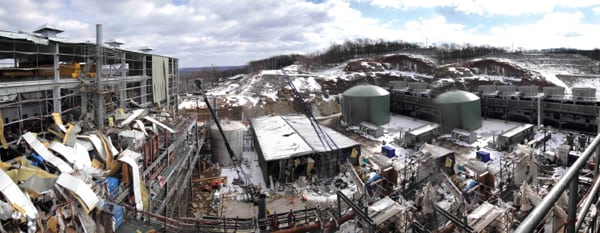
Investigative efforts continue into the cause and origin of Sunday’s catastrophic explosion that killed five workers and injured 27 others at Kleen Energy System’s natural gas–fired plant being built at a remote location in Middletown, Conn.
Middletown Mayor Sebastian Giuliano’s office said today that all employees of the plant who were on the roster for work on Sunday had been accounted for based on information provided by site contractors.
The 620-MW gas-fired plant, majority owned by Energy Investors Funds, a private-equity group, was reportedly 96% complete and due to come online in the fall. Construction began in June 2008. It was one of the largest power plant construction projects in the Northeast.
Investigators are now looking into a range of possibilities to determine the cause and origin of the blast, including the “purging” of natural gas pipes, the mayor’s office said. Police had ruled out terrorism or intentional crime—but not criminal negligence.
The South Fire District continued to work today on mitigating site hazards, and agencies were working on performing GPS mapping of damaged cylinders and other materials. Area officials were reportedly concerned about a snowstorm expected to hit the region tomorrow with between six and 12 inches of snow.
It is unclear how much the damage will cost. The power plant had been insured for damages totaling as much as $877 million to the facility alone, according to documents filed with the state.
The explosion rocked the plant at about 11:30 a.m. on Sunday, but it wasn’t until the following morning that authorities said they were confident that no more workers were buried in the rubble. Officials said there was no master list of who was working on the site.
“I still don’t know what happened. If it was a design flaw in the plant, it is one thing. If it is human error, that is another,” Mayor Giuliano told The Wall Street Journal this week.
Gas purging had been taking place Sunday at the plant, city officials reportedly told local media. The process involves clearing gas lines or pipes of air, rust, or debris before the lines become operational, to enable a pure stream of gas. It is the integral final step in the construction of power plants because even the smallest particle left inside the lines can damage pipes and equipment.
But it is a process that has proven fatal in the past. In some cases, an inert gas is first pumped into lines before they are filled with natural gas. If a pocket of air remains in a line after purging, it can create a fire that propagates back into a pipe, causing an explosion. Gas can also be purged from lines before welding or other maintenance takes place.
No federal regulations govern the purging process, though three organizations—the National Fire Protection Association, the American Gas Association, and the International Code Council—set standards that are adopted by many jurisdictions.
The Middletown explosion occurred just days after the Chemical Safety Board issued an urgent safety recommendation (PDF) related to gas purging after findings were released in an investigation of a blast at a ConAgra Foods beef jerky factory last June. That blast caused four deaths, three critical life-threatening burn injuries, and other injuries that sent a total of 67 people to the hospital.
The Chemical Safety Board had also issued a safety bulletin (PDF) on gas purging last October, with four key recommendations for completing the procedure safely. Lessons described in the bulletin included purging gases to a safe location outdoors, away from ignition sources, evacuating non-essential workers during purging, using combustible gas monitors to detect any hazardous gas accumulations, and effective training for personnel involved in purging.
Sources: City of Middletown, The Wall Street Journal, The New York Times